What is Predominant reaction, equivalent solution?
Also known as: predominant reaction · equivalent solution
Definition 10.10University Chemistry — Year 1 · Chapter 10 — Acid–Base Equilibria and the Predominant-Reaction Method
In a solution containing several acids and bases, the predominant reaction is the reaction of largest constant between the strongest acid and the strongest base present. When it is quantitative it is treated as total, and the solution is replaced by the equivalent solution: the solution obtained once this reaction is complete, which has the same pH as the real one.
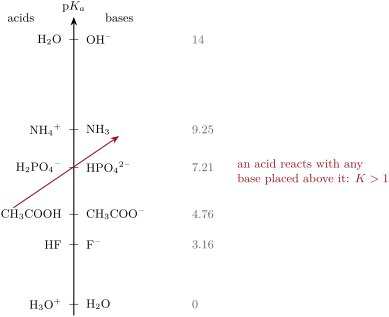
A scale of pKa (drawn with pKa increasing upwards; values on the right). An acid reacts favourably with any base placed above it on the scale: here ethanoic acid with ammonia, K=109.25−4.76=104.49.
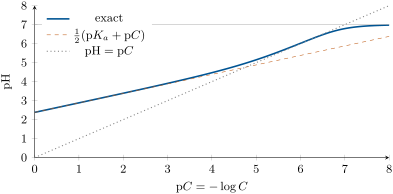
pH of ethanoic acid solutions against pC, computed exactly from the charge balance. Concentrated, the acid is little dissociated and follows 21(pKa+pC); diluted below about 10−6 mol/L it is fully dissociated and behaves as a strong acid; very dilute, the pH tends to 7.
Examples
Example 10.13(Ethanoic acid and ammonia)
Mix 0.10mol of ethanoic acid and 0.10mol of ammonia in 1.0L. The strongest acid is CHX3COOH, the strongest base NHX3: CHX3COOH+NHX3CHX3COOX−+NHX4X+, K=109.25−4.76=104.49, quantitative. The equivalent solution contains 0.10mol/L of CHX3COOX− and of NHX4X+. Its predominant reaction, NHX4X++CHX3COOX−NHX3+CHX3COOH, has the small constant 10−4.49 and keeps [NHX3]=[CHX3COOH], whence, as for an ampholyte, pH=21(4.76+9.25)=7.01.
Example 10.15(Phosphoric acid at 0.10mol/L)
The predominant reaction is the first acidity. With x=[HX3OX+], x2/(0.10−x)=10−2.15; here x is not small compared with C, so the quadratic x2+Ka1x−Ka1C=0 is solved: x=0.0233mol/L, pH=1.63. The second acidity (pKa2=7.21) contributes nothing at this pH.
 Coach
Coach