10Acid–Base Equilibria and the Predominant-Reaction Method
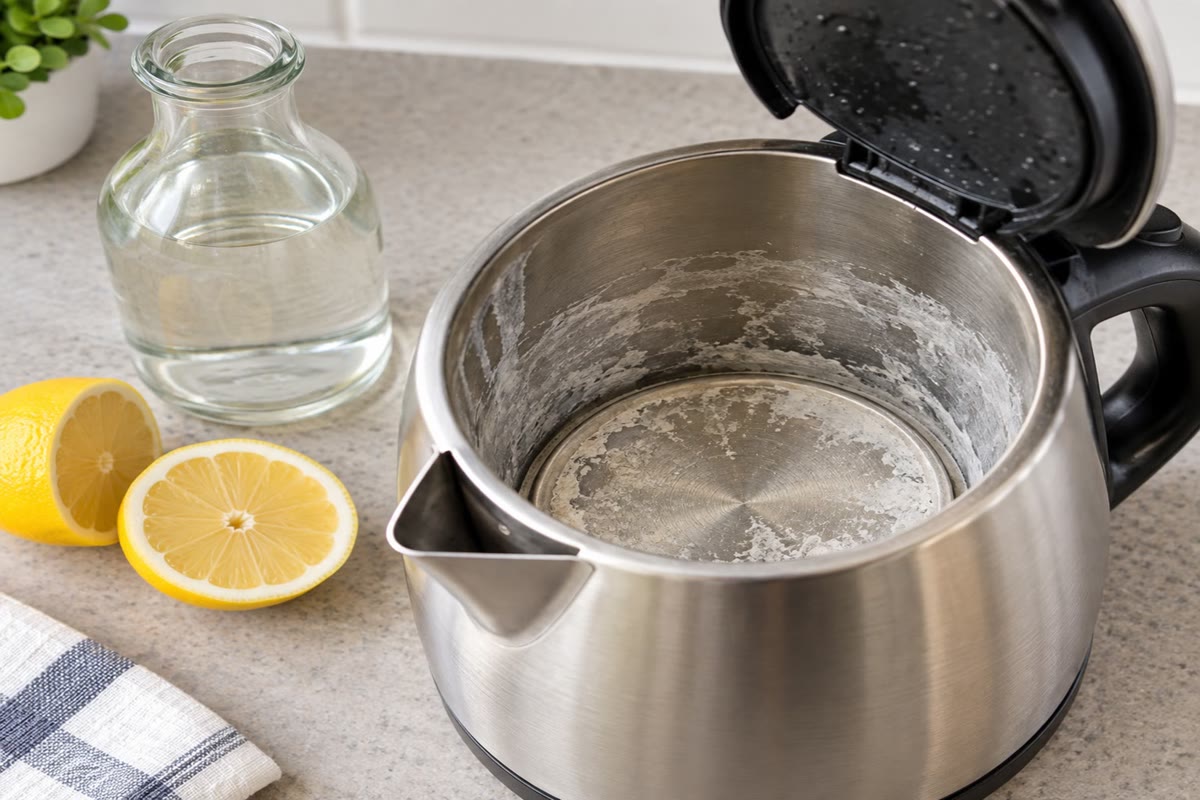
Vinegar dissolves the limescale of a kettle; so does lemon juice, a little faster. Blood keeps its pH between narrow limits whatever we eat; a fizzy drink is acidic because of the carbon dioxide dissolved in it. All these are acid–base equilibria in water, and a chemist faced with a solution containing several acids and bases — a mixture, a buffer, a polyprotic acid — needs a reliable way to find its pH and the concentrations of its species. This chapter builds that method: a scale of strengths, diagrams of predominance, and the predominant-reaction method, which reduces any mixture to the one reaction that matters.
Limescale, calcium carbonate, in a kettle. The weak acids of vinegar and lemon juice react with the carbonate ion and dissolve it.
10.1 Brønsted couples and the pH
Definition 10.1(Brønsted acid and base, couple)
A Brønsted acid is a species able to give a proton HX+; a Brønsted base is a species able to accept one. An acid HA and the base A that it becomes by losing a proton form an acid–base couple HA/A, related by the formal half-equation HA⇌A+HX+. In water the proton is never free: it is carried by a water molecule as HX3OX+.
Definition 10.2(Ampholyte)
An ampholyte (an amphoteric species) is the base of one couple and the acid of another: water (HX3OX+/HX2O and HX2O/OHX−), the hydrogencarbonate ion (COX2,HX2O/HCOX3X− and HCOX3X−/COX3X2−), the dihydrogenphosphate ion.
Water undergoes autoprotolysis, 2HX2OHX3OX++OHX−, of constant Ke=[HX3OX+][OHX−], the ionic product of water; at 25∘C, Ke=10−14.00, so pKe=14.00. The pH of a solution is pH=−loga(HX3OX+)≈−log[HX3OX+]. A solution is neutral when [HX3OX+]=[OHX−], that is at pH=pKe/2=7.00 at 25∘C.
10.2 Strength: Ka, pKa and the levelling effect
Definition 10.4(Acidity constant)
The acidity constant of a couple HA/A is the constant of the reaction of the acid with water,
The larger Ka (the smaller pKa), the stronger the acid and the weaker its conjugate base.
Definition 10.5(Strong and weak acids and bases)
An acid is strong in water if its reaction with water is total: no molecule HA remains (hydrochloric, nitric, perchloric acids, the first acidity of sulfuric acid); otherwise it is weak. A base is strong if its reaction with water is total, giving OHX− (hydroxides, the oxide ion, alkoxides), and weak otherwise.
Definition 10.6(Levelling effect)
In water, every acid stronger than HX3OX+ reacts totally to give HX3OX+, and every base stronger than OHX− totally to give OHX−: their strengths cannot be distinguished. This is the levelling effect of the solvent. Weak acids and bases in water have 0<pKa<14, the couples of water itself (pKa(HX3OX+/HX2O)=0 and pKa(HX2O/OHX−)=14) bounding the scale.
couple
pKa
couple
pKa
HSOX4X−/SOX4X2−
1.99
COX2,HX2O/HCOX3X−
6.37
HX3POX4/HX2POX4X−
2.15
HX2POX4X−/HPOX4X2−
7.21
HF/FX−
3.16
HClO/ClOX−
7.55
HCOOH/HCOOX−
3.74
NHX4X+/NHX3
9.25
CHX3COOH/CHX3COOX−
4.76
CX6HX5OH/CX6HX5OX−
9.99
CX6HX5NHX3X+/CX6HX5NHX2
4.60
HCOX3X−/COX3X2−
10.33
CX6HX5COOH/CX6HX5COOX−
4.21
CHX3NHX3X+/CHX3NHX2
10.66
10.3 Predominance and distribution diagrams
Definition 10.7(Predominance and distribution diagrams)
For a couple HA/A, pH=pKa+log([A]/[HA]): the acid predominates ([HA]>[A]) for pH<pKa, the base for pH>pKa. The predominance diagram is the pH axis divided at each pKa into the domains where each form predominates. The distribution diagram gives the fraction of each form, [form]/C, as a function of pH.
Proposition 10.8(The Henderson relation and the fractions)
For a couple HA/A of total concentration C=[HA]+[A],
One unit of pH away from pKa, the minor form is below 10 % of the total; two units away, below 1 %.
Proof. Take the logarithm of Ka=[A][HX3OX+]/[HA]. Then [A]/[HA]=10pH−pKa, and dividing [HA] by [HA]+[A] gives the fractions. At pH=pKa+1, [HA]/C=1/11<10%; at +2, 1/101. ∎
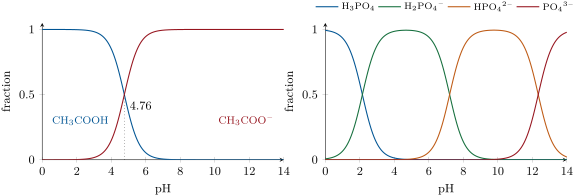
Distribution diagrams of ethanoic acid (left) and phosphoric acid (right), and the predominance diagram of phosphoric acid. Each crossing of two neighbouring curves lies at a pKa; the ampholytesHX2POX4X− and HPOX4X2− are almost the only form at the middle of their domains.
10.4 The predominant-reaction method
Proposition 10.9(Constant of an acid–base reaction)
The reaction of the acid HA1 of a couple with the base A2 of another, HA1+A2⇌A1+HA2, has the constant
K=Ka2Ka1=10pKa2−pKa1.
It is favourable (K>1) when the acid is stronger than the acid that forms (pKa1<pKa2), and quantitative (in the sense of Method 7.23) when the difference of pKa exceeds about 4.
Proof. The reaction is the sum of HA1+HX2O⇌A1+HX3OX+ (Ka1) and of the reverse of HA2+HX2O⇌A2+HX3OX+ (1/Ka2); Proposition 7.19 gives K=Ka1/Ka2. ∎
In a solution containing several acids and bases, the predominant reaction is the reaction of largest constant between the strongest acid and the strongest base present. When it is quantitative it is treated as total, and the solution is replaced by the equivalent solution: the solution obtained once this reaction is complete, which has the same pH as the real one.
Method 10.11(The predominant-reaction method)
To find the pH and the composition of a solution:
list the species introduced (and water) and place their couples on a pKa scale, acids on one side, bases on the other;
find the strongest acid and the strongest base present;
if the constant of their reaction is large (K>104, or ΔpKa>4), treat the reaction as total and write the equivalent solution; go back to step 2;
when the predominant reaction has a small constant, it fixes the pH: write its progress table and solve Q=K, usually with the hypothesis that its extent is small;
check the hypotheses: the minor species are indeed minor, and the other reactions (including the autoprotolysis of water) are negligible.
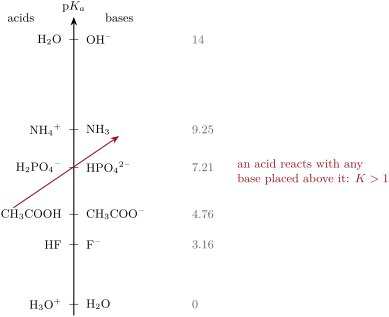
A scale of pKa (drawn with pKa increasing upwards; values on the right). An acid reacts favourably with any base placed above it on the scale: here ethanoic acid with ammonia, K=109.25−4.76=104.49.
weak acid, little dissociated: pH=21(pKa+pC), valid if pH<pKa−1;
weak base, little protonated: pH=21(pKe+pKa−pC), valid if pH>pKa+1;
ampholyte with pKa2−pKa1>4: pH=21(pKa1+pKa2), whatever C (if not too dilute).
Proof.Strong acid: HA+HX2OAX−+HX3OX+ is total, [HX3OX+]=C, water’s own contribution (10−7) being negligible if C>10−6.5. Weak acid: the predominant reaction is HA+HX2O⇌A+HX3OX+ with extent x=[HX3OX+]=[A]; if x≪C, Ka=x2/C, pH=21(pKa+pC); the hypothesis [A]<[HA]/10 is pH<pKa−1. Weak base: the same with A+HX2O⇌HA+OHX−, of constant Ke/Ka. Ampholyte HA−: the predominant reaction is 2HA−⇌H2A+A2−, so [H2A]=[A2−]; multiplying Ka1=[HA−]h/[H2A] by Ka2=[A2−]h/[HA−] gives h2=Ka1Ka2. ∎
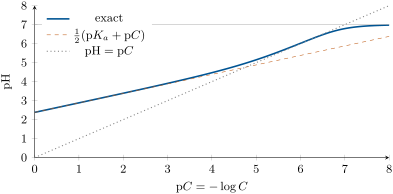
pH of ethanoic acid solutions against pC, computed exactly from the charge balance. Concentrated, the acid is little dissociated and follows 21(pKa+pC); diluted below about 10−6 mol/L it is fully dissociated and behaves as a strong acid; very dilute, the pH tends to 7.
Example 10.13(Ethanoic acid and ammonia)
Mix 0.10mol of ethanoic acid and 0.10mol of ammonia in 1.0L. The strongest acid is CHX3COOH, the strongest base NHX3: CHX3COOH+NHX3CHX3COOX−+NHX4X+, K=109.25−4.76=104.49, quantitative. The equivalent solution contains 0.10mol/L of CHX3COOX− and of NHX4X+. Its predominant reaction, NHX4X++CHX3COOX−NHX3+CHX3COOH, has the small constant 10−4.49 and keeps [NHX3]=[CHX3COOH], whence, as for an ampholyte, pH=21(4.76+9.25)=7.01.
10.5 Polyprotic acids and buffers
Definition 10.14(Polyprotic acid)
A polyprotic acid can give several protons in succession, each step with its own constant: phosphoric acid HX3POX4 (pKa = 2.15, 7.21, 12.34), carbonic acid (COX2,HX2O; 6.37, 10.33), sulfuric acid (first acidity strong, second 1.99). The successive pKa increase: removing a proton from a species that is already negative costs more.
Example 10.15(Phosphoric acid at 0.10mol/L)
The predominant reaction is the first acidity. With x=[HX3OX+], x2/(0.10−x)=10−2.15; here x is not small compared with C, so the quadratic x2+Ka1x−Ka1C=0 is solved: x=0.0233mol/L, pH=1.63. The second acidity (pKa2=7.21) contributes nothing at this pH.
Definition 10.16(Buffer solution)
A buffer solution is a solution whose pH changes little when a small amount of acid or base is added, or when it is diluted. The usual buffer is a mixture of a weak acid and its conjugate base in comparable amounts; its pH is close to the pKa of the couple.
Proposition 10.17(Why a buffer resists)
For a buffer of na mol of acid and nb mol of base, pH=pKa+log(nb/na) does not depend on the volume. Adding δ mol of a strong acid changes it by
which is smallest for na=nb at given total amount.
Proof. The strong acid reacts totally with the base: nb→nb−δ, na→na+δ. The derivative of f(δ)=log(nb−δ)−log(na+δ) at 0 is −ln101(nb1+na1); for na+nb fixed, na1+nb1 is smallest when na=nb. ∎
Definition 10.18(Degree of dissociation)
The degree of dissociation of a weak acid HA at analytical concentration C is α=[A]/C, the fraction of the acid dissociated by water; it satisfies Ostwald’s dilution law α2C/(1−α)=Ka, and tends to 1 as C→0.
In the lab— Making a buffer
A buffer is prepared in the laboratory by weighing the acid and its salt (for instance sodium dihydrogenphosphate and disodium hydrogenphosphate), or by adding a measured volume of sodium hydroxide solution to the acid while a pH meter, calibrated beforehand with two standard buffers, is read; the solution is then made up to the mark in a volumetric flask.
10.6 Exercises
Exercise 10.1★
Write the conjugate base of HX2SOX4, HCOX3X−, NHX4X+ and HX2O, and the conjugate acid of NHX3, HPOX4X2−, OHX− and HX2O. Which of these species are ampholytes?
Solution
Solution of Exercise 10.1.
Conjugate bases: HSOX4X−, COX3X2−, NHX3, OHX−. Conjugate acids: NHX4X+, HX2POX4X−, HX2O, HX3OX+. Ampholytes: HCOX3X−, HX2O, HPOX4X2− (and HSOX4X−, base of sulfuric acid and acid of its second couple).
Exercise 10.2★
Using the table of pKa, rank hydrofluoric acid, ethanoic acid, the ammonium ion and hypochlorous acid by strength, and give Ka for each.
Draw the predominance diagram of the couple CHX3COOH/CHX3COOX−. Which form predominates in a soft drink of pH 3, in blood of pH 7.4? What fraction of the acid is in the acid form at pH 3.76?
Solution
Solution of Exercise 10.4.
CHX3COOH below pH 4.76, CHX3COOX− above. At pH 3 the acid form predominates (98 %); in blood (pH 7.4) the ethanoate ion. At pH 3.76 the acid fraction is 1/(1+10−1)=0.91.
Exercise 10.5★★
Compute the pH of a 0.10mol/L solution of ammonia and check the hypothesis made.
Solution
Solution of Exercise 10.5.
Predominant reactionNHX3+HX2ONHX4X++OHX−, K=10−(14.00−9.25)=10−4.75. If little NHX3 reacts: [OHX−]=KC=1.3×10⁻³mol/L, pH=11.13. Check: [NHX4X+]=1.3% of C, and pH>pKa+1: valid.
Exercise 10.6★★
Compute the pH of a 0.010mol/L ethanoic acid solution and the degree of dissociation; check the hypothesis.
Solution
Solution of Exercise 10.6.
pH=21(4.76+2.00)=3.38 (the exact value is 3.39); α=10−3.38/0.010=0.042: 4 % dissociated, below 10 %, and pH<pKa−1: valid.
Exercise 10.7★★
Write the predominant reaction, its constant and the pH of a solution obtained by mixing, in 1.0L, 0.10mol of hydrofluoric acid and 0.050mol of sodium hydroxide.
Solution
Solution of Exercise 10.7.
HF+OHX−FX−+HX2O, K=1014.00−3.16=1010.84: total. The equivalent solution holds 0.050mol/L each of HF and FX−, a buffer: pH=pKa=3.16.
Exercise 10.8★★
A buffer contains 0.050mol of ethanoic acid and 0.050mol of sodium ethanoate in 1.0L. Compute its pH, then the pH after adding 0.010mol of hydrochloric acid. Compare with the same addition to 1.0L of pure water.
Solution
Solution of Exercise 10.8.
pH=4.76. The hydrochloric acid converts 0.010mol of ethanoate into acid: pH=4.76+log(0.040/0.060)=4.58, a change of 0.18. In pure water the pH would fall from 7.00 to 2.00.
Exercise 10.9★★
Hydrochloric and nitric acids have the same strength in water, but not in pure ethanoic acid as solvent. Explain, and say what the strongest acid that can exist in water is.
Solution
Solution of Exercise 10.9.
In water both acids react totally to give HX3OX+: the solvent levels them. Ethanoic acid is a much weaker base than water, so in it the two acids react only partly, to different extents, and their strengths can be compared. The strongest acid that can exist in water is HX3OX+.
Exercise 10.10★★★
Compute the pH of a 0.10mol/L solution of sodium carbonate, and check that the second basicity can be neglected.
Solution
Solution of Exercise 10.10.
COX3X2−+HX2OHCOX3X−+OHX−, K=10−(14.00−10.33)=10−3.67; [OHX−]=10−3.67×0.10=4.6×10⁻³mol/L (4.6 % of C), pH=11.67. The second basicity, HCOX3X−+HX2OCOX2+HX2O+OHX−, has K=10−7.63: it gives [COX2]≈10−7.6, negligible.
Exercise 10.11★★★
Prove Ostwald’s dilution law and compute the degree of dissociation of ethanoic acid at C=1.0×10⁻³mol/L. Why does the approximation α≪1 fail here?
Solution
Solution of Exercise 10.11.
[A]=[HX3OX+]=αC and [HA]=(1−α)C, so Ka=α2C/(1−α). With C=10−3: α2+0.0174α−0.0174=0, α=0.12. The acid is 12 % dissociated: the hypothesis of a little-dissociated acid (α<10%) fails, and the quadratic must be solved.
Exercise 10.12★★★
A solution contains 0.010mol/L of hydrochloric acid and 0.10mol/L of ethanoic acid. Find its pH and the concentration of ethanoate ions; explain why the weak acid hardly dissociates.
Solution
Solution of Exercise 10.12.
Hydrochloric acid fixes [HX3OX+]=0.010mol/L: pH 2.00. Then
negligible beside 0.010: the HX3OX+ from the strong acid pushes the equilibrium of the weak acid back.
10.7 Problem: A Phosphate Buffer for the Cell-Culture Lab
Problem 10.1
Weekend problem — the three acidities of phosphoric acid, the pH of its three sodium salts, equivalent solutions, and the volume of sodium hydroxide that gives a pH 7.20 buffer
Cells grown in a laboratory need a medium at pH close to 7.2. Data at 25∘C: pKa of phosphoric acid 2.15, 7.21 and 12.34; pKe=14.00.
Sketch the pH as a function of n from 0 to 0.300mol.
Why is the solution of question 14 a good buffer?
Part IV — Preparing 1.00L of pH 7.20 buffer. Sodium hydroxide is available at 1.00mol/L.
What ratio [HPOX4X2−]/[HX2POX4X−] gives pH 7.20?
Express the amounts of HX2POX4X− and HPOX4X2− in terms of the amount x of hydroxide added beyond the first 0.100mol.
Compute x.
By how much does the pH change if 1.0×10⁻³mol of hydrochloric acid is added to this buffer? to 1.00L of pure water?
Would the pH change if the buffer were diluted ten times? Explain.
Compute the volume of sodium hydroxide solution to add to 0.100mol of phosphoric acid to obtain 1.00L of buffer at pH 7.20.
Solution
Solution of Problem 10.1.
1.HX3POX4/HX2POX4X−, HX2POX4X−/HPOX4X2−, HPOX4X2−/POX4X3−; for instance HX3POX4HX2POX4X−+HX+. 2. Boundaries at 2.15, 7.21 and 12.34. 3. pH 1: HX3POX4; 5: HX2POX4X−; 9: HPOX4X2−; 13: POX4X3−. 4.HX2POX4X− and HPOX4X2−. 5. Each proton leaves an ion of higher negative charge, which holds the next proton more strongly. 6.HX3POX4+HX2OHX2POX4X−+HX3OX+; the formula 21(pKa+pC)=1.58 violates pH<pKa−1=1.15: about a fifth of the acid reacts. 7.x2+Ka1x−Ka1C=0 with Ka1=10−2.15: x=0.0233mol/L, pH=1.63. 8.2HX2POX4X−HX3POX4+HPOX4X2−, K=102.15−7.21=10−5.06. 9.pH=21(2.15+7.21)=4.68. 10.pH=21(7.21+12.34)=9.78. 11. None: 1.63, 4.68 and 9.78; a mixture of two of them is needed. 12.HX3POX4+OHX−HX2POX4X−+HX2O, K=1014.00−2.15=1011.85: quantitative. 13.0.100mol/L of HX2POX4X−: pH 4.68. 14. The next 0.050mol of hydroxide converts half of it: 0.050mol/L of HX2POX4X− and of HPOX4X2−, pH 7.21. 15.0.100mol/L of HPOX4X2−: pH 9.78. 16. The pH rises from 1.63, jumps around n=0.100 (to 4.68), rises slowly through 7.21 at n=0.150, jumps around n=0.200 (to 9.78), passes 12.34 near n=0.250 and reaches about 12.6 at n=0.300 (0.100mol/L of POX4X3−: x2/(0.100−x)=10−1.66, x=0.037, pH 12.57). 17. It contains equal amounts of the acid and the base of a couple of pKa 7.21 (Proposition 10.17). 18.107.20−7.21=0.977. 19.n(HX2POX4X−)=0.100−x, n(HPOX4X2−)=x. 20.x/(0.100−x)=0.977, x=0.0494mol. 21. The acid converts 0.0010mol of HPOX4X2−: pH=7.21+log(0.0484/0.0516)=7.18, a change of −0.02. In pure water: from 7.00 to 3.00. 22. No: the pH depends on the ratio of the amounts, which dilution does not change (as long as the activities stay close to the concentrations). 23.0.100+0.0494=0.149mol of hydroxide: 149mL of the 1.00mol/L solution, made up to 1.00L.