 Coach
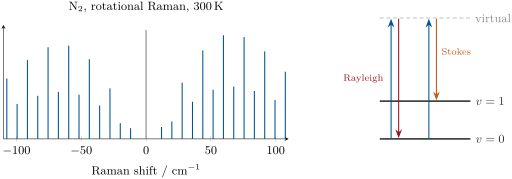
CoachWhen light of frequency crosses a sample, most of the scattered light keeps the frequency : Rayleigh scattering. A small fraction is shifted by the rotational or vibrational frequencies of the molecules: Raman scattering. Lines at lower frequency are Stokes lines (the molecule gained energy), at higher frequency anti-Stokes lines (it lost energy).
Examples
Example 6.22 (Nitrogen, seen by Raman)
has no dipole and no infrared or microwave spectrum, but its polarisability is anisotropic: its rotational Raman lines start at from the exciting line and are spaced by . Their intensities alternate 2:1 between even and odd : the two nuclei are identical, and nuclear-spin statistics (Chapter 11) give even- levels twice the weight of odd ones.