University Chemistry — Year 3 · Bachelor Year 3
11Statistical Thermodynamics Applied
Liquid hydrogen kept in the best insulated tank still boils away, and in the first days after liquefaction it boils away far faster than the heat leaking through the walls can explain. The heat comes from inside the liquid. Hydrogen molecules exist in two forms, which differ only in the relative orientation of the spins of their two protons and which convert into one another only very slowly; at the conversion of one form into the other releases more heat than is needed to evaporate the liquid. This chapter applies the partition functions of Chapter 10 to heat capacities, to these nuclear-spin isomers and to the entropy that some crystals keep at 0 K, then computes equilibrium constants and isotope effects from spectroscopic data alone.
You already know
Chapter 10 built the molecular partition function and its four factors, and derived , and from it. The Year 2 volume related the standard equilibrium constant to the standard Gibbs energy of reaction, , and established the van ’t Hoff equation; Chapter 2 stated that a wavefunction changes sign when two identical fermions are exchanged; Chapter 6 found the 3:1 alternation of line intensities in the rotational Raman spectrum of -like molecules. The Grade 9 part of the first volume defined isotopes.
11.1 Heat capacities of gases
The heat capacity at constant volume is , and with Theorem 10.19 each kind of motion contributes separately. Two limits govern everything.
Theorem 11.1 (Equipartition theorem)
When the energy levels of a motion are closely spaced compared with , each term of its energy that is quadratic in a coordinate or a momentum contributes to the mean energy of a molecule, hence to the molar heat capacity. This statement is the equipartition theorem.
Partial proof. In the classical limit the sum over the states of a motion becomes an integral, and a quadratic term contributes the factor , proportional to . By Theorem 10.19, its mean energy is . That the classical integral is the limit of the quantum sum was shown for translation and rotation in Chapter 10; for vibration it follows from the next proposition when . ∎
Translation has three quadratic terms (); the rotation of a linear molecule two (), of a non-linear one three (); each vibration two, kinetic and potential (). A linear molecule of atoms thus tends to at high temperature. The limit is almost never reached for vibrations at room temperature.
Proposition 11.2 (Vibrational heat capacity)
A harmonic vibration of characteristic temperature contributes, with ,
the Einstein function, which tends to 1 when and falls exponentially, as , when .
Proof. From Proposition 10.16, per mole. Differentiating with respect to , with , gives . For , and the ratio tends to 1; for large it behaves as . ∎
Method 11.3 (The heat capacity of a gas from its modes)
- Translation: , always.
- Rotation: (linear) or (non-linear) if , true for every gas but hydrogen above a few tens of kelvins.
- Vibrations: one Einstein term per normal mode, from the fundamental wavenumbers; a degenerate mode counts as many times as its degeneracy.
- Add, and for an ideal gas.
A motion is said to be frozen when is small compared with its first excitation: it then holds no energy and contributes nothing to . The vibration of () is frozen at room temperature and ; that of () is half awake, at .
11.2 Nuclear-spin statistics
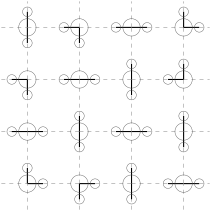
The two nuclei of are identical fermions. Exchanging them changes the sign of the total wavefunction (Chapter 2); exchanging them is the same as rotating the molecule end over end, which multiplies the rotational wavefunction by and the nuclear-spin function by or .
Theorem 11.4 (Nuclear-spin statistics)
In a homonuclear diatomic molecule whose nuclei have spin , in a ground electronic state , there are symmetric and antisymmetric nuclear-spin states. For fermions (half-integer ) the antisymmetric ones go with even and the symmetric ones with odd ; for bosons (integer ) the opposite. For () even and odd levels have spin weights 1 and 3; for (), 6 and 3. When only one parity of exists at all: the linear molecule, with two nuclei and a symmetric ground state, has only even rotational levels.
Partial proof. The symmetry postulate (the total wavefunction is antisymmetric under the exchange of two identical fermions, symmetric for bosons) is admitted. The products of one-nucleus spin states give symmetric states with , and for each of the pairs one symmetric and one antisymmetric combination: symmetric and antisymmetric states. In a state the electronic and vibrational functions are unchanged by the exchange, so the product of rotational and spin functions must have the required overall sign: for fermions, , which pairs even with antisymmetric spin states. For : 3 symmetric, 1 antisymmetric; for : 6 and 3. ∎
Definition 11.5 (Ortho and para hydrogen)
Ortho hydrogen is the form of with the two proton spins in a symmetric (triplet) state, which occupies only the odd rotational levels; para hydrogen the form with the antisymmetric (singlet) spin state, which occupies only the even levels.
Converting one into the other requires flipping one nuclear spin relative to the other, which collisions with other hydrogen molecules hardly do: in pure hydrogen the two forms behave for days as two different gases. A paramagnetic surface, whose inhomogeneous magnetic field acts differently on the two protons, catalyses the conversion.
Proposition 11.6 (Equilibrium ortho–para ratio)
At equilibrium the fraction of para hydrogen is
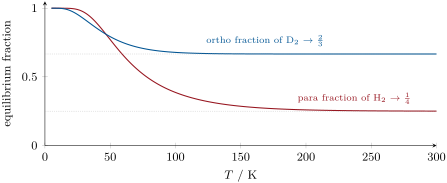
which tends to 1 at 0 K and to at high temperature. For , the ortho form (even ) tends to 1 at 0 K and to at high temperature.
Proof. The Boltzmann distribution over all the states, with the spin weights of Theorem 11.4. At 0 K only , which is even, is populated. At high temperature the even and odd sums are each half of , and the ratio is ; for , . ∎
For , : the equilibrium mixture is half para at , 99.8 % para at the boiling point, , and 25.07 % at room temperature. Hydrogen kept at room temperature, called normal hydrogen, is therefore a 3:1 mixture of ortho and para.
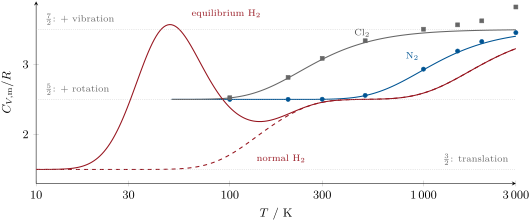
The heat capacity of hydrogen shows the consequences. In normal hydrogen the ortho and para molecules are two gases mixed in fixed proportions; each has its own ladder of levels, starting at and at , and its rotation freezes separately. In equilibrium hydrogen, heating also converts para into ortho, which absorbs energy and gives the peak of the figure above. The first measurements, made without a catalyst, followed the normal-hydrogen curve, and it was the interpretation of that curve as a frozen 3:1 mixture that first revealed the two forms.
Remark 11.7
The symmetry number of Proposition 10.15 is now justified. At high temperature each spin state finds about half the rotational levels allowed, so that : the total-spin factor is left out by convention, and remains.
Definition 11.8 (Residual entropy)
The residual entropy of a crystal is the entropy it retains as because its molecules remain frozen in one of many arrangements of equal or almost equal energy.
Proposition 11.9 (Residual entropies of carbon monoxide and of ice)
A crystal of molecules frozen in equally likely arrangements has . Solid , each molecule pointing either way, has . Ice, with every oxygen bonded to two hydrogen atoms and hydrogen-bonded to two others, has and .
Proof. Definition 10.22 applied at . : the dipole of the molecule is so small that the orientations CO and OC have almost the same energy, and each of molecules has two: , . Ice (Pauling’s count): each of the hydrogen atoms sits on an OO line, near one end or the other: arrangements. Of the 16 ways of placing the four hydrogens around one oxygen, 6 give it exactly two near hydrogens (a water molecule); treating the oxygens as independent, a fraction of the arrangements satisfies each of them: . ∎
The tables quote, for , the statistical entropy (Chapter 10); the calorimetric value is lower by a gap of the order of , somewhat smaller because the orientations are not quite random. For ice, the gap between the calorimetric entropy of water vapour and its statistical value agreed with Pauling’s count when he made it in 1935, confirming that the protons of ice are disordered. The third law, in the form “the entropy of a perfect crystal is zero at 0 K”, applies to the crystals that do reach a single arrangement.
11.3 Equilibrium constants from partition functions
Theorem 11.10 (Equilibrium constant from partition functions)
For a reaction between ideal gases,
where is the partition function of in the standard molar volume , each counted from its own ground state, and is the molar energy of reaction at 0 K, from the ground state of the reactants to that of the products.
Proof. By Theorem 10.23, a mole of ideal gas at has , and is the energy of its ground state on a scale common to all the species. So , and gives the result. ∎
Method 11.11 (Computing an equilibrium constant from spectroscopic data)
- For each species: , with symmetry numbers and electronic degeneracies.
- from dissociation energies (measured from the ground vibrational level, so zero-point energies are included) or from formation enthalpies at 0 K.
- Multiply, and check the units: is a pure number, the standard pressure entering through .
Example 11.12 (The dissociation of iodine)
For , from the formation enthalpies at 0 K of the thermochemical tables. At : for I, , , (the level lies up), so ; for , , and , so . Then , ; the tables give .
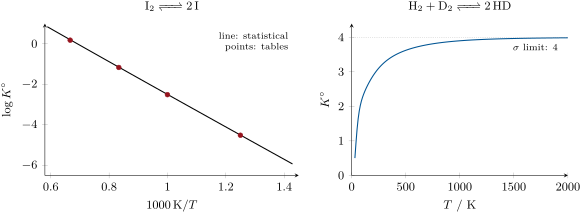
Proposition 11.13 (The H + D exchange)
For , at high temperature.
Proof. At high temperature the translational, rotational and vibrational factors are , and (the force constant, an electronic property, is the same for the three molecules), and . With , , and , 1, (in units of the proton mass, ignoring the small difference between D and 2H):
All the mass factors cancel exactly: only the symmetry numbers remain, . ∎
At the statistical constant is 3.26: the zero-point energies of , and HD (, and ) give , a factor ; rotation, still partly quantised for these light molecules, also matters.
Proposition 11.14 (The van ’t Hoff equation recovered)
The statistical equilibrium constant obeys .
Proof. Each depends on through its levels and through : per mole, by Theorem 10.19. Hence for ideal gases. ∎
From the slope of the left panel of the figure, the enthalpy of dissociation of iodine near is : plus the extra translational energy of two atoms over a molecule, minus its rotational and vibrational energy.
11.4 Isotope effects
Isotopologues have the same electronic structure, hence the same potential energy curve and force constants, but different masses: their vibrational wavenumbers, zero-point energies and partition functions differ, and so do their equilibrium constants.
Definition 11.15 (Equilibrium isotope effect, fractionation factor, value)
The equilibrium isotope effect of a reaction is the ratio of its equilibrium constants with the light and the heavy isotope. The fractionation factor between two phases or compounds A and B is , where is the ratio of the heavy to the light isotope (for example ). The value of a sample is , in per mil (‰).
Proposition 11.16 (Isotope effects from zero-point energies)
For an exchange at temperatures where the stretching vibrations are frozen, the dominant factor of the equilibrium constant is
and for a hydrogen bound to a heavy atom. The heavy isotope concentrates in the stiffer bond.
Proof. Theorem 11.10 with the energies measured from the bottom of the common potential curves: is the change of zero-point energy. The translational and rotational factors nearly cancel between two exchanges of the same isotopes on heavy partners, and the vibrational partition functions are 1 when frozen. With and for heavy X, , and : negative, so , when X–H is the stiffer bond. ∎
The same reasoning explains the fractionation of oxygen isotopes between water and its vapour, between water and the carbonate of a shell, or between two minerals: the fractionation factor tends to 1 at high temperature (as tends to its symmetry limit) and departs from 1 as the temperature falls. Measured as values, it is a thermometer: the O of the carbonate of fossil shells records the temperature of the water in which they grew, and that of the ice of polar cores the temperature of the clouds that formed its snow.
In the lab — An ortho–para converter
A hydrogen liquefier cools the gas in stages, and between the stages passes it through beds of a paramagnetic catalyst, typically hydrated iron(III) oxide. The conversion heat is then removed at each temperature by the refrigerator, and the liquid that reaches the tank is close to its equilibrium composition, almost entirely para. Without the catalyst, the heat of conversion would be released in the tank.
Safety


Hydrogen: an extremely flammable gas, stored under pressure or as a cryogenic liquid. It forms explosive mixtures with air over a very wide range and burns with an almost invisible flame; the liquid causes cold burns and its vapour displaces air.
History — The two hydrogens, 1927–1929
Werner Heisenberg and Friedrich Hund predicted in 1927 that hydrogen molecules should exist in two forms differing by their nuclear spins, and David Dennison showed the same year that the puzzling heat capacity of hydrogen measured below room temperature was that of a 3:1 mixture of the two, frozen in its room-temperature composition. In 1929 Karl Friedrich Bonhoeffer and Paul Harteck adsorbed hydrogen on charcoal at liquid-air temperature, desorbed almost pure para hydrogen, recognised by its different thermal conductivity, and found that it changed back into the normal mixture only very slowly.
11.5 Exercises
Exercise 11.1 ★
Give the high-temperature limit of of (linear, 3 atoms), and say which contributions are still frozen at room temperature.
Solution
Solution of Exercise 11.1.
. At room temperature translation and rotation are classical, the two stretches are frozen and the doubly degenerate bend, the lowest vibration, is partly excited.
Exercise 11.2 ★
Evaluate the Einstein function at and at .
Solution
Solution of Exercise 11.2.
: . : .
Exercise 11.3 ★
With for , compute the equilibrium para fraction at (only and matter) and at ().
Solution
Solution of Exercise 11.3.
: . : even sum ; odd sum ; .
Exercise 11.4 ★
Explain why deuterium (nuclear spin 1) gives ortho:para weights , which form is stable at 0 K, and what the ratio is at room temperature.
Solution
Solution of Exercise 11.4.
For there are symmetric and antisymmetric spin states; deuterons are bosons, so the total wavefunction is symmetric: symmetric spin states with even (ortho, weight 6), antisymmetric with odd (para, weight 3). Ortho-deuterium, which contains , is stable at 0 K; at room temperature ortho:para = 2:1.
Exercise 11.5 ★★
The zero-point energies of , and HD are 2170.3, 1542.3 and . Compute for and the factor at . Compare with the full statistical value, 3.26.
Solution
Solution of Exercise 11.5.
; , and . The full value, 3.26, is 6 % higher: the translational, rotational and vibrational factors only cancel exactly in the classical limit, and the rotation of these light molecules is still partly quantised at .
Exercise 11.6 ★★
Estimate the residual entropy of a crystal of (linear NNO, which can point either way) and of (which can place its D on any of four positions).
Solution
Solution of Exercise 11.6.
: two orientations, . : four, (upper limits, reached if the arrangements are random).
Exercise 11.7 ★★
Compute of at from and compare with the tabulated .
Solution
Solution of Exercise 11.7.
: Einstein function ; , , 0.4 % below the table (anharmonicity).
Exercise 11.8 ★★
Compute the vibrational heat capacity of () at , as a fraction of its equipartition value.
Solution
Solution of Exercise 11.8.
: , i.e. , 92 % of : the vibration of iodine is almost classical at room temperature.
Exercise 11.9 ★★
A water sample A has ‰ and a sample B ‰ on the same scale. Which is richer in ? Compute the fractionation factor .
Solution
Solution of Exercise 11.9.
B is richer in . .
Exercise 11.10 ★★★
In the exchange (data of the exercise), and , with X and Y heavy. Estimate at and say where the deuterium goes.
Solution
Solution of Exercise 11.10.
; . Deuterium goes preferentially to X, the stiffer bond, where its zero-point energy saving is largest.
Exercise 11.11 ★★★
The statistical constants of are at and at . Deduce the mean over the interval and explain why it exceeds .
Solution
Solution of Exercise 11.11.
. The two atoms carry of enthalpy; the molecule (rotation) plus its vibrational energy , slightly less than : the difference, about at , adds to .
Exercise 11.12 ★★★
For para hydrogen at low temperature only and matter. Show that its rotational heat capacity is with , and evaluate it at ().
Solution
Solution of Exercise 11.12.
Levels 0 () and (): , , , and . At , : .
11.6 Problem: Storing Liquid Hydrogen
Problem 11.1
Weekend problem — storing liquid hydrogen: the two nuclear-spin forms, the heat of their conversion, the boil-off it causes and the catalyst that prevents it
Hydrogen is liquefied at its boiling point, under , where its enthalpy of vaporisation is . Rotational levels: with and (). Molar mass . The uncatalysed ortho para conversion in the liquid is taken first-order, (data of the problem).
Part I — The two forms.
- How many nuclear-spin states does a pair of protons have? How many are symmetric under exchange, how many antisymmetric?
- Which spin states go with even , which with odd , and why?
- Give the spin weights of the even and odd levels.
- Show that the ortho:para ratio of hydrogen at room temperature is 3:1.
- Compute the energy of above , in and in .
- Compute the equilibrium para fraction at .
- The equilibrium mixture is half para at about . Why is this temperature close to ?
Part II — The heat of conversion.
- What is the ortho fraction of freshly liquefied hydrogen without a catalyst? Why does it not change during liquefaction?
- Compute the heat released when a mole of it reaches equilibrium at .
- Express it per kilogram.
- Express the enthalpy of vaporisation per kilogram.
- Compare the two.
- Why can a better insulation of the tank not remove this heat?
Part III — Boil-off.
- Give the ortho fraction after a time in the tank.
- Compute it after .
- Compute the heat released per mole of liquid in the first .
- What fraction of the liquid would this heat evaporate?
- Repeat for a week. Why does this simple estimate overstate the loss?
- Compute the half-life of the conversion.
Part IV — The catalyst and the heat capacity.
- Where, in a liquefier, should the conversion take place, and why?
- Is normal hydrogen at at ortho–para equilibrium?
- Why do normal and equilibrium hydrogen have different heat capacities between about 30 and ?
- Read on the heat-capacity figure the maximum of of equilibrium hydrogen, and explain why it exceeds .
- What is of normal hydrogen at ?
- State the result: the ratio of the heat of conversion of normal hydrogen to its enthalpy of vaporisation, and its meaning for the tank.
Solution
Solution of Problem 11.1.
1. : three symmetric (the triplet), one antisymmetric (the singlet). 2. Protons are fermions, so the total wavefunction changes sign on exchange; the rotational function gives : even goes with the antisymmetric singlet (para), odd with the symmetric triplet (ortho). 3. Even levels 1, odd levels 3. 4. At () the even and odd rotational sums are nearly equal; weighted 1 and 3 they give 1:3 (para fraction 0.2507). 5. . 6. . 7. With only and 1, half para means , : the competition is between the weight 9 of and its Boltzmann factor. 8. 0.75. Without a catalyst the conversion needs days, the liquefaction hours. 9. . 10. . 11. . 12. The heat of conversion is 1.17 times the enthalpy of vaporisation. 13. It is produced inside the liquid, not brought in through the walls. 14. , with . 15. . 16. . 17. : 28 % of the tank in a day. 18. After , , heat , equal to the enthalpy of vaporisation: in this model the tank is empty. The estimate overstates the loss because the evaporated molecules carry their unconverted ortho hydrogen away; the real loss is smaller but still large. 19. . 20. In the liquefier, on catalyst beds at successive temperatures, so that the refrigerator removes the conversion heat before the liquid is stored. 21. Yes: the equilibrium para fraction at is 0.2507. 22. In normal hydrogen the two forms cannot interconvert, so each one’s rotation freezes on its own ladder of levels; in equilibrium hydrogen part of the heat supplied converts para into ortho. 23. About 3.57 near : besides exciting rotation, the heat converts molecules from to , higher, a reaction with a positive enthalpy. 24. 1.50: rotation is frozen in both forms (para in , ortho in ). 25. Heat of conversion / enthalpy of vaporisation for normal hydrogen: its conversion alone could evaporate the whole tank, which is why hydrogen is converted to para before storage.