All books

Professional

Apps About Coach Log in Start reading

Chemistry · Glossary

What is Shells, subshells and electron configuration?

Also known as: shell · subshell · electron configuration

Definition 23.1 School Chemistry — Grades 1 to 12 · Chapter 23 — Electron Shells and the Periodic Table

The electrons of an atom are arranged in shells, numbered n=1,2,3,…n = 1, 2, 3, \ldots from the nucleus outwards; the higher nn, the further from the nucleus and the less tightly held the electrons. Each shell is divided into subshells named by a letter: shell 1 has an s subshell (1s), shell 2 an s and a p subshell (2s, 2p), shell 3 has 3s and 3p (and 3d, met later). An s subshell holds at most 2 electrons, a p subshell at most 6. The electron configuration of an atom lists its occupied subshells with their numbers of electrons as exponents: 1s2 2s2 2p41\mathrm{s}^2\,2\mathrm{s}^2\,2\mathrm{p}^4 for oxygen.

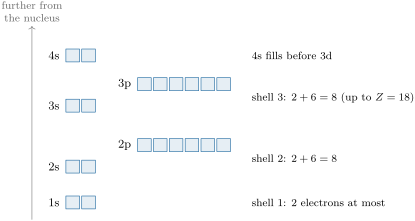
The order of filling, up to Z = 20. Each small box is a place for one electron: an s subshell has 2 places, a p subshell 6.
The order of filling, up to Z=20Z = 20. Each small box is a place for one electron: an s subshell has 2 places, a p subshell 6.

Examples

Example 23.4 (Counting valence electrons)

Oxygen, 1s2 2s2 2p41\mathrm{s}^2\,2\mathrm{s}^2\,2\mathrm{p}^4: outer shell n=2n = 2, 2+4=62 + 4 = 6 valence electrons. Sodium, …3s1\ldots 3\mathrm{s}^1: 1 valence electron. Chlorine, …3s2 3p5\ldots 3\mathrm{s}^2\,3\mathrm{p}^5: 7. Neon, 1s2 2s2 2p61\mathrm{s}^2\,2\mathrm{s}^2\,2\mathrm{p}^6: 8, a full shell.

Read in context →