School Chemistry — Grades 1 to 12 · Grades 1–12
23Electron Shells and the Periodic Table
Neon glows red-orange in a sign; sodium, a soft metal, catches fire in water; chlorine is a choking yellow-green gas. Yet their atoms differ by only one or two protons: neon has 10, sodium 11, chlorine 17. Why should neighbours in the periodic table behave so differently, while sodium and potassium, far apart in atomic number, behave so alike? The answer lies in how the electrons of an atom are arranged.
You already know
An atom has protons in its nucleus and, when neutral, electrons around it (Chapter 16). The periodic table orders the elements by in periods (rows) and groups (columns); elements of a group behave alike (Chapter 20). Atoms gain or lose electrons to become ions (Chapter 17).
23.1 Electron configuration
Definition 23.1 (Shells, subshells and electron configuration)
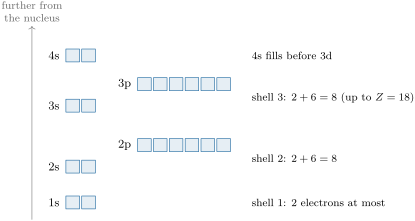
The electrons of an atom are arranged in shells, numbered from the nucleus outwards; the higher , the further from the nucleus and the less tightly held the electrons. Each shell is divided into subshells named by a letter: shell 1 has an s subshell (1s), shell 2 an s and a p subshell (2s, 2p), shell 3 has 3s and 3p (and 3d, met later). An s subshell holds at most 2 electrons, a p subshell at most 6. The electron configuration of an atom lists its occupied subshells with their numbers of electrons as exponents: for oxygen.
Method 23.2 (Writing an electron configuration, up to )
- Count the electrons: for a neutral atom.
Fill the subshells in this order, each up to its maximum before starting the next:
- Check that the exponents add up to the number of electrons.
Sodium, : . Chlorine, : . Calcium, : .
23.2 Valence electrons
Definition 23.3 (Valence and core electrons)
The electrons of the outermost occupied shell (the shell with the highest ) are the valence electrons; the others are the core electrons. Only the valence electrons take part in chemical reactions.
Example 23.4 (Counting valence electrons)
Oxygen, : outer shell , valence electrons. Sodium, : 1 valence electron. Chlorine, : 7. Neon, : 8, a full shell.
23.3 The table rebuilt from configurations
Proposition 23.5 (Period and group from the configuration)
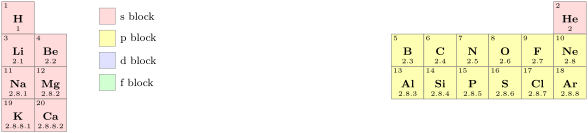
For the elements up to :
- the period of an element is the number of its outer shell;
- elements of a same group have the same number of valence electrons — one in group 1, two in group 2, three to eight in groups 13 to 18 (helium, with 2, is an exception).
The left two columns, where the last electrons enter an s subshell, form the s block; groups 13 to 18 form the p block.
23.4 Families
Definition 23.6 (Chemical families)
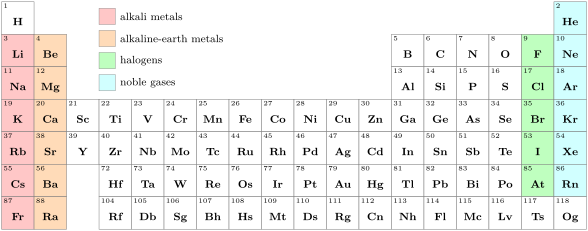
A chemical family is a group of the periodic table whose elements share their main chemical properties. Three families are named: the alkali metals (group 1 except hydrogen: lithium, sodium, potassium…), soft metals that react strongly with water; the halogens (group 17: fluorine, chlorine, bromine, iodine), coloured, reactive non-metals; and the noble gases (group 18: helium, neon, argon…), which hardly react with anything.
Proposition 23.7 (Why a family behaves alike)
The elements of a family have the same number of valence electrons, and chemistry is the business of the valence electrons: lithium, sodium and potassium all have one, the halogens seven, the noble gases a full outer shell.
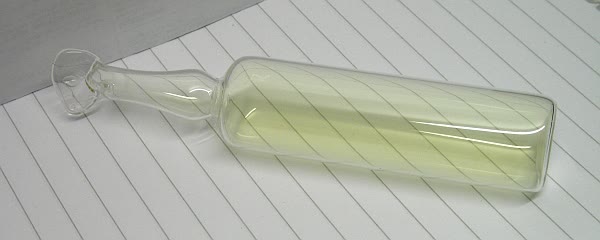
In the lab — Sodium in water
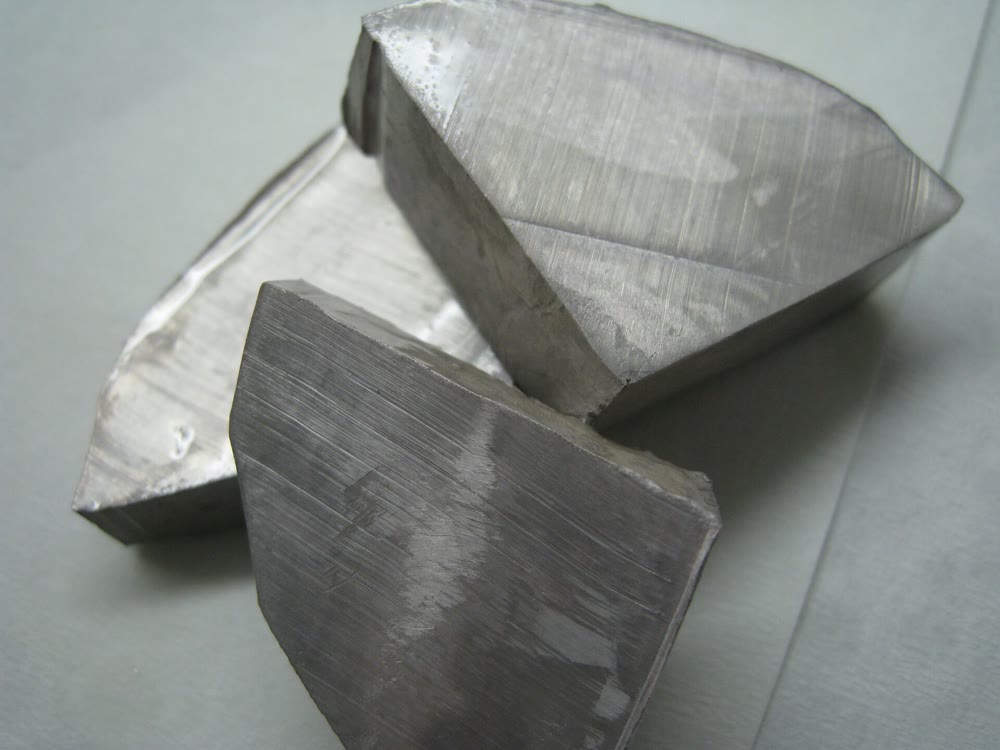
Behind a screen, the teacher drops a piece of sodium the size of a grain of rice into a large bowl of water. It floats, melts into a shiny ball and whizzes about, fizzing, until it has gone; the gas given off is hydrogen, and the water left is basic.
Safety


Sodium: releases flammable hydrogen with water (GHS02), causes severe burns (GHS05). Chlorine: an oxidising gas (GHS03), toxic if inhaled (GHS06), also an irritant and very toxic to aquatic life. Both are handled only by the teacher.
23.5 Stable ions and the noble-gas rule
Definition 23.8 (Duet and octet rules)
The noble gases, with a full outer shell, hardly react: their configuration is especially stable. When atoms of the first elements form ions, they gain or lose electrons so as to reach the configuration of the nearest noble gas: two electrons in shell 1, like helium, for the lightest atoms — the duet rule — and eight electrons in the outer shell, like neon or argon, for the others — the octet rule.
Example 23.9 (Ions predicted by the rule)
Sodium, , loses its single valence electron: , , like neon. Magnesium, , loses two: . Aluminium, , loses three: . Chlorine, , gains one: , , like argon. Oxygen, , gains two: . Sulfur, : . Lithium, , loses one and keeps , like helium: .

Remark 23.10 (Limits of the rule)
The rule works well for the first twenty elements and their simple ions. Many elements, such as iron ( and ), do not follow it; the reasons, and a better description of electrons, are given in the Year 1 volume.
23.6 Exercises
Exercise 23.1 ★
Write the electron configurations of carbon (), nitrogen () and magnesium ().
Solution
Solution of Exercise 23.1.
C: . N: . Mg: .
Exercise 23.2 ★
How many valence electrons do carbon, nitrogen and magnesium have?
Solution
Solution of Exercise 23.2.
Carbon 4, nitrogen 5, magnesium 2.
Exercise 23.3 ★
In which period and which group is the element of configuration ?
Solution
Solution of Exercise 23.3.
Outer shell : period 3. valence electrons: group 15 (phosphorus).
Exercise 23.4 ★
Name the three families of this chapter and give two elements of each.
Solution
Solution of Exercise 23.4.
Alkali metals (lithium, sodium, potassium); halogens (fluorine, chlorine, bromine, iodine); noble gases (helium, neon, argon).
Exercise 23.5 ★
State the octet rule.
Exercise 23.6 ★★
Using the noble-gas rule, give the ion formed by potassium () and by fluorine (), with their configurations.
Solution
Solution of Exercise 23.6.
K, , loses one: , (argon). F, , gains one: , (neon).
Exercise 23.7 ★★
An element has 2 electrons in its third shell and its third shell is its outer shell. Give its configuration, its atomic number and its name.
Solution
Solution of Exercise 23.7.
: , magnesium.
Exercise 23.8 ★★
Using stable ions, write the formula of the ionic compound formed by magnesium and chlorine, then by aluminium and oxygen.
Solution
Solution of Exercise 23.8.
and : . and : .
Exercise 23.9 ★★
Look at the table of the first twenty elements. Which elements have the same number of valence electrons as oxygen?
Exercise 23.10 ★★
Why does neon, unlike sodium and chlorine, form no ions in chemical reactions?
Exercise 23.11 ★★
The ion has the configuration of argon. Find .
Exercise 23.12 ★★★
Helium has 2 valence electrons but sits in group 18, not group 2. Explain using its configuration.
Exercise 23.13 ★★★
Potassium reacts with water even more violently than sodium. Using the distance of the valence electron from the nucleus, suggest why.
Solution
Solution of Exercise 23.13.
Its valence electron is in shell 4, further from the nucleus than sodium’s in shell 3: less tightly held, it is lost more easily.
Exercise 23.14 ★★★
Give the configurations of , , and . What do they have in common?
Exercise 23.15 ★★★
An element of period 3 forms the ion . Find its group, its configuration and its name.
Solution
Solution of Exercise 23.15.
It gains 3 electrons to reach an octet: it has 5 valence electrons, group 15. In period 3, it is phosphorus:
23.7 Problem: Ruby, Sapphire and Corundum
Problem 23.1
Weekend problem — the electrons behind a gemstone: from two configurations to the number of electrons moved in one gram
Rubies and sapphires are gem forms of corundum, an ionic compound of aluminium and oxygen; a trace of other metals gives them their colours. Corundum is hard enough to scratch almost anything, and powdered corundum is used to polish lenses. Take the mass of a nucleon as ; aluminium-27 has 27 nucleons, oxygen-16 has 16.
Part I — The atoms.
- Give the numbers of protons and electrons of an aluminium atom () and of an oxygen atom ().
- Write their electron configurations.
- How many valence electrons does each have? In which period and group is each?
- Is aluminium a metal or a non-metal? And oxygen?
Part II — The ions.
- Using the octet rule, which ion does aluminium form? Write its configuration.
- Which ion does oxygen form? Write its configuration.
- Which noble gas has the same configuration as both ions?
- How many electrons does an aluminium atom lose, and an oxygen atom gain?
Part III — The formula.
- Find the formula of corundum, the neutral compound of these ions.
- In one formula unit, how many electrons are lost by the aluminium atoms? Gained by the oxygen atoms?
- Why must these two numbers be equal?
- A ruby contains a trace of chromium ions in place of some . Why can a ion take the place of an ion without upsetting the charges?
Part IV — One gram of corundum.
- How many nucleons are there in one formula unit of corundum?
- Compute the mass of one formula unit (electrons neglected).
- How many formula units are there in of corundum?
- How many ions and ions is that?
- Why can the electrons be neglected in question 14?
- How many electrons were transferred from aluminium to oxygen to make of corundum?
Solution
Solution of Problem 23.1.
1. Aluminium: 13 protons, 13 electrons. Oxygen: 8 protons, 8 electrons.
2. Al: . O: .
3. Al: 3 valence electrons, period 3, group 13. O: 6, period 2, group 16.
4. Aluminium is a metal, oxygen a non-metal.
5. : .
6. : .
7. Neon.
8. Aluminium loses 3, oxygen gains 2.
9. : .
10. Lost: . Gained: .
11. Electrons are not created or destroyed: those lost by aluminium are exactly those gained by oxygen, and the compound is neutral.
12. It carries the same charge, : the charges of the crystal still balance.
13. nucleons.
14. .
15. formula units.
17. An electron is about 1836 times lighter than a nucleon; the 50 electrons of a formula unit weigh less than three hundredths of one nucleon.
18. electrons transferred for of corundum.