 Coach
CoachThe standard reference state of an element at temperature is its most stable form at under : , , and as perfect gases, carbon as graphite, sodium as the metal, bromine as the liquid (at ). The standard enthalpy of formation of a compound is the standard reaction enthalpy of its formation reaction, the one that makes one mole of the compound from its elements in their reference states. By construction, for an element in its reference state.
Examples
Example 1.8 (Formation reactions)
The formation reaction of water is , with at ; that of methane is , ; that of nitrogen monoxide, , : an endothermic compound, which the hot gases of an engine nevertheless make. The half coefficients are not a problem: the formation reaction is a bookkeeping device, not a mechanism.
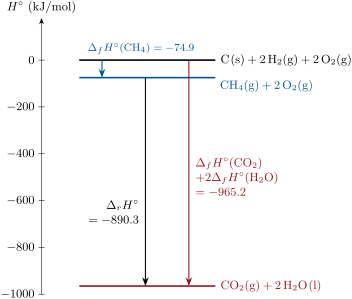
Example 1.11 (Combustion of methane)
For , at . The value measured in a calorimeter is : the table and the flame agree within the uncertainty of the data. If the water leaves as vapour (), : the difference, , is the enthalpy of vaporisation of two moles of water, which a gas boiler recovers by condensing its fumes.
Example 1.13 (Carbon to carbon monoxide)
Burning carbon always makes some carbon dioxide, so the enthalpy of is not measured directly. The two combustions () and (, measured) are; the target is the first minus the second: , the formation enthalpy of carbon monoxide.