All books

Professional

Apps About Coach Log in Start reading

Chemistry · Glossary

What is Structure types?

Also known as: caesium chloride type · rock-salt type · zinc-blende type · fluorite type · antifluorite type

Definition 6.5 University Chemistry — Year 1 · Chapter 6 — Crystals II: Ionic, Covalent and Molecular Solids

Ionic crystals are classified by a few structure types, named after a representative compound:

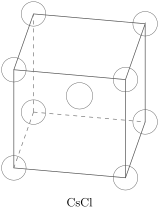
  • caesium chloride type: anions at the corners of a cube, the cation at its centre (8:8);
  • rock-salt type (sodium chloride type): anions on an FCC lattice, cations in all its octahedral sites (6:6);
  • zinc-blende type: anions on an FCC lattice, cations in half of its tetrahedral sites, one in two in alternation (4:4);
  • fluorite type: cations on an FCC lattice, anions in all its tetrahedral sites (8:4), formula MXX2\ce{MX2}; in the antifluorite type the roles are exchanged (LiX2O\ce{Li2O}, 4:8).

The pair of numbers gives the coordination of the cation and of the anion.
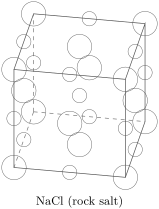
Left: the rock-salt cell, Cl- (green) on an FCC lattice, Na+ (violet) in every octahedral site. Right: the caesium chloride cell, Cl- at the corners, Cs+ (blue) at the centre. Ions drawn smaller than in contact. Left: the rock-salt cell, Cl- (green) on an FCC lattice, Na+ (violet) in every octahedral site. Right: the caesium chloride cell, Cl- at the corners, Cs+ (blue) at the centre. Ions drawn smaller than in contact.
Left: the rock-salt cell, ClX−\ce{Cl-} (green) on an FCC lattice, NaX+\ce{Na+} (violet) in every octahedral site. Right: the caesium chloride cell, ClX−\ce{Cl-} at the corners, CsX+\ce{Cs+} (blue) at the centre. Ions drawn smaller than in contact.
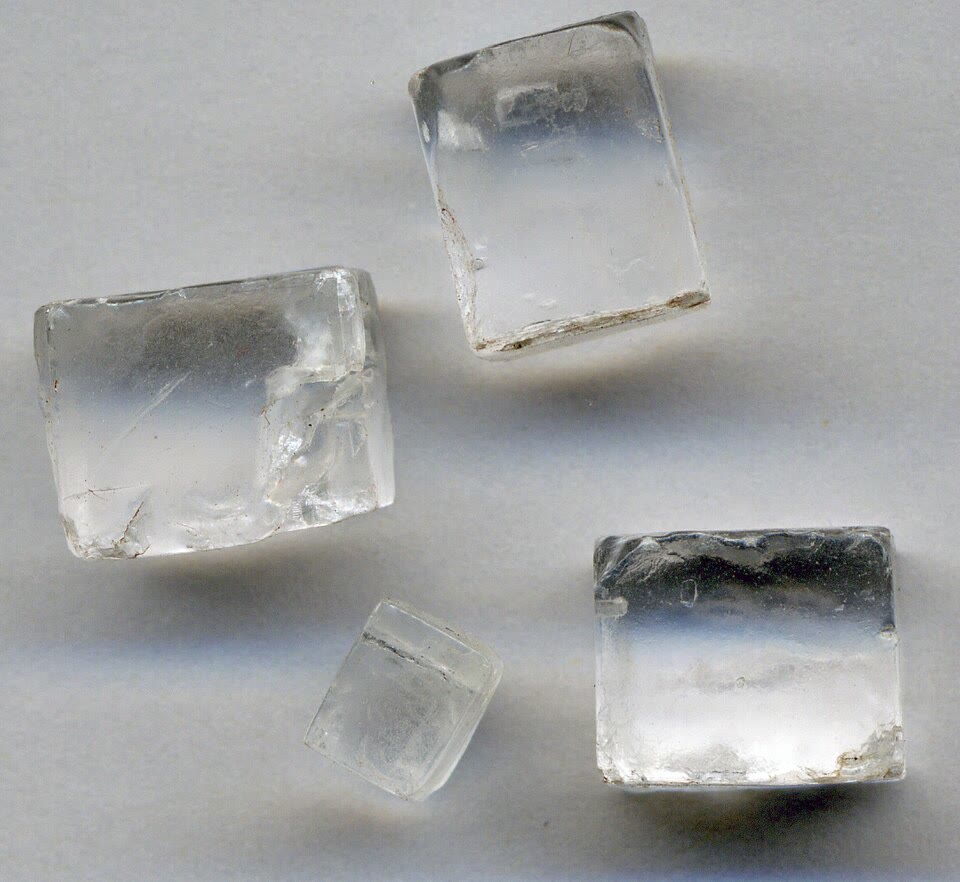
Halite (rock salt) crystals. Photo: James St. John, CC BY 2.0.
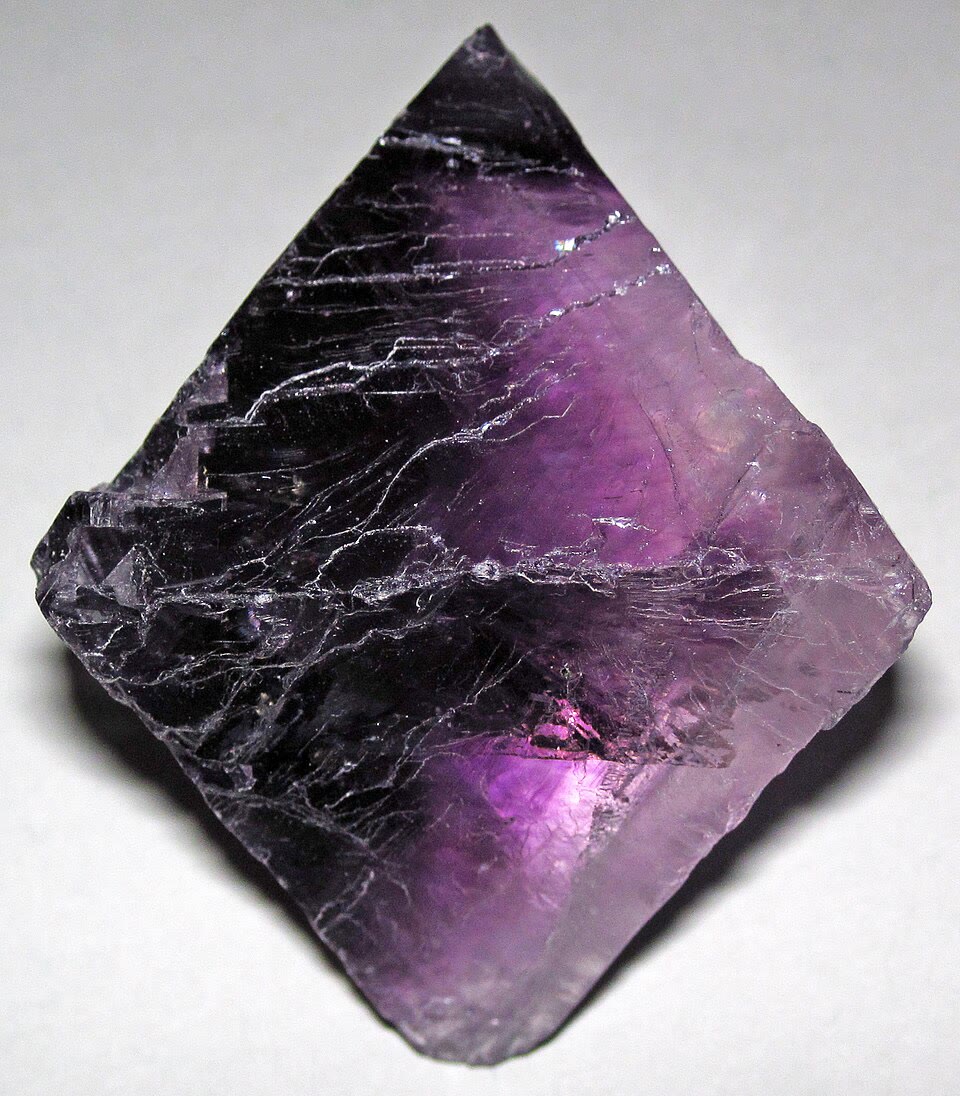
Fluorite, CaFX2\ce{CaF2}. Photo: James St. John, CC BY 2.0.
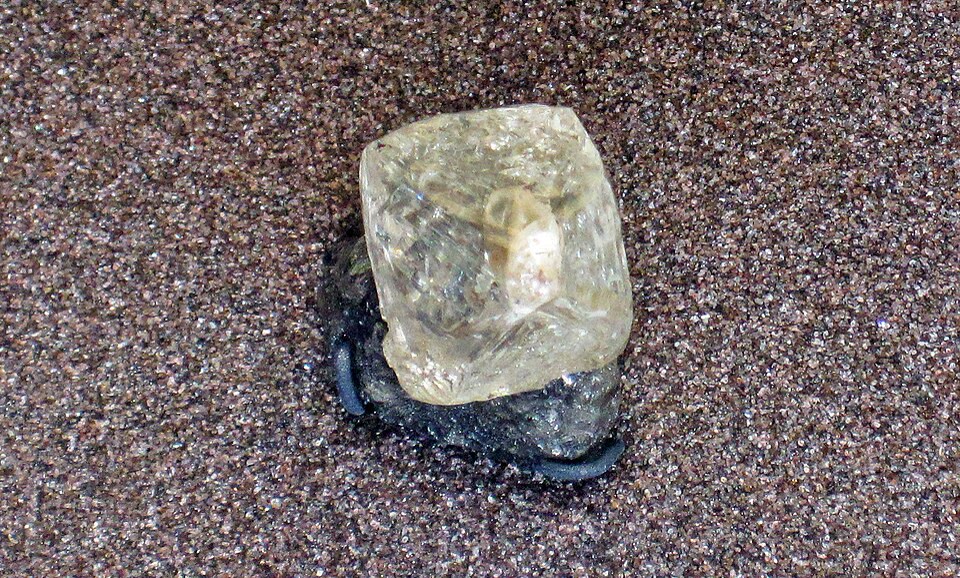
A rough diamond octahedron. Photo: James St. John, CC BY 2.0.

Examples

Example 6.7 (Sodium chloride and caesium chloride)

Sodium chloride has a=564.1 pma = 564.1\,\mathrm{pm}: r++r−=a/2=282.0 pmr_+ + r_- = a/2 = 282.0\,\mathrm{pm}, against 102+181=283 pm102 + 181 = 283\,\mathrm{pm} from the Shannon radii; x=102/181=0.56x = 102/181 = 0.56, in the octahedral range. Its density is ρ=4×58.44/(6.022×1023×(5.641×10−8)3)=2.16 g/cm3\rho = 4 \times 58.44/(6.022 \times 10^{23} \times (5.641 \times 10^{-8})^3) = 2.16\,\mathrm{g}/\mathrm{cm}^{3}, measured 2.17 g/cm32.17\,\mathrm{g}/\mathrm{cm}^{3}. Caesium chloride has a=412.3 pma = 412.3\,\mathrm{pm}: r++r−=a3/2=357.1 pmr_+ + r_- = a\sqrt3/2 = 357.1\,\mathrm{pm}, and x=174/181=0.96x = 174/181 = 0.96, in the cubic range.

Example 6.9 (Zinc blende and fluorite)

Zinc blende has a=540.9 pma = 540.9\,\mathrm{pm}: r++r−=a3/4=234.2 pmr_+ + r_- = a\sqrt3/4 = 234.2\,\mathrm{pm} (Shannon: 60+184=244 pm60 + 184 = 244\,\mathrm{pm}, the sulfide radius being tabulated only for six neighbours), and x=60/184=0.33x = 60/184 = 0.33, in the tetrahedral range. Fluorite has a=546.3 pma = 546.3\,\mathrm{pm}: r++r−=236.6 pmr_+ + r_- = 236.6\,\mathrm{pm} (Shannon 112+131=243 pm112 + 131 = 243\,\mathrm{pm}), and x=0.85x = 0.85: the cation sits in a cube of 8 anions, as the rule demands.

Read in context →