University Chemistry — Year 1 · Bachelor Year 1
6Crystals II: Ionic, Covalent and Molecular Solids
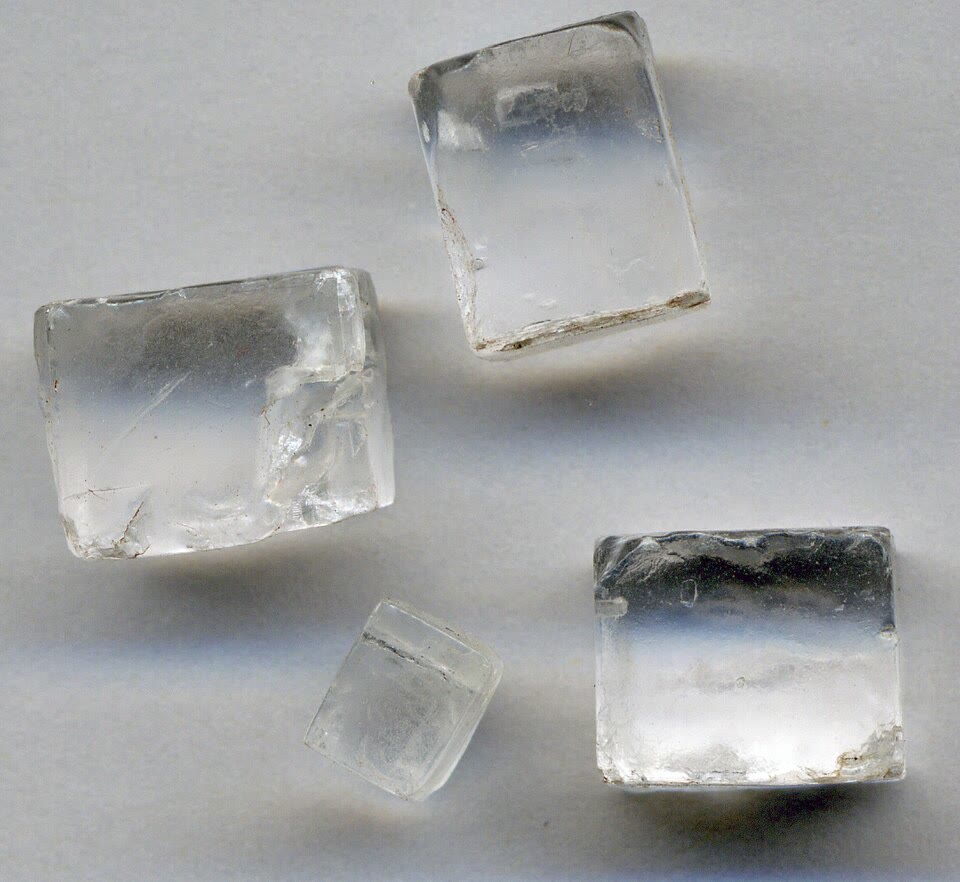
Table salt, crushed, breaks into tiny cubes; a diamond is the hardest natural material, yet graphite, made of the same carbon atoms, is soft enough to write with; ice floats on water. All are crystals, but their particles are held together in different ways: ions by electrostatic attraction, atoms by covalent bonds, molecules by the intermolecular forces of Chapter 4. This chapter applies the cell geometry of the previous chapter to these three families of solids, and explains, from the sizes of the ions, why sodium chloride and caesium chloride adopt different structures.
You already know
A cell’s multiplicity, coordination number and compactness, and the octahedral and tetrahedral sites of the face-centred cubic lattice, were defined in Chapter 5; the density of a crystal is (Proposition 5.8). Ionic radii were introduced in Definition 2.6.
6.1 Ionic crystals and radius ratios
Definition 6.1 (Ionic crystal)
An ionic crystal is a crystal of cations and anions held together by electrostatic attraction. Each ion is surrounded by ions of opposite charge; the crystal is electrically neutral, so the numbers of cations and anions in a cell are in the ratio of the formula.
Proposition 6.2 (Properties of ionic crystals)
Ionic crystals are hard but brittle (a shift of one layer brings ions of the same sign face to face, and the crystal cleaves), have high melting points, do not conduct as solids but conduct when molten or dissolved, and dissolve in polar solvents of high permittivity.
Proof. Admitted at this level. ∎
Definition 6.3 (Radius ratio)
In an ionic crystal of a cation of radius and an anion of radius , the radius ratio is (usually , cations being smaller than anions).
Proposition 6.4 (The radius-ratio rule)
In the hard-sphere model, a structure in which each cation touches anions is stable only if the anions do not touch one another, which requires above a limit fixed by the geometry: for 8 neighbours (cube), for 6 (octahedron), for 4 (tetrahedron). The structure adopted is the one of highest coordination allowed by .
Proof. The cation sits in the hole between anions in contact with it. At the limit, the anions also touch one another. Cube: the anions are at the corners of a cube of edge and the cation at its centre, so . Octahedron: four anions in a square of side , the cation at its centre, . Tetrahedron: the anions at alternate corners of a cube of edge , the cation at the centre, . Dividing by gives the limits. Below the limit the cation rattles in a hole too large for it: the anions repel without the attraction being increased, so a lower coordination, with a smaller hole, is preferred. ∎

6.2 Four structure types
Definition 6.5 (Structure types)
Ionic crystals are classified by a few structure types, named after a representative compound:
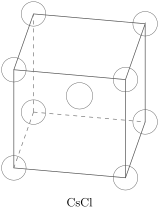
- caesium chloride type: anions at the corners of a cube, the cation at its centre (8:8);
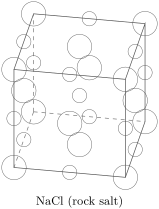
- rock-salt type (sodium chloride type): anions on an FCC lattice, cations in all its octahedral sites (6:6);
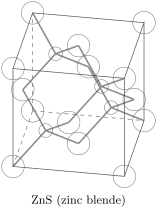
- zinc-blende type: anions on an FCC lattice, cations in half of its tetrahedral sites, one in two in alternation (4:4);
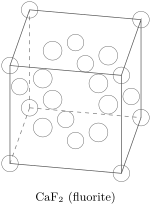
- fluorite type: cations on an FCC lattice, anions in all its tetrahedral sites (8:4), formula ; in the antifluorite type the roles are exchanged (, 4:8).
The pair of numbers gives the coordination of the cation and of the anion.
Proposition 6.6 (Rock-salt and caesium chloride types)
In the rock-salt type, formula units per cell, the ions touch along an edge, , and the structure requires . In the caesium chloride type, , the ions touch along the main diagonal, , and the structure requires .
Proof. Rock salt: the anions of the FCC lattice count , the cations in the 4 octahedral sites . Along an edge, anion, cation and anion follow one another in contact. The anions do not overlap if the face diagonal, which holds three anions of which two touch at most, satisfies , that is , or . Caesium chloride: anion and 1 cation; on the main diagonal, anion, cation, anion in contact; the anions do not overlap along an edge if , that is , or . ∎
Example 6.7 (Sodium chloride and caesium chloride)
Sodium chloride has : , against from the Shannon radii; , in the octahedral range. Its density is , measured . Caesium chloride has : , and , in the cubic range.
Proposition 6.8 (Zinc-blende and fluorite types)
In the zinc-blende type, , each ion is surrounded by four of the other kind at the corners of a tetrahedron, and the ions touch along a quarter of the main diagonal: . In the fluorite type, units, each cation has 8 anion neighbours (a cube), each anion 4 cation neighbours (a tetrahedron), and again .
Proof. Zinc blende: 4 anions on the FCC lattice and 4 cations in half of the 8 tetrahedral sites. A tetrahedral site at lies at from its four anions. Fluorite: 4 cations and 8 anions in all the tetrahedral sites, ratio . The 8 anions inside the cell form a cube of edge , each of whose cubes of anions holds a cation at the centre of every second one; an anion has its 4 cation neighbours at . ∎
Example 6.9 (Zinc blende and fluorite)
Zinc blende has : (Shannon: , the sulfide radius being tabulated only for six neighbours), and , in the tetrahedral range. Fluorite has : (Shannon ), and : the cation sits in a cube of 8 anions, as the rule demands.
Method 6.10 (Predicting a structure)
To predict the structure of an ionic compound or :
- compute from tabulated radii (for the expected coordination);
- read the coordination of the cation from the radius-ratio rule;
- choose the type that has this coordination and the right formula: with 8: ; with 6: ; with 4: zinc blende; with 8: fluorite;
- check against the measured lattice parameter; remember that polarisable ions (, ) and small, charged cations give bonds partly covalent, for which the rule fails.
6.3 Covalent crystals
Definition 6.11 (Covalent crystal)
A covalent crystal (or network solid) is a crystal in which all the atoms are linked by covalent bonds into one giant molecule: diamond, silicon, quartz . In a layered covalent crystal such as graphite, the covalent network extends only in planes, which are held to one another by van der Waals interactions.
Proposition 6.12 (The diamond structure)
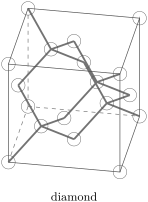
In diamond the carbon atoms occupy the FCC lattice and half of its tetrahedral sites, as the two kinds of ions of zinc blende: , each carbon bonded to four others at the corners of a tetrahedron, at the distance . For touching spheres the compactness is
Proof. . Neighbouring atoms touch: , so and . ∎
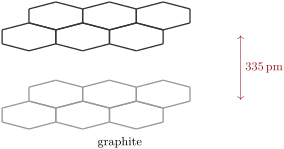
Example 6.13 (Diamond, silicon, graphite)
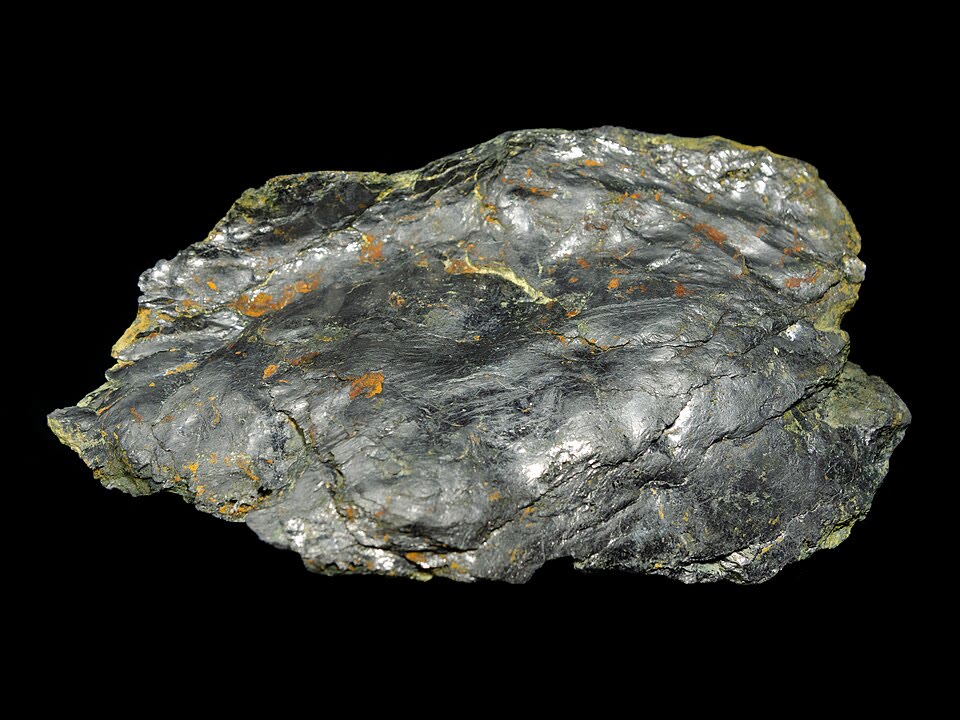
Diamond has : , the single bond of ethane, and . Silicon, of the same structure with , has and (measured 2.33). In graphite each carbon is bonded to three others in a plane at , a bond order between one and two (resonance over the layer), while the layers are apart. Diamond, rigid in three dimensions, is the hardest natural material and an insulator; graphite cleaves between its layers, which slide easily, and conducts electricity within them through its delocalised electrons.
6.4 Molecular crystals
Definition 6.14 (Molecular crystal)
A molecular crystal is a crystal of molecules held together by intermolecular forces — van der Waals interactions and, if possible, hydrogen bonds — while each molecule keeps its own covalent bonds: diiodine, dry ice , ice, sugar.
Proposition 6.15 (Properties of molecular crystals)
Molecular crystals are soft and melt or sublime at low temperatures, since only weak intermolecular forces are broken; they do not conduct.
Proof. Admitted at this level. ∎
Example 6.16 (Ice)
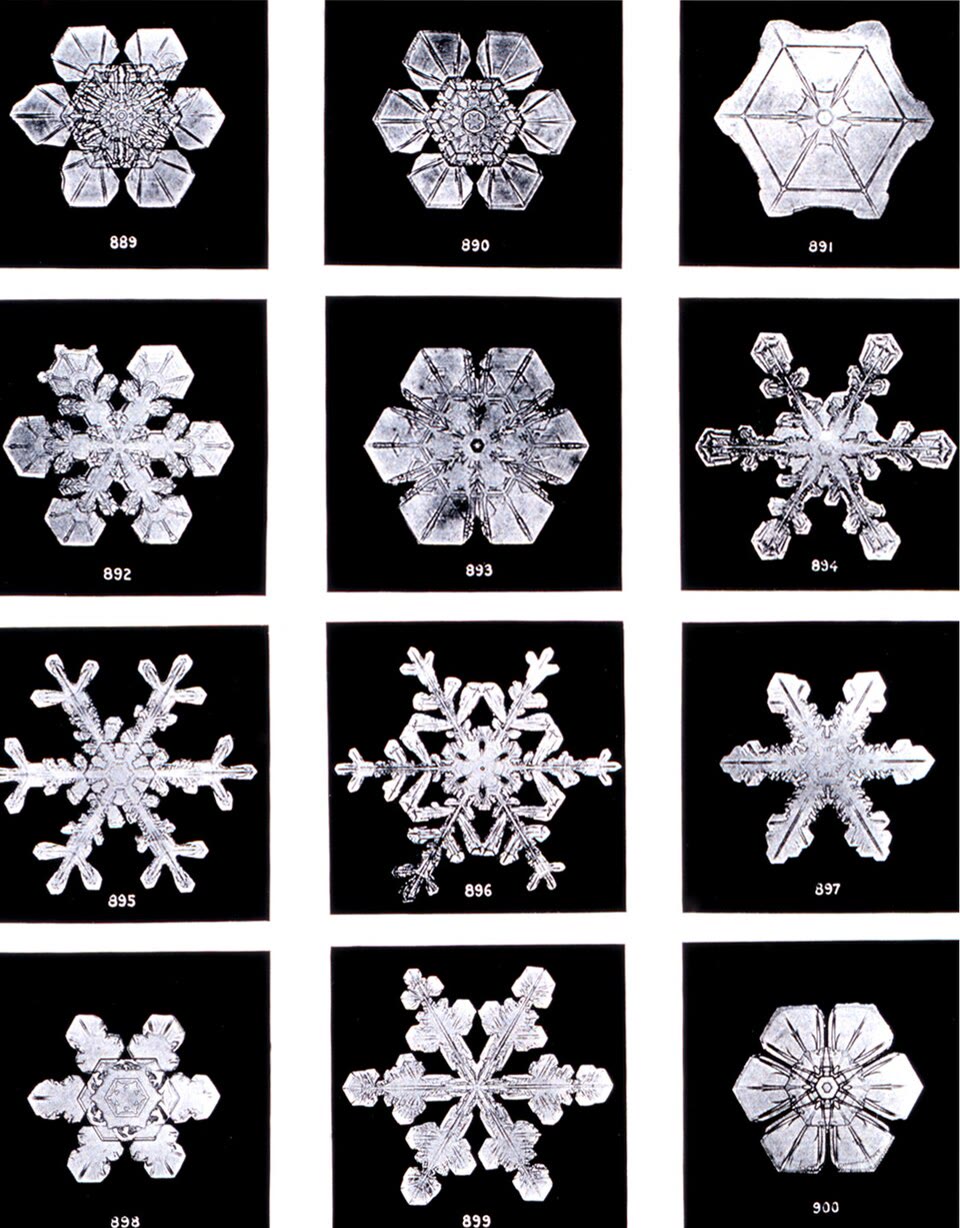
In ordinary ice each water molecule is hydrogen-bonded to four others at the corners of a tetrahedron: two by its own hydrogens and two by its lone pairs. This open, hexagonal network, imposed by the directions of the hydrogen bonds, leaves much empty space: ice is less dense than liquid water, in which the network is partly broken and the molecules come closer. The hexagonal symmetry of the network shows in the six-fold shape of snow crystals.
6.5 Comparing the four kinds of solids
| solid | particles | cohesion | properties | examples |
|---|---|---|---|---|
| metallic | cations, electrons | metallic bond | conductor, ductile | , , |
| ionic | cations, anions | electrostatic | hard, brittle, insulating | , |
| covalent | atoms | covalent bonds | very hard, high melting | diamond, |
| molecular | molecules | van der Waals, H bonds | soft, low melting | , ice |
Remark 6.17 (A continuum)
The classes are idealisations. Zinc sulfide has bonds partly ionic, partly covalent, which is why its sulfide–zinc distance is shorter than the sum of the ionic radii; graphite is covalent in its layers and molecular between them. The electronegativity difference (Proposition 2.17) is the guide: the larger it is, the more ionic the solid.
6.6 Exercises
Exercise 6.1 ★
In the rock-salt cell, count the cations and the anions, give the coordination of each, and check that the formula is respected.
Solution
Solution of Exercise 6.1.
Anions: ; cations: . Each ion has 6 neighbours of the other kind (6:6). Four cations and four anions: .
Exercise 6.2 ★
Caesium chloride has . Compute the shortest distance and the number of formula units per cell.
Solution
Solution of Exercise 6.2.
Half the main diagonal: . One and : one formula unit.
Exercise 6.3 ★
Using the radii and , compute the radius ratio of and predict the coordination of the cation.
Solution
Solution of Exercise 6.3.
, between 0.414 and 0.732: octahedral coordination (6), the rock-salt type.
Exercise 6.4 ★
Classify as metallic, ionic, covalent or molecular: copper, sodium chloride, diamond, diiodine, quartz , ice, calcium fluoride.
Solution
Solution of Exercise 6.4.
Metallic: copper. Ionic: sodium chloride, calcium fluoride. Covalent: diamond, quartz. Molecular: diiodine, ice.
Exercise 6.5 ★★
Prove that the rock-salt structure requires .
Solution
Solution of Exercise 6.5.
Along an edge, anion–cation–anion in contact: . Along a face diagonal lie two anions at the distance ; they must not overlap: , so , that is .
Exercise 6.6 ★★
Compute the density of sodium chloride from () and compare with .
Solution
Solution of Exercise 6.6.
, against measured.
Exercise 6.7 ★★
Compute the density of caesium chloride (, ) and compare with the measured .
Solution
Solution of Exercise 6.7.
, the measured value.
Exercise 6.8 ★★
For zinc blende (, ) compute the distance and the density, and compare with the measured .
Solution
Solution of Exercise 6.8.
; , close to the measured of natural sphalerite.
Exercise 6.9 ★★
Graphite has a hexagonal cell with and , containing 4 atoms. Compute the distance in a layer (), the distance between layers () and the density. Why is graphite less dense than diamond?
Solution
Solution of Exercise 6.9.
; interlayer . Cell volume , , against for diamond: the layers are far apart, held only by London forces.
Exercise 6.10 ★★★
Prove that the compactness of diamond is , and explain why the hardest material is one of the least compact.
Solution
Solution of Exercise 6.10.
See the proof of Proposition 6.12: . Hardness comes from the strength and the three-dimensional rigidity of the covalent bonds, not from packing: each atom has only four neighbours, at fixed angles, which leaves much empty space.
Exercise 6.11 ★★★
Silicon has the diamond structure with . Compute the bond length, the covalent radius of silicon and the density (); compare with .
Exercise 6.12 ★★★
Rubidium chloride has (six neighbours) and . Which structure does the radius-ratio rule predict? Under ordinary conditions it is of the rock-salt type with : check the distance, and suggest why the rule fails here.
Solution
Solution of Exercise 6.12.
: the rule predicts the caesium chloride type. In the rock-salt structure, , close to : the observed structure is consistent. The rule treats ions as hard spheres and ignores their polarisability and the small difference of energy between the two structures (rubidium chloride takes the caesium chloride type under pressure); it is a guide, not a law.
6.7 Problem: Fluorite, the Mineral and the Lens
Problem 6.1
Weekend problem — the fluorite cell, its radius ratio, two relatives ( and diamond), and the density of fluorite computed from its cell
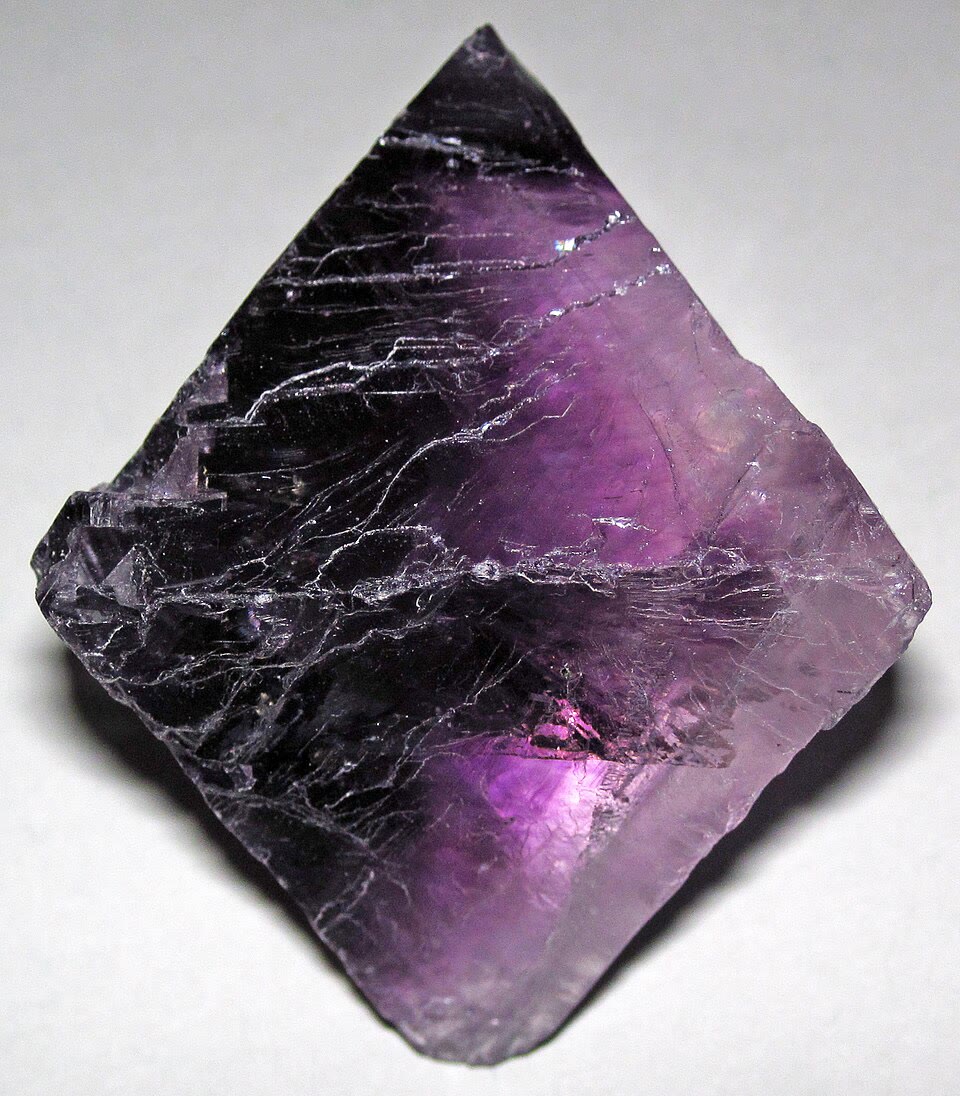
Fluorite, , is a mineral; grown as large clear crystals it makes lenses that transmit ultraviolet light. Its cell is cubic, ; on an FCC lattice, in the tetrahedral sites. Radii: (eight neighbours), (four neighbours). Molar masses (g/mol): 40.08, 19.00, 6.94, 16.00, 12.01, 28.09; .
Part I — The cell.
- Give the positions of the ions in the cell and count them.
- How many tetrahedral sites does the cell contain? Deduce the number of ions and check the formula.
- What is the coordination of ? Of ?
- Compute the shortest distance.
- Compare it with the sum of the ionic radii.
- Compute the shortest distance and say whether the anions touch.
Part II — The radius ratio.
- Compute .
- What coordination of the cation does the radius-ratio rule allow?
- Why can not take the caesium chloride structure, although its cation is 8-coordinated?
- Describe fluorite as a simple cubic arrangement of with in the centres of half of the small cubes.
- Compute the compactness of fluorite.
Part III — Two relatives. Lithium oxide, , is antifluorite with ; (four neighbours), (eight neighbours). Diamond: .
- Where are the and the ions in the antifluorite cell?
- Compute the distance and compare with the sum of the radii.
- Compute the density of and compare with the measured .
- Which ionic structure has the same arrangement of positions as diamond?
- Compute the bond length and the density of diamond.
- Why is diamond so much less compact than fluorite, although its atoms fill the same kind of positions?
Part IV — The density of fluorite.
- Compute the molar mass of .
- Compute the mass of one cell.
- Compute the volume of one cell, in .
- What would a vacancy in one site in every hundred cells do to the density?
- Compute the density of fluorite from its cell, and compare it with the measured .
Solution
Solution of Problem 6.1.
1. At the 8 corners and the 6 face centres: ions. 2. 8 tetrahedral sites, all occupied: 8 for 4 , ratio 1:2, . 3. : 4 at the corners of a tetrahedron. : 8 at the corners of a cube. 4. . 5. : within 3 %. 6. The ions form a simple cubic array of edge , slightly more than : they almost touch. 7. . 8. : coordination 8. 9. The caesium chloride type has as many cations as anions; with twice as many anions, only half of the cubes of anions can hold a cation. 10. The 8 of the cell form a cube of 8 small cubes of edge ; the ions occupy the centres of 4 of them, in alternation, like the black squares of a three-dimensional chessboard. 11. . 12. on the FCC lattice (corners and face centres), in the 8 tetrahedral sites. 13. ; . 14. , the measured value. 15. Zinc blende: diamond is zinc blende with carbon on both kinds of positions. 16. ; . 17. In diamond only half the tetrahedral sites are filled, and by atoms as large as those of the lattice, which touch only along the bonds: . In fluorite all the sites are filled and the small cations fill the gaps between large anions: . 18. . 19. . 20. . 21. One missing per hundred cells removes of the mass, 0.06 %: invisible at three figures (and a must go too, or the crystal would not be neutral). 22. , exactly the measured density: the model of the cell, built from one X-ray measurement of , accounts for the mass of the mineral.