All books

Professional

Apps About Coach Log in Start reading

Chemistry · Glossary

What is Van der Waals interactions?

Also known as: van der Waals interaction · Keesom interaction · Debye interaction · London interaction

Definition 4.1 University Chemistry — Year 1 · Chapter 4 — Intermolecular Forces and Solvents

The van der Waals interactions are the attractions between neutral molecules that come from the interaction of their dipoles. Three kinds are distinguished:

  • the Keesom interaction (or orientation interaction) between two permanent dipoles, which tend to align head to tail;
  • the Debye interaction (or induction interaction) between a permanent dipole and the dipole it induces in a polarisable neighbour;
  • the London interaction (or dispersion interaction) between the instantaneous dipoles that the fluctuations of the electron clouds create in any two atoms or molecules, polar or not, and that induce each other.

The three van der Waals interactions. Black partial charges are permanent (polar molecules); orange ones are induced or instantaneous. In each case the facing charges are opposite, so the molecules attract.
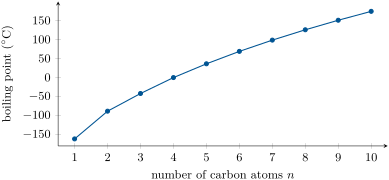
Boiling points of the linear alkanes C_nH_2n+2, methane to decane. Each added CH2 adds electrons and contact surface, hence London attraction; the increment shrinks slowly, from about 75\, C at the start to 25\, C at decane.
Boiling points of the linear alkanes CXnHX2n+2\ce{C_nH_{2n+2}}, methane to decane. Each added CHX2\ce{CH2} adds electrons and contact surface, hence London attraction; the increment shrinks slowly, from about 75 ∘C75\,{}^{\circ}\mathrm{C} at the start to 25 ∘C25\,{}^{\circ}\mathrm{C} at decane.

Examples

Example 4.3 (Noble gases and halogens)

The atoms of a noble gas attract one another only by London forces, which grow with the number of electrons: helium boils at −268.9 ∘C-268.9\,{}^{\circ}\mathrm{C}, neon at −246.1 ∘C-246.1\,{}^{\circ}\mathrm{C}, argon at −185.9 ∘C-185.9\,{}^{\circ}\mathrm{C}, krypton at −153.4 ∘C-153.4\,{}^{\circ}\mathrm{C}, xenon at −108.1 ∘C-108.1\,{}^{\circ}\mathrm{C}. Likewise, at room temperature, difluorine and dichlorine are gases, dibromine a liquid (boiling at 58.8 ∘C58.8\,{}^{\circ}\mathrm{C}) and diiodine a solid.

Example 4.7 (Ethanol and its isomer)

Ethanol, CHX3CHX2OH\ce{CH3CH2OH}, and methoxymethane, CHX3OCHX3\ce{CH3OCH3}, have the same formula CX2HX6O\ce{C2H6O} and nearly the same London interactions. Ethanol, whose O−H\ce{O-H} group is both donor and acceptor, boils at 78.4 ∘C78.4\,{}^{\circ}\mathrm{C}; methoxymethane, which can only accept, boils at −25.0 ∘C-25.0\,{}^{\circ}\mathrm{C}.

Read in context →