University Chemistry — Year 1 · Bachelor Year 1
4Intermolecular Forces and Solvents
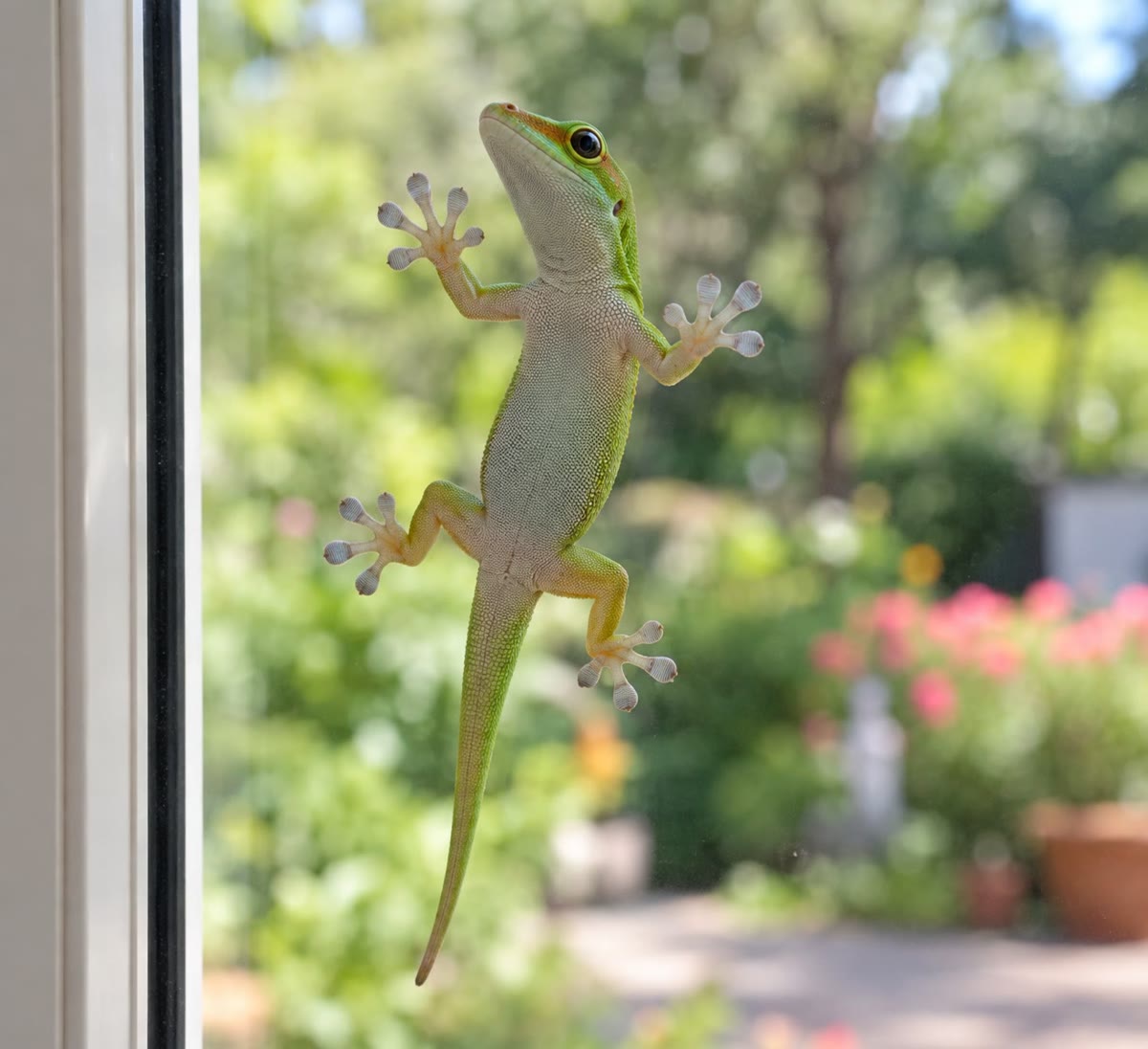
A gecko runs up a window pane and hangs from it by one toe; no glue, no suction, only the attraction between the molecules of its toe pads and those of the glass. Water, a molecule lighter than carbon dioxide, boils at , while carbon dioxide is a gas at room temperature. Oil floats on vinegar and never mixes with it; table salt dissolves in water and not in petrol. All these facts are decided not by the bonds inside molecules but by the much weaker forces between them. This chapter classifies those forces, measures their effects on boiling points, and uses them to choose a solvent.
You already know
Book 1 (grade 11) introduced van der Waals forces and hydrogen bonds, and explained that ionic solids dissolve by dissociation and solvation. Dipole moments were defined in Definition 3.22 and polarisability in Definition 2.19. From physics we use Coulomb’s law: two charges and at a distance in vacuum attract or repel with a force of norm .
4.1 Van der Waals interactions
Definition 4.1 (Van der Waals interactions)
The van der Waals interactions are the attractions between neutral molecules that come from the interaction of their dipoles. Three kinds are distinguished:
- the Keesom interaction (or orientation interaction) between two permanent dipoles, which tend to align head to tail;
- the Debye interaction (or induction interaction) between a permanent dipole and the dipole it induces in a polarisable neighbour;
- the London interaction (or dispersion interaction) between the instantaneous dipoles that the fluctuations of the electron clouds create in any two atoms or molecules, polar or not, and that induce each other.

Proposition 4.2 (Strength and range)
For two molecules at a distance , each of the three van der Waals energies varies as : the attraction is felt only between neighbours. Their energies are of the order of a few kilojoules per mole, about a hundred times less than a covalent bond. The London term grows with the polarisabilities of the two partners; it is present between all molecules and is usually the largest of the three, except for small very polar molecules.
Proof. Admitted at this level. ∎
Example 4.3 (Noble gases and halogens)
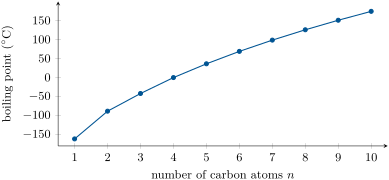
The atoms of a noble gas attract one another only by London forces, which grow with the number of electrons: helium boils at , neon at , argon at , krypton at , xenon at . Likewise, at room temperature, difluorine and dichlorine are gases, dibromine a liquid (boiling at ) and diiodine a solid.
4.2 The hydrogen bond
Definition 4.4 (Hydrogen bond)
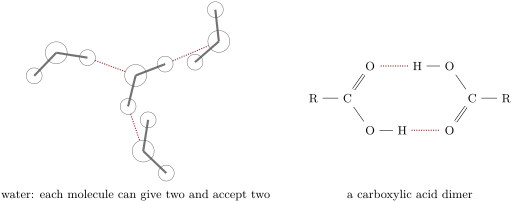
A hydrogen bond is an attraction between a hydrogen atom bonded to a small, very electronegative atom X (, or ) and a lone pair of another electronegative atom Y. The molecule that carries is the hydrogen-bond donor, the one that carries Y the acceptor. Its energy, 10 to , lies between van der Waals interactions and covalent bonds; the three atoms , , are nearly aligned.
Remark 4.5 (Why N, O and F)
A strongly electronegative X leaves hydrogen with a large partial positive charge; hydrogen, which has no inner electrons, is tiny, so the lone pair of Y can come very close to it. Both conditions are needed: bonds are not polar enough, and or bonds involve atoms too large and too weakly electronegative to make strong hydrogen bonds.
Proposition 4.6 (Hydrogen bonds raise boiling points)
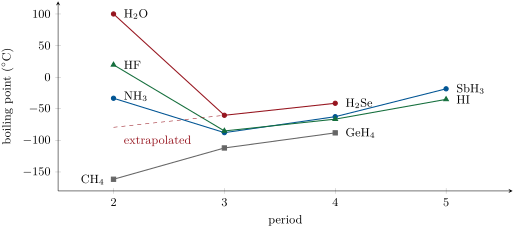
Among the hydrides of groups 15, 16 and 17, the boiling point increases from period 3 to period 5, following the London interaction; the period-2 hydrides , and , which form hydrogen bonds, boil far above the extrapolation of that trend. The hydrides of group 14 (, , ) form no hydrogen bonds and follow the trend.
Example 4.7 (Ethanol and its isomer)
Ethanol, , and methoxymethane, , have the same formula and nearly the same London interactions. Ethanol, whose group is both donor and acceptor, boils at ; methoxymethane, which can only accept, boils at .
4.3 Solvents
Definition 4.8 (Relative permittivity)
In a medium, the Coulomb force between two charges is divided by a number , the relative permittivity (or dielectric constant) of the medium:
It is large for liquids of polar molecules, which orient around the charges and screen them: for water at , for hexane at .
Definition 4.9 (Polar, protic and aprotic solvents)
A polar solvent is made of molecules with a large dipole moment and has a large relative permittivity (above about 15); an apolar solvent has a small one. A protic solvent has molecules that carry hydrogen atoms able to form hydrogen bonds ( or ); an aprotic solvent has none.
| solvent | (D) | polarity | proticity | |
|---|---|---|---|---|
| water | 78.4 | 1.86 | polar | protic |
| methanol | 32.6 | 1.67 | polar | protic |
| ethanol | 24.3 | 1.52 | polar | protic |
| acetonitrile, | 37.5 | 3.92 | polar | aprotic |
| propanone (acetone) | 20.7 | 2.88 | polar | aprotic |
| dichloromethane | 9.08 | 1.62 | weakly polar | aprotic |
| ethyl ethanoate | 6.02 | 1.78 | weakly polar | aprotic |
| ethoxyethane | 4.34 | 1.15 | weakly polar | aprotic |
| benzene | 2.28 | 0 | apolar | aprotic |
| hexane | 1.89 | 0 | apolar | aprotic |
Definition 4.10 (Solvation, ionising and dissociating power)
The solvation of a solute particle is its surrounding by solvent molecules oriented and bound to it by intermolecular forces (hydration, in water). The ionising power of a solvent is its ability to turn a polar covalent bond of the solute into an ion pair, a property of polar solvents with a large dipole moment; its dissociating power is its ability to separate the ions of a pair, measured by its relative permittivity.
Proposition 4.11 (Dissolving in three steps)
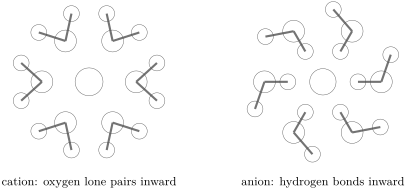
The dissolution of an electrolyte in a solvent can be described in three steps: ionisation (for a molecular solute such as ), dissociation of the ion pairs, and solvation of the separated ions. A solvent dissolves an ionic or very polar solute well when it is polar (ionising), of high permittivity (dissociating) and able to solvate both ions — the cations by its lone pairs, the anions by hydrogen bonds if it is protic. Water does all three.
Example 4.12 (Hydrogen chloride in water and in hexane)
In water, is ionised and dissociated completely: ; the solution conducts. In hexane, apolar and of low permittivity, it dissolves as molecules and the solution does not conduct.
4.4 Solubility, miscibility and amphiphiles
Proposition 4.13 (Like dissolves like)
A solute dissolves well in a solvent when the interactions between solute and solvent molecules are comparable to those they lose: polar or ion-forming solutes in polar solvents, apolar solutes in apolar solvents, hydrogen-bonding solutes in protic solvents.
Reasoning. Dissolving breaks solute–solute and solvent–solvent interactions and makes solute–solvent ones. If the solute is apolar and the solvent water, the water molecules lose hydrogen bonds to make room for it and gain only weak London interactions in exchange: dissolution is unfavourable. If both are apolar, the London interactions lost and gained are comparable, and mixing is favoured by the disorder it creates. ∎
Definition 4.14 (Miscible liquids)
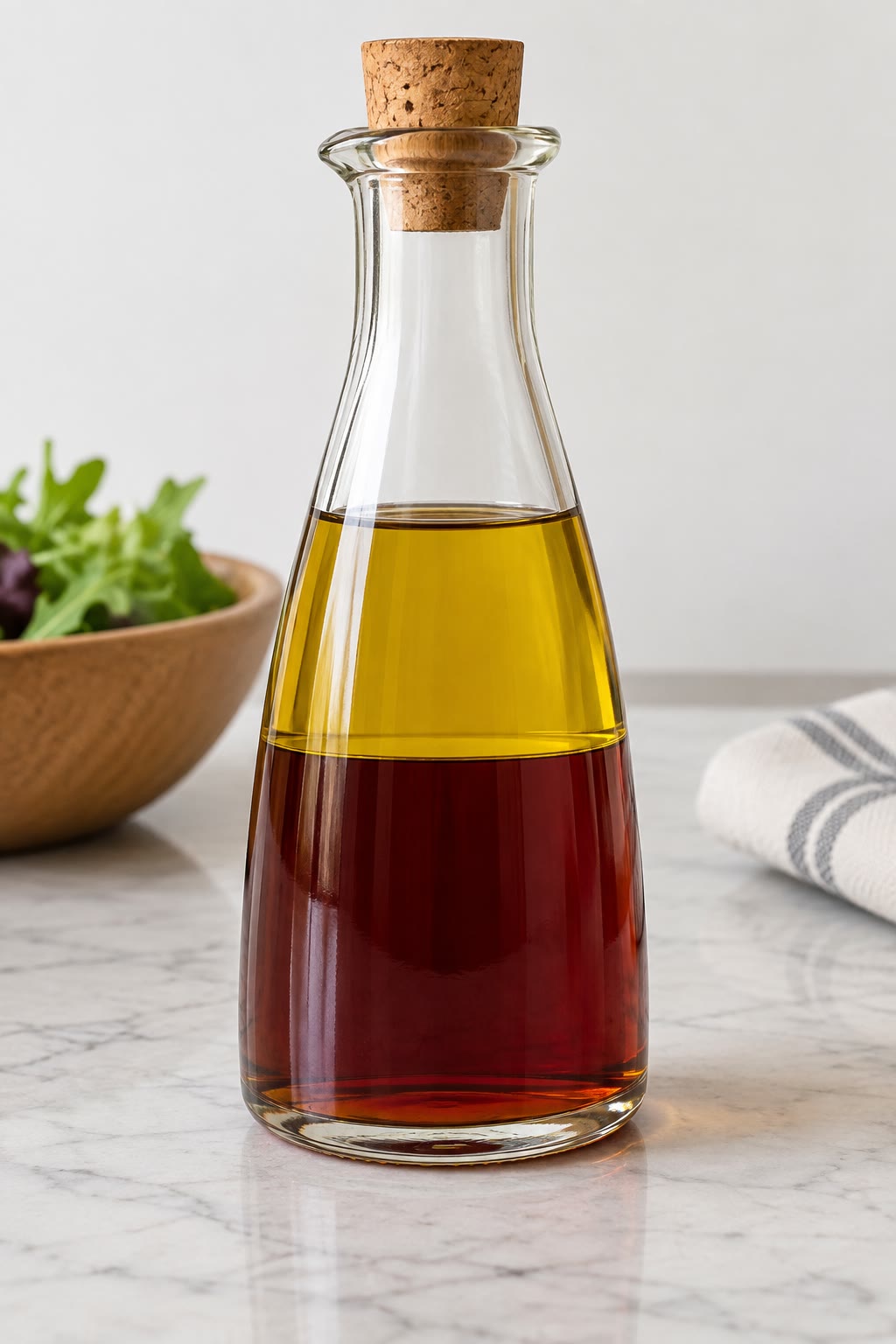
Two liquids are miscible when they mix in all proportions into a single liquid phase; otherwise they form two layers, the less dense on top.
Example 4.15 (Water with ethanol, water with hexane)
Ethanol is miscible with water: both are protic and polar, and ethanol hydrogen-bonds with water as well as with itself. Hexane and water are immiscible. Diiodine, a molecular solid, is barely soluble in water but dissolves readily in hexane or dichloromethane: shaken with such a solvent, aqueous iodine passes into the organic layer, the principle of liquid–liquid extraction (Chapter 29).
Definition 4.16 (Hydrophilic, hydrophobic, amphiphilic)
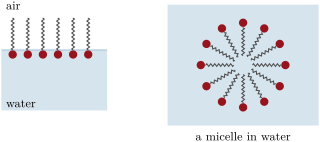
A group is hydrophilic when it interacts favourably with water (ionic or polar groups: , , ) and hydrophobic when it does not (hydrocarbon chains). A molecule is amphiphilic when it carries both a hydrophilic head and a hydrophobic tail.
Example 4.17 (Soap)
Sodium dodecanoate, , is amphiphilic. At the surface of water its molecules stand with the head in the water and the tail in the air. In the bulk, above a small concentration, they gather into spheres — micelles — with the tails inside and the heads outside. Grease, apolar, dissolves in the hydrophobic core of the micelles and is carried away by the water.
Method 4.18 (Choosing a solvent)
To choose a solvent for a solute or a reaction:
- characterise the solute: ionic, polar, able to give or accept hydrogen bonds, or apolar;
- choose a solvent of the same kind (Proposition 4.13), with a high permittivity if ions must be separated;
- for a reaction between an anion and a molecule, prefer a polar aprotic solvent, which dissolves the salt without binding the anion by hydrogen bonds (Chapter 19);
- for an extraction, choose a solvent immiscible with the first one and in which the solute is much more soluble.
4.5 Exercises
Exercise 4.1 ★
Name the interactions present between the particles of liquid argon, liquid hydrogen chloride, liquid water, liquid methane and solid diiodine, and say which dominates in each.
Solution
Solution of Exercise 4.1.
Argon: London only. Hydrogen chloride: Keesom, Debye and London, London dominating (Exercise 4.8); chlorine is too large for strong hydrogen bonds. Water: hydrogen bonds dominate, with the three van der Waals terms. Methane: London only. Diiodine: London only, strong because the molecule is large and very polarisable.
Exercise 4.2 ★
Which of these substances form hydrogen bonds between their own molecules: , , , , , ? Which can only accept hydrogen bonds from another molecule?
Solution
Solution of Exercise 4.2.
Between their own molecules: (), () and . and have lone pairs on O or F but no hydrogen on them: they can only accept hydrogen bonds, from water for instance. neither gives nor accepts.
Exercise 4.3 ★
Using the table of solvents, classify water, ethanol, propanone, hexane, dichloromethane and acetonitrile as polar or apolar, protic or aprotic.
Solution
Solution of Exercise 4.3.
Water and ethanol: polar, protic. Propanone and acetonitrile: polar, aprotic. Dichloromethane: weakly polar, aprotic. Hexane: apolar, aprotic.
Exercise 4.4 ★
Explain why diiodine dissolves much better in hexane than in water, and why sodium chloride does the opposite.
Solution
Solution of Exercise 4.4.
Diiodine is apolar: in hexane it exchanges London interactions for London interactions, while in water it would break hydrogen bonds without replacing them. Sodium chloride is ionic: only a solvent of high permittivity can separate its ions and only a polar one solvate them; hexane () does neither.
Exercise 4.5 ★★
Methanol boils at , ethanol at , ethanoic acid at and methoxymethane at . Explain the order.
Solution
Solution of Exercise 4.5.
Methoxymethane has no : it cannot donate hydrogen bonds and boils lowest. Methanol and ethanol are both hydrogen-bonded; ethanol, with one more , has stronger London interactions. Ethanoic acid forms hydrogen-bonded dimers and is the heaviest: it boils highest.
Exercise 4.6 ★★
Compute the Coulomb force between a and a ion apart in vacuum (, ), then in water () and in hexane (). Comment.
Solution
Solution of Exercise 4.6.
In vacuum . In water ; in hexane . Water weakens the attraction 41 times more than hexane: it can keep the ions apart, hexane cannot.
Exercise 4.7 ★★
Propanone and water are miscible in all proportions; hexane and water are not. Explain, considering the interactions broken and formed.
Solution
Solution of Exercise 4.7.
Mixing propanone with water breaks some water–water hydrogen bonds but forms new ones between water and the oxygen of , plus dipole–dipole interactions: the balance is favourable. Hexane offers water only weak London interactions in exchange for the hydrogen bonds it would break: the two liquids stay apart.
Exercise 4.8 ★★
has a dipole moment of and boils at ; has and boils at . Why does the less polar molecule boil higher?
Solution
Solution of Exercise 4.8.
has more electrons and a larger, more polarisable cloud: its London interaction exceeds that of by more than its Keesom interaction falls short. London dominates.
Exercise 4.9 ★★
Draw the cyclic dimer of ethanoic acid. In benzene solution, ethanoic acid behaves as if its molar mass were about twice ; in water it does not. Explain both facts.
Solution
Solution of Exercise 4.9.
 facing its partner, two bonds closing an eight-membered ring. In benzene, apolar and aprotic, nothing competes with these bonds: the acid is dimerised and behaves as a particle of about . In water, each acid molecule hydrogen-bonds with water instead: the dimers break up.
Exercise 4.10 ★★★
Describe the dissolution of sodium chloride in water in terms of dissociation and solvation, and that of hydrogen chloride in water in terms of ionisation, dissociation and solvation. Why does hydrogen chloride in hexane give a non-conducting solution?
Solution
Solution of Exercise 4.10.
Sodium chloride is made of ions: water, of high permittivity, separates them (dissociation) and hydrates them (oxygen towards , hydrogen towards ). Hydrogen chloride is a polar molecule: water, polar, turns the bond into an ion pair (ionisation), separates the pair (dissociation) and hydrates the ions. Hexane is apolar and of low permittivity: it neither ionises nor dissociates, so no ions carry the current.
Exercise 4.11 ★★★
From the boiling points of the linear alkanes (pentane , decane ), compute the mean increase per group between and , and estimate the boiling point of undecane. Why does the increment decrease along the series?
Solution
Solution of Exercise 4.11.
per . The last increment (nonane to decane) is , so undecane should boil near . Each adds the same London contribution, but a smaller and smaller fraction of the molecule’s total, while the temperature needed to overcome the interactions is already high.
Exercise 4.12 ★★★
Sodium dodecyl sulfate, , is a detergent. Identify its hydrophilic and hydrophobic parts, sketch its arrangement at the surface of water and in a micelle, and explain how it removes an oily stain from a fabric.
Solution
Solution of Exercise 4.12.
Hydrophilic part: the sulfate head with its counter-ion; hydrophobic part: the twelve-carbon chain. At the surface, heads in the water and tails in the air; in a micelle, tails inside and heads outside. The tails dissolve in the grease of the stain, the heads keep it in contact with water, and the grease is lifted off in micelles.
4.6 Problem: If Water Had No Hydrogen Bonds
Problem 4.1
Weekend problem — London forces in the noble gases and the alkanes, the choice of a solvent, and the boiling point water would have without hydrogen bonds
Boiling points under (in ): , , , , ; pentane 36.1, hexane 68.8; , , ; , , ; 100.0, , ; 19.6, , .
Part I — London alone.
- Which interaction holds the atoms of liquid argon together?
- Explain the increase of the boiling point from helium to xenon.
- Why is the boiling point of helium the lowest of all substances?
- Compare pentane and hexane: what does one group add?
- Methane, silane and germane have no dipole moment. Which interaction explains the order of their boiling points?
- Why is no hydrogen bond possible in methane?
Part II — Choosing solvents. Use the table of solvents of the chapter.
- Which solvent of the table dissolves sodium chloride best, and why?
- By what factor is the attraction between two ions smaller in water than in hexane at the same distance?
- A reaction between the anion and an organic molecule should be run in a solvent that dissolves the salt but does not bind the anion by hydrogen bonds. Choose one.
- To extract diiodine from an aqueous solution, which solvent of the table would you choose, and in which layer will the iodine end?
- Explain why ethanol cannot be used for that extraction.
- Ethoxyethane is barely miscible with water although it is polar. Propose an explanation.
Part III — The other hydrides.
- For group 17, compute the change of boiling point from to , and extrapolate the same change back to period 2.
- Compare the extrapolated value with the boiling point of .
- Same two questions for group 15 (, and ).
- For group 14, does lie above or below the extrapolation from and ? Why is that not surprising?
- Rank the excesses of , and water.
- Count the hydrogen bonds each molecule of , and can give and accept, and explain the ranking.
Part IV — Water without hydrogen bonds.
- Why are and suitable for an extrapolation, and why not water itself?
- Compute the change of boiling point from to .
- Write the equation of the straight line through these two points, with the period as variable.
- Deduce the boiling point water would have at .
- By how much do hydrogen bonds raise the boiling point of water?
- Conclude: at what temperature would water boil if its molecules attracted one another like those of ?
Solution
Solution of Problem 4.1.
1. The London interaction, the only one between apolar atoms. 2. From helium to xenon the number of electrons and the size grow, hence the polarisability and the London attraction. 3. Helium has two electrons held tightly by its nucleus: the least polarisable atom, with the weakest London attraction. 4. : one adds electrons and contact surface, hence London attraction. 5. London, growing with polarisability: . 6. Carbon is not electronegative enough to polarise strongly, and methane has no lone pair to accept a hydrogen bond. 7. Water: polar, protic, of the highest permittivity; it separates and solvates both ions. 8. : the attraction is 41 times weaker in water. 9. Acetonitrile (or propanone): polar enough to dissolve the salt, aprotic so that the anion stays free. 10. Hexane: immiscible with water, apolar like diiodine. The iodine passes into the hexane, the upper layer (hexane is less dense than water). 11. Ethanol is miscible with water: no second layer forms. 12. Its oxygen accepts hydrogen bonds from water, but it cannot donate any and its two ethyl groups are hydrophobic: it dissolves only slightly. 13. per period; extrapolated : . 14. boils at , above the extrapolation. 15. ; extrapolated : ; actual , higher. 16. ; extrapolated : ; actual , below. Methane forms no hydrogen bonds; it is simply small and weakly polarisable. 17. Water (about ) (123) (80). 18. can give three but accept only one (one lone pair); can accept three but give only one. Water gives two and accepts two: every molecule can take part in four hydrogen bonds, a full three-dimensional network. 19. and form no significant hydrogen bonds: their boiling points follow the London trend that water would follow without them. Water itself is the anomaly being measured. 20. per period. 21. in . 22. . 23. . 24. Without its hydrogen bonds water would boil near , and would be a gas on Earth.