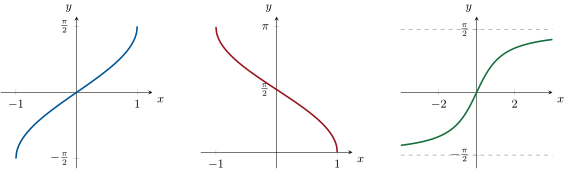
The restrictions
sin:[−2π,2π]→[−1,1],cos:[0,π]→[−1,1],tan:(−2π,2π)→R
are strictly monotonic bijections. Their inverse maps are written arcsin, arccos and arctan. Thus, for instance, y=arcsinx (x∈[−1,1]) is the angle in [−2π,2π] whose sine is x.
Examples
Example 4.11 (Recognizing a hidden constant)
Study g(x)=arctan1+x1−x on (−1,+∞). Chain rule and a short computation:
g′(x)=1+(1+x1−x)21⋅(1+x)2−(1+x)−(1−x)=(1+x)2+(1−x)2−2=1+x2−1,
since (1+x)2+(1−x)2=2+2x2. So g′=−arctan′: the function g+arctan has zero derivative on the interval (−1,+∞), hence is constant there; its value at x=0 is arctan1+arctan0=4π. Conclusion:
arctan1+x1−x=4π−arctanx(x>−1).
On (−∞,−1) the same derivative computation holds but the constant is different (−43π: evaluate the limit as x→−∞). The insight: “zero derivative implies constant” is an interval-by-interval statement — exactly the subtlety exploited in Exercise 4.6 and Exercise 4.10.
Example 4.14 (Wrapping back to the principal interval)
Compute
arctan(tan43π)andarctan(tan517π).
The recipe: replace the angle by the unique angle of (−2π,2π) with the same tangent, i.e. subtract the right multiple of π (the period of tan). First: 43π−π=−4π, so the answer is −4π. Second: 517π−3π=52π∈(−2π,2π), so the answer is 52π. The computation is a Euclidean division of the angle by π in disguise — and the analogous recipes for arcsin (reflect into [−2π,2π], period 2π) and arccos (reflect into [0,π]) drive Exercise 4.1 and the piecewise answer of Exercise 4.10.
Example 4.15 (Adding arctangents safely)
Let us prove
arctan21+arctan51+arctan81=4π.
Two ingredients: the tangent addition formula, and — the step beginners forget — a localization of the sum. First, tan(u+v)=1−tanutanvtanu+tanv with u=arctan21, v=arctan51 gives
tan(u+v)=1−10121+51=9/107/10=97,thentan(u+v+arctan81)=1−72797+81=65/7265/72=1.
Second, each of the three angles lies in (0,4π) (their arguments are less than 1), so the sum lies in (0,43π); the only angle there with tangent 1 is 4π. Without the localization the conclusion would be “4π up to a multiple of π” — half a proof. The same two-step discipline runs Exercise 4.8 and Exercise 4.12.
 Coach
Coach