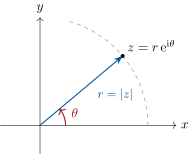
Let . An argument of , written , is any measure of the angle from the positive real axis to the ray ; it is defined up to . Writing ,
Introducing the notation
this becomes the exponential form .
 Coach
Log in
Start reading
Coach
Log in
Start reading
Mathematics · Glossary
Also known as: argument
Let . An argument of , written , is any measure of the angle from the positive real axis to the ray ; it is defined up to . Writing ,
Introducing the notation
this becomes the exponential form .