The equationx2=−1 has no real solution. Enlarging R with a single new number i whose square is −1 produces the field C of complex numbers, in which every polynomial equation has solutions — and whose arithmetic encodes the geometry of the plane: translations, rotations and scalings become additions and multiplications.
28.1 Algebraic form
Definition 28.1(Complex numbers)
The set of complex numbers is
C={a+ib:a,b∈R},
where i is a symbol subject to the single rule i2=−1; addition and multiplication are performed as for real polynomials in i, reducing i2 to −1. The reals a and b are the real partRe(z) and imaginary partIm(z) of z=a+ib; this expression is the algebraic form of z, and it is unique: a+ib=a′+ib′ if and only if a=a′ and b=b′.
Example 28.2
(2+3i)(1−i)=2−2i+3i−3i2=5+i.
Definition 28.3(Conjugate)
The conjugate of z=a+ib is z=a−ib.
Proposition 28.4(Properties of conjugation)
For all z,w∈C:
z+w=z+w,zw=zw,z=z,z+z=2Re(z),z−z=2iIm(z),
and zz=a2+b2≥0 for z=a+ib. Moreover z∈R if and only if z=z.
Proof. All are direct computations from the algebraic forms; for instance zz=(a+ib)(a−ib)=a2−(ib)2=a2+b2. ∎
Method 28.5(Dividing complex numbers)
To write a quotient in algebraic form, multiply numerator and denominator by the conjugate of the denominator:
2+i1=(2+i)(2−i)2−i=52−i=52−51i.
Every nonzero complex number therefore has an inverse: C is a field.
28.2 The complex plane, modulus and argument
Definition 28.6(Affix, modulus)
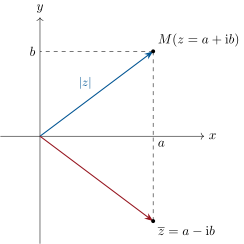
In the plane with orthonormalcoordinates, the point M(a,b) is the image of z=a+ib, and z is the affix of M. The modulus of z is the distance from M to the origin:
∣z∣=a2+b2=zz.
The point M(a,b) of affixz: the modulus∣z∣ is the length OM, and the conjugatez is the reflection of z in the real axis.
using Re(u)≤∣u∣. The distance statement is the Pythagorean formula applied to the coordinates of zB−zA. ∎
Definition 28.8(Argument, trigonometric and exponential forms)
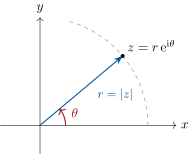
Let z=0. An argument of z, written arg(z), is any measure θ of the angle from the positive real axis to the ray OM; it is defined up to 2kπ. Writing r=∣z∣,
z=r(cosθ+isinθ)(trigonometric form).
Introducing the notation
eiθ=cosθ+isinθ,
this becomes the exponential formz=reiθ.
Exponential form: z is determined by its distance r to the origin and the angle θ from the positive real axis.
Proof. Induction on n≥0 using Theorem 28.9; extend to n<0 by taking inverses. ∎
Method 28.11(Switching between forms)
From algebraic to exponential: compute r=∣z∣, then find θ with cosθ=ra, sinθ=rb (locate the correct quadrant before invoking an inverse cosine). From exponential to algebraic: expand rcosθ+irsinθ. Use the algebraic form for sums, the exponential form for products, powers and quotients.
Example 28.12
z=1+i: ∣z∣=2 and cosθ=sinθ=21, so θ=4π and z=2eiπ/4. Hence z20=210e5iπ=−1024.
28.3 Second-degree equations and roots of unity
Theorem 28.13(Quadratic equations with real coefficients)
Let a,b,c∈R, a=0, and Δ=b2−4ac. The equationaz2+bz+c=0 has solutions in C:
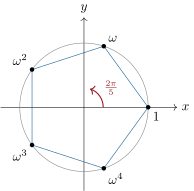
Their images are the vertices of a regular n-gon inscribed in the unit circle, and for n≥2 their sum is 0.
Proof. Each ωk satisfies ωkn=e2ikπ=1, and they are pairwise distinct since their arguments lie in [0,2π). Conversely, if zn=1 then ∣z∣n=1, so ∣z∣=1 (positive real) and z=eiθ with nθ≡0(mod2π), i.e.θ=n2kπ; reducing k modulo n lands among the ωk. The vertices are equally spaced by angle n2π: a regular n-gon. Finally, with ω=ω1, ω=1 and the geometric sum gives
k=0∑n−1ωk=k=0∑n−1ωk=ω−1ωn−1=0.
∎
The fifth roots of unity, ω=e2iπ/5: the vertices of a regular pentagon inscribed in the unit circle (Exercise 28.10).
Example 28.16
The cube roots of unity are 1, j=e2iπ/3=−21+i23 and j=j2, satisfying 1+j+j2=0.
28.4 Complex numbers and plane geometry
Proposition 28.17(Geometric dictionary)
Let A,B,C,D be points of affixesa,b,c,d (a=b, c=d).
The rotation of center ω (affix) and angle θ is z↦ω+eiθ(z−ω).
The scaling (homothety) of center ω and ratio k∈R∗ is z↦ω+k(z−ω).
b−ad−c has modulusABCD and argument the angle between the vectorsAB and CD. In particular, AB⊥CD if and only if b−ad−c is purely imaginary, and A,B,C are collinear (C=A, C=B) if and only if b−ac−a∈R.
Proof. (1) and (3) restate the coordinate formulas. For (2), the map w↦eiθw multiplies moduli by 1 and adds θ to arguments: it is the rotation of angle θ about the origin; conjugating by the translation sending ω to 0 gives the general center. For (4), moduli and arguments of quotients subtract (Theorem 28.9). ∎
Describe geometrically the set of points M of affixz such that: (a) ∣z−2∣=∣z+i∣; (b) ∣z−1−i∣=3; (c) z+1z−1 is purely imaginary.
Solution
Solution of Exercise 28.4.
(a)∣z−2∣=∣z−(−i)∣ means M is equidistant from A(2,0) and B(0,−1): the perpendicular bisector of [AB].
(b) Distance 3 from the point (1,1): the circle of center 1+i and radius 3.
(c) By Proposition 28.17(4), z+1z−1 purely imaginary means the vectors from A(1,0) to M and from B(−1,0) to M are orthogonal: M sees the segment [AB] under a right angle. The set is the circle of diameter [AB] (the unit circle) minus the points A and B themselves.
Exercise 28.5★★
Using De Moivre’s formula and the binomial theorem, express cos3θ as a polynomial in cosθ, and sin3θ in terms of sinθ.
Solution
Solution of Exercise 28.5.
De Moivre: cos3θ+isin3θ=(cosθ+isinθ)3. Expanding by the binomial theorem with c=cosθ, s=sinθ:
(c+is)3=c3+3ic2s−3cs2−is3=(c3−3cs2)+i(3c2s−s3).
Identifying parts and using s2=1−c2, c2=1−s2:
cos3θ=4cos3θ−3cosθ,sin3θ=3sinθ−4sin3θ.
Exercise 28.6★★
(Linearization.) Using cosθ=2eiθ+e−iθ, linearize cos3θ (write it as a combination of coskθ), and deduce ∫0π/2cos3θdθ.
(Consistent with W3=32 in Exercise 25.9, since ∫0π/2cos3=∫0π/2sin3 by the symmetry θ↦2π−θ.)
Exercise 28.7★★
Let A and B have affixesa=1+i and b=3+2i. Determine the two points C making the triangle ABC equilateral, as the images of B under the rotations of center A and angles ±3π.
Solution
Solution of Exercise 28.7.
c=a+e±iπ/3(b−a) with b−a=2+i and e±iπ/3=21±i23:
eiπ/3(2+i)=(21+i23)(2+i)=(1−23)+i(21+3),
so c1=(2−23)+i(23+3), and similarly with the angle −3π: c2=(2+23)+i(23−3).
Exercise 28.8★★★
Solve z4=−4 in C and plot the solutions. Factor z4+4 into two quadratic polynomials with real coefficients.
Solution
Solution of Exercise 28.8.
−4=4eiπ, so the solutions of z4=−4 are
zk=2ei(4π+2kπ),k=0,1,2,3,
i.e.1+i, −1+i, −1−i, 1−i: the vertices of a square of circumradius 2. Grouping conjugateroots,
Let u=ω+ω4 and v=ω2+ω3. Show that u+v=−1 and uv=−1, and deduce that u=2−1+5.
Conclude that cos52π=45−1.
Solution
Solution of Exercise 28.10.
1.ω is a 5-th root of unity different from 1, so the sum of all five roots vanishes (Theorem 28.15), which reads 1+ω+ω2+ω3+ω4=0.
2.u+v=ω+ω2+ω3+ω4=−1 by point 1. For the product, using ω5=1:
uv=(ω+ω4)(ω2+ω3)=ω3+ω4+ω6+ω7=ω3+ω4+ω+ω2=−1.
So u,v are the roots of X2+X−1=0: {2−1+5,2−1−5}. Now u=ω+ω=2cos52π>0 (since 52π<2π), so u=2−1+5.
3.cos52π=2u=45−1.
28.6 Problem: The pentagon in the mirror of unity
Problem 28.1
Weekend problem — the fifth roots of unity compute cos72∘ exactly, the golden ratio signs the result, and multiplication turns out to be rotation
Euclid could construct the regular pentagon but the reason why it yields to ruler and compass — while the humble 20∘ angle does not — stayed hidden for two thousand years. It hides in this chapter: the five fifth roots of unity (Theorem 28.15) sum to zero, and that one line of algebra squeezes cos72∘ out of a quadratic equation — square roots only, hence constructible, and signed, of course, by the golden ratio. Around this jewel: fluency, de Moivre’s shortcut to trigonometry, and multiplication unmasked as geometry.
Part I — Fluency.
Compute (2+i)(3−i), 1−i1+i (Method 28.5), and ∣3+4i∣.
Set c=cos52π and use the double-angle formula for cos54π to convert question 8 into a quadratic equation for c; solve it and conclude
cos72∘=45−1.
Verify numerically, then let the golden ratio sign its work: show c=2φ1 where φ=21+5 (Problem 2.1) — and state the famous geometric echo: in a regular pentagon, the diagonal is φ times the side.
Part III — De Moivre’s shortcuts.
The construction verdict: cos72∘ needs only square roots (question 9), so the pentagon is ruler-and-compass constructible; cos20∘ satisfies an unbreakable cubic (Problem 24.1), so the 60∘ angle cannot be trisected. State the emerging criterion (square roots buildable, cube roots not), whose full theory — Gauss, age 19, and the 17-gon — lives in the university volumes.
Expand (cosθ+isinθ)3 with the binomial theorem and de Moivre, and re-derive cos3θ=4cos3θ−3cosθ in three lines — compare with the addition-formula route of Problem 24.1.
Cross-check with Exercise 28.9: for θ=52π and n=4, what does the sum 1+cosθ+⋯+cos4θ equal, and why is that consistent with question 8?
Describe completely the map z↦(1+i)z: by what angle does it rotate, by what factor does it scale, and what does it do to the unit square?
Prove ∣z1z2∣=∣z1∣∣z2∣ with conjugates (Proposition 28.7), then compute (1+i)n for n=1,2,3,4 and describe the spiral the powers trace.
The number j=e2iπ/3: show 1+j+j2=0, and verify on the triangle (1,j,j2) the classical criterion: a+jb+j2c=0 holds for (one orientation of) an equilateral triangle abc.
The fundamental theorem of algebra (admitted: d’Alembert–Gauss): every polynomial factors completely over C. Deduce the real-world corollary — every real polynomial factors into real linear and quadratic pieces — and point to question 12 as an instance.
Finale — C’s portrait, one sentence each: numbers become points; multiplication becomes rotation-and-scaling; the roots of unity become regular polygons; de Moivre turns powers into trigonometric identities; and algebraic closure guarantees that no equation ever needs a bigger world. Coda: which two celebrated numbers met in question 10?
4.z2=eiπ/2: z=±eiπ/4=±22(1+i). And Δ=4−20=−16: z=1±2i.
5.z↦iz: rotation by a quarter turn about the origin. ∣z−(1+i)∣=2: the circle of center 1+i and radius 2.
6.(ωk)5=e2iπk=1, and the five points e2ikπ/5 are distinct: all five solutions of z5=1. They sit on the unit circle at equal angles of 72∘: a regular pentagon with one vertex at 1.
7.S=1+ω+⋯+ω4 satisfies (1−ω)S=1−ω5=0, and ω=1: S=0. (The pentagon’s balance point is its center.)
8.ω4=ω and ω3=ω2: pairing conjugates, the real part of the sum reads 1+2cos52π+2cos54π=0.
9.cos54π=2c2−1, so 1+2c+4c2−2=0, i.e. 4c2+2c−1=0: c=4−1+5 (the positive root, since 72∘ is acute): cos72∘=45−1.
10. Numerically c≈0.30902: matches the calculator. And 2φ1=1+51=45−1 (rationalize): c=2φ1. The pentagon is golden through and through: its diagonal cuts its side in the ratio φ — the pentagram’s endless self-similarity.
11. Square roots are compass-constructible (the half-circle machine of the Middle School volume’s geometric mean), so a number built from rationals by square roots alone — like cos72∘ — is constructible; cube roots are not, and cos20∘ needs one: the pentagon yields, trisection resists. Gauss’s criterion settles every regular polygon — his 17-gon at nineteen made him choose mathematics.
12.−4=4eiπ: the fourth roots have modulus2 and arguments4π+k2π: the four numbers ±1±i. Pairing conjugates: (z−1−i)(z−1+i)=z2−2z+2 and (z+1−i)(z+1+i)=z2+2z+2: the factorization of Exercise 28.8.
13.(cosθ+isinθ)3=cos3θ+3icos2θsinθ−3cosθsin2θ−isin3θ; by de Moivre this equals cos3θ+isin3θ. Real parts: cos3θ=cos3θ−3cosθ(1−cos2θ)=4cos3θ−3cosθ — and the imaginary parts hand over sin3θ for free.
14. It is the real part of 1+ω+⋯+ω4=0: the sum equals 0 — exactly question 8, seen through Exercise 28.9’s kernel.
16.1+i=2eiπ/4: the map rotates the plane by 45∘ and scales it by 2. The unit square becomes a tilted square of side 2 — doubled in area, spun an eighth of a turn.
17.∣z1z2∣2=z1z2z1z2=z1z1z2z2=∣z1∣2∣z2∣2: take square roots. Powers of 1+i: 1+i, 2i, −2+2i, −4: each a 45∘ turn further and 2 times longer — an outward spiral through moduli 2,2,22,4,…
18.j is a third root of unity distinct from 1, so (question 7’s argument with n=3) 1+j+j2=0. Criterion on the standard triangle: a+jb+j2c=1+j⋅j+j2⋅j2=1+j2+j4=1+j2+j=0: satisfied, as the equilateral triangle (1,j,j2) demands.
19. Over C, a real polynomial splits into linear factors; its non-real roots come in conjugate pairs (conjugate the equation), and each pair multiplies into a real quadratic z2−2Re(z0)z+∣z0∣2: hence the real factorization into degree-1 and degree-2 pieces — question 12 performed it on z4+4.
20. Points; rotation-and-scaling; regular polygons; trigonometric identities by expansion; and a closed world where every equation of degree n has its nroots. Coda: in question 10, π’s pentagon shook hands with the golden ratio — Euclid’s two most famous guests, introduced at last by a sum of five arrows equal to zero.