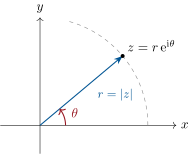
Let . An argument of , written , is any measure of the angle from the positive real axis to the ray ; it is defined up to . Writing ,
Introducing the notation
this becomes the exponential form .
 Coach
登录
开始阅读
书籍暂未推出简体中文版——当前显示英文版。
Mathematics · 术语表
又称: argument
Let . An argument of , written , is any measure of the angle from the positive real axis to the ray ; it is defined up to . Writing ,
Introducing the notation
this becomes the exponential form .