সব বই

পেশাদার

1 Markets I: The Ecosystem and Exchange-Traded Marketsবাজার অনলাইন 2 Markets II: Rates, FX and Creditবাজার অনলাইন 3 Markets III: Commodities, Energy and Cryptoবাজার অনলাইন 4 Quantitative Methodsপদ্ধতি অনলাইন 5 Derivatives and Volatilityডেরিভেটিভস অনলাইন 6 Rates, Credit, XVA and Riskসুদহার, ঋণ ও ঝুঁকি অনলাইন 7 Research Craft: Predictors, Backtests, Measurement, Portfoliosগবেষণা অনলাইন 8 Strategies I: Equities and Futuresকৌশল অনলাইন 9 Strategies II: Volatility, Relative Value, Macro and the Bank Desksকৌশল অনলাইন 10 Microstructure and Executionএক্সিকিউশন অনলাইন 11 Market Making and High-Frequency Tradingমার্কেট মেকিং অনলাইন 12 Machine Learning for Marketsমেশিন লার্নিং অনলাইন 13 Low-Latency Softwareপ্রযুক্তি অনলাইন 14 Networks, Hardware and Trading Infrastructureপ্রযুক্তি অনলাইন 15 Research, Data and Risk Platformsপ্রযুক্তি অনলাইন 16 The Desk and the Firmপ্রতিষ্ঠান অনলাইন 17 The Industry: Firms, Roles and Careersক্যারিয়ার অনলাইন 18 Interviews I: Maths, Probability and Speedক্যারিয়ার অনলাইন 19 Interviews II: Markets, Trading Games and the Final Roundক্যারিয়ার অনলাইন 20 Interviews III: Codeক্যারিয়ার অনলাইন
অ্যাপ পরিচিতি Coach সাইন ইন পড়া শুরু করো

বইগুলো এখনো বাংলা ভাষায় পাওয়া যায় না — ইংরেজি সংস্করণ দেখানো হচ্ছে।

Mathematics · পরিভাষা

Average speed কী?

অন্য নাম: speed

Definition 61.1 Primary & Middle School Mathematics · অধ্যায় 61 — Proportionality, Speed and Averages

The average speed of a journey is the quotient

v=dt(distance divided by duration),v = \frac{d}{t} \qquad \left(\text{distance divided by duration}\right),

in kilometers per hour (km/h), meters per second (m/s), … The formula turns around: d=v×td = v \times t and t=dvt = \frac{d}{v}.

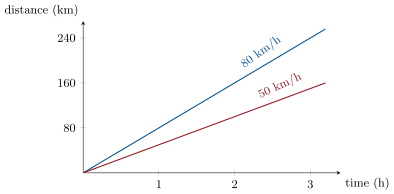
At constant speed, distance is proportional to time: a straight line through the origin, whose steepness is the speed.

উদাহরণ

Example 61.2

A train covers 270270 km in 11 h 3030 min. First convert the time: 11 h 3030 min =1.5= 1.5 h. Then

v=2701.5=180 km/h.v = \frac{270}{1.5} = 180 \text{ km/h}.

Distance at 9090 km/h during 22 h 2020 min =73= \frac73 h: d=90×73=210d = 90 \times \frac73 = 210 km. Time for 3535 km at 1414 km/h: t=3514=2.5t = \frac{35}{14} = 2.5 h =2= 2 h 3030 min.

Example 61.6 (Flow, density, price per kilo)

Speed has many cousins, all treated the same way:

  • a tap fills 4848 L in 44 min: flow rate 484=12\frac{48}{4} = 12 L/min, so filling a 150150 L tub takes 15012=12.5\frac{150}{12} = 12.5 min;
  • 0.60.6 kg of cheese costs 99 euros: price 90.6=15\frac{9}{0.6} = 15 euros per kg;
  • a car uses 6.36.3 L for 9090 km: consumption 6.390×100=7\frac{6.3}{90} \times 100 = 7 L per 100100 km.

Identify the quotient, and the three-way formula (q=abq = \frac ab, a=qba = qb, b=aqb = \frac aq) does the rest.

Example 61.9 (Average speed over two legs)

A cyclist rides 3030 km at 3030 km/h, then 3030 km at 1515 km/h. The average speed over the whole trip is not 30+152=22.5\frac{30 + 15}{2} = 22.5 km/h. Compute with the definition:

  1. times: 3030=1\frac{30}{30} = 1 h, then 3015=2\frac{30}{15} = 2 h; total 33 h;
  2. total distance 6060 km, so v=603=20v = \frac{60}{3} = 20 km/h.

The slow leg lasts longer, so it weighs more — an average of speeds must be weighted by time.

প্রসঙ্গসহ পড়ো →