সব বই

পেশাদার

1 Markets I: The Ecosystem and Exchange-Traded Marketsবাজার অনলাইন 2 Markets II: Rates, FX and Creditবাজার অনলাইন 3 Markets III: Commodities, Energy and Cryptoবাজার অনলাইন 4 Quantitative Methodsপদ্ধতি অনলাইন 5 Derivatives and Volatilityডেরিভেটিভস অনলাইন 6 Rates, Credit, XVA and Riskসুদহার, ঋণ ও ঝুঁকি অনলাইন 7 Research Craft: Predictors, Backtests, Measurement, Portfoliosগবেষণা অনলাইন 8 Strategies I: Equities and Futuresকৌশল অনলাইন 9 Strategies II: Volatility, Relative Value, Macro and the Bank Desksকৌশল অনলাইন 10 Microstructure and Executionএক্সিকিউশন অনলাইন 11 Market Making and High-Frequency Tradingমার্কেট মেকিং অনলাইন 12 Machine Learning for Marketsমেশিন লার্নিং অনলাইন 13 Low-Latency Softwareপ্রযুক্তি অনলাইন 14 Networks, Hardware and Trading Infrastructureপ্রযুক্তি অনলাইন 15 Research, Data and Risk Platformsপ্রযুক্তি অনলাইন 16 The Desk and the Firmপ্রতিষ্ঠান অনলাইন 17 The Industry: Firms, Roles and Careersক্যারিয়ার অনলাইন 18 Interviews I: Maths, Probability and Speedক্যারিয়ার অনলাইন 19 Interviews II: Markets, Trading Games and the Final Roundক্যারিয়ার অনলাইন 20 Interviews III: Codeক্যারিয়ার অনলাইন
অ্যাপ পরিচিতি Coach সাইন ইন পড়া শুরু করো

বইগুলো এখনো বাংলা ভাষায় পাওয়া যায় না — ইংরেজি সংস্করণ দেখানো হচ্ছে।

Mathematics · পরিভাষা

Convergent sequence কী?

অন্য নাম: limit of a sequence

Definition 20.10 High School Mathematics · অধ্যায় 20 — Sequences

A sequence (un)(u_n) converges to the real number ℓ\ell if every open interval containing ℓ\ell contains all the terms unu_n from some index on. We then write lim⁡n→+∞un=ℓ\lim\limits_{n\to+\infty} u_n = \ell.

Equivalently: for every ε>0\varepsilon > 0, there exists N∈NN \in \N such that for all n≥Nn \geq N, ∣un−ℓ∣≤ε\abs{u_n - \ell} \leq \varepsilon.

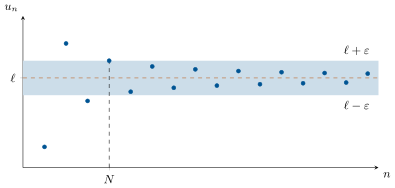
Convergence of u_n = 2 + (-1)n/n to = 2: given > 0, all terms from the index N on lie in the band [ - , + ].
Convergence of un=2+(−1)nnu_n = 2 + \frac{(-1)^n}{n} to ℓ=2\ell = 2: given ε>0\varepsilon > 0, all terms from the index NN on lie in the band [ℓ−ε, ℓ+ε]\intcc{\ell-\varepsilon}{\ell+\varepsilon}.

উদাহরণ

Example 20.22

Let u0=2u_0 = 2 and un+1=12(un+2un)u_{n+1} = \frac{1}{2}\left(u_n + \frac{2}{u_n}\right). One checks by induction that un≥2u_n \geq \sqrt{2} for all nn (the inequality 12(x+2/x)≥2\frac{1}{2}(x + 2/x) \geq \sqrt{2} for x>0x>0 is equivalent to (x−2)2≥0(x - \sqrt2)^2 \geq 0), then that (un)(u_n) is decreasing, since

un+1−un=2−un22un≤0.u_{n+1}-u_n=\frac{2-u_n^2}{2u_n}\leq 0 .

Decreasing and bounded below, (un)(u_n) converges to some ℓ≥2\ell \geq \sqrt{2}, which must satisfy ℓ=12(ℓ+2/ℓ)\ell = \frac{1}{2}(\ell + 2/\ell), i.e. ℓ2=2\ell^2 = 2. Hence un→2u_n \to \sqrt{2}. This is Heron’s algorithm, already used by the Babylonians; its convergence is extremely fast (u3u_3 already gives 2\sqrt 2 to eight decimal places).

প্রসঙ্গসহ পড়ো →