A sequence is a list of real numbers indexed by the natural numbers. Sequences model discrete evolutions — populations counted year by year, balances of a bank account, successive approximations of a number — and their limits are the first serious encounter with the infinite. This chapter sets up the vocabulary, the principle of induction, and the fundamental convergence theorems.
20.1 Reasoning by induction
Theorem 20.1(Principle of induction)
Let P(n) be a statement depending on an integern, and let n0∈N. If
(base case)P(n0) is true, and
(inductive step) for every n≥n0, P(n) implies P(n+1),
then P(n) is true for every n≥n0.
Proof. Suppose, for contradiction, that the set A of integersn≥n0 for which P(n) is false is nonempty. Then A has a smallest element m.1 Since P(n0) is true, m>n0, so m−1≥n0 and m−1∈/A, i.e. P(m−1) is true. The inductive step applied to n=m−1 then shows that P(m) is true, contradicting m∈A. ∎
Example 20.2
Let us prove Bernoulli’s inequality: for every real a>0 and every n∈N,
(1+a)n≥1+na.
Base case. For n=0, both sides equal 1. Inductive step. Suppose (1+a)n≥1+na for some n∈N. Since 1+a>0, multiplying both sides by 1+a preserves the inequality:
(1+a)n+1≥(1+na)(1+a)=1+(n+1)a+na2≥1+(n+1)a.
By induction, the inequality holds for all n∈N.
Method 20.3(Writing an induction proof)
Always make the statement P(n) explicit before starting. A complete proof has three visible parts: the base case, the inductive step (“assume P(n); we prove P(n+1)”), and the conclusion invoking the principle of induction. The most common error is to prove the inductive step without ever using the hypothesis P(n): if that happens, either the proof is wrong or induction was not needed.
20.2 Vocabulary of sequences
Definition 20.4(Sequence)
A sequence is a functionu:N→R (or from {n∈N:n≥n0} to R). The image of n is written un, and the sequence itself (un)n∈N or simply (un).
A sequence may be defined explicitly, by a formula un=f(n), or by recurrence, by its first term and a relation un+1=f(un).
Definition 20.5(Monotonicity)
A sequence(un) is increasing if un+1≥un for all n, decreasing if un+1≤un for all n, and monotonic if it is increasing or decreasing. It is strictly increasing (resp. decreasing) when the inequalities are strict.
Method 20.6(Studying the monotonicity of a sequence)
Three standard techniques:
study the sign of un+1−un;
if all terms are positive, compare unun+1 to 1;
if un=f(n) with f defined on [0,+∞), use the variations of f.
Definition 20.7(Bounded sequence)
A sequence(un) is bounded above if there exists M∈R with un≤M for all n; bounded below if there exists m∈R with un≥m for all n; and bounded if both hold.
20.2.1 Arithmetic and geometric sequences
Definition 20.8(Arithmetic and geometric sequences)
Proof. The explicit forms follow by immediate inductions. For the arithmetic sum, write S=u0+⋯+un and add the same sum written in reverse order: each of the n+1 column sums equals u0+un, so 2S=(n+1)(u0+un). For the geometric sum, compute S−qS: all terms cancel in pairs except the first and the last, so (1−q)S=u0(1−qn+1). ∎
20.3 Limit of a sequence
Definition 20.10(Convergent sequence)
A sequence(un)converges to the real numberℓ if every open interval containing ℓ contains all the terms un from some index on. We then write n→+∞limun=ℓ.
Equivalently: for every ε>0, there exists N∈N such that for all n≥N, ∣un−ℓ∣≤ε.
Convergence of un=2+n(−1)n to ℓ=2: given ε>0, all terms from the index N on lie in the band [ℓ−ε,ℓ+ε].
Definition 20.11(Divergence to infinity)
The sequence(un)tends to +∞ if for every A∈R, there exists N∈N such that un≥A for all n≥N. We write n→+∞limun=+∞; the definition of limun=−∞ is analogous. A sequence that does not converge is said to diverge.
Remark 20.12
A sequence can diverge without tending to ±∞: the sequenceun=(−1)n takes only the values 1 and −1 and has no limit.
The indeterminate forms are (+∞)+(−∞), 0×∞, ∞∞ and 00.
Proof. We prove the sum rule for finite limits; the other cases are similar and left as exercises. Let ε>0. There exist N1,N2 such that ∣un−ℓ∣≤ε/2 for n≥N1 and ∣vn−ℓ′∣≤ε/2 for n≥N2. For n≥max(N1,N2), the triangle inequality gives
∣(un+vn)−(ℓ+ℓ′)∣≤∣un−ℓ∣+∣vn−ℓ′∣≤ε.
∎
Method 20.15(Lifting an indeterminate form)
Faced with an indeterminate form, factor out the dominant term. For instance
Partial proof. We prove the third statement. Let (un) be increasing and not bounded above, and let A∈R. Since A is not an upper bound, there exists N with uN≥A; by monotonicity, un≥uN≥A for all n≥N. Hence un→+∞.
The two convergence statements rely on the least upper bound property of R; they are admitted at this level (and proved in the first year of university). ∎
Remark 20.19
The theorem guarantees the existence of the limit but does not give its value. An increasingsequencebounded above by Mconverges to some ℓ≤M, not necessarily to M.
Theorem 20.20(Limit of geometric sequences)
Let q∈R.
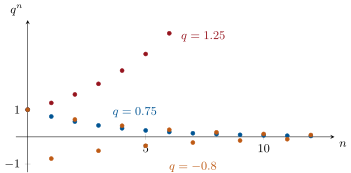
If q>1, then qn→+∞.
If q=1, then qn→1.
If ∣q∣<1, then qn→0.
If q≤−1, then (qn) diverges and has no limit.
Proof.1. Write q=1+a with a>0. Bernoulli’s inequality (Example 20.2) gives qn≥1+na→+∞, and we conclude by comparison (Theorem 20.16).
2. Immediate.
3. If q=0 the claim is clear. Otherwise ∣q∣<1 gives 1/∣q∣>1, so (1/∣q∣)n→+∞ by point 1, hence ∣q∣n→0, and −∣q∣n≤qn≤∣q∣n allows us to conclude by the squeeze theorem.
4. For q≤−1, (q2n) takes values ≥1 while (q2n+1) takes values ≤−1: no single limit can attract both subsequences. ∎
The three behaviours of (qn): divergence to +∞ for q>1 (red), convergence to 0 for ∣q∣<1 (blue), and damped oscillation — still convergence to 0 — for −1<q<0 (orange).
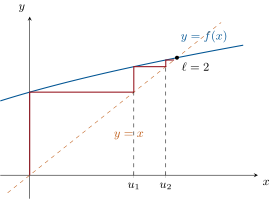
prove by induction that (un) stays in an intervalI on which f is well behaved (and, often, that (un) is monotonic);
deduce convergence from the monotone convergence theorem;
pass to the limit in the relation un+1=f(un): if f is continuous and un→ℓ∈I, then ℓ satisfies f(ℓ)=ℓ (see Chapter 21); solve this equation and select the right root.
Staircase construction for un+1=un+2, u0=0 (Exercise 20.6): each vertical step reads f(un) on the curve, each horizontal step carries it back through y=x. The sequence climbs to the fixed pointℓ=2, where the curve meets the line.
Example 20.22
Let u0=2 and un+1=21(un+un2). One checks by induction that un≥2 for all n (the inequality 21(x+2/x)≥2 for x>0 is equivalent to (x−2)2≥0), then that (un) is decreasing, since
un+1−un=2un2−un2≤0.
Decreasing and bounded below, (un)converges to some ℓ≥2, which must satisfy ℓ=21(ℓ+2/ℓ), i.e. ℓ2=2. Hence un→2. This is Heron’s algorithm, already used by the Babylonians; its convergence is extremely fast (u3 already gives 2 to eight decimal places).
20.5 Exercises
Exercise 20.1★
Prove by induction that for all n∈N,
12+22+⋯+n2=6n(n+1)(2n+1).
Solution
Solution of Exercise 20.1.
Let P(n) be the statement ∑k=1nk2=6n(n+1)(2n+1). Base case: for n=0 both sides are 0 (empty sum). Inductive step: assume P(n). Then
Since 2n2+7n+6=(n+2)(2n+3), this is 6(n+1)(n+2)(2(n+1)+1), which is P(n+1). By induction, P(n) holds for all n.
Exercise 20.2★
Study the monotonicity of the sequences defined for n≥1 by
an=nn+1,bn=n2n,cn=n2−10n.
Solution
Solution of Exercise 20.2.
an+1−an=n+1n+2−nn+1=n(n+1)n(n+2)−(n+1)2=n(n+1)−1<0: (an) is strictly decreasing.
(bn) has positive terms and bnbn+1=n+12n+1⋅2nn=n+12n≥1⟺2n≥n+1⟺n≥1: (bn) is increasing (strictly for n≥2).
cn+1−cn=(n+1)2−10(n+1)−n2+10n=2n−9, which is negative for n≤4 and positive for n≥5: (cn) decreases up to c5=−25, its minimum, then increases. It is not monotonic.
Exercise 20.3★
Compute the limits of the sequences with general terms
where n!=1×2×⋯×n. For the second limit, bound nnn! by a term of a geometric sequence.
Solution
Solution of Exercise 20.5.
Since −1≤cosn≤1,
n+1n−1≤n+1n+cosn≤1,
and n+1n−1→1, so the limit is 1 by the squeeze theorem.
For the second limit, write
0≤nnn!=n1⋅n2⋯nn≤n1,
because every factor nk with 2≤k≤n is at most 1. Since n1→0, the squeeze theorem gives nnn!→0. (The suggested geometric bound also works: each factor with k≤n/2 is at most 21, giving the stronger bound (1/2)⌊n/2⌋.)
Deduce that (un)converges and determine its limit.
Solution
Solution of Exercise 20.6.
1.u0=0∈[0,2]. If 0≤un≤2, then 2≤un+2≤4, so 2≤un+1≤2; in particular 0≤un+1≤2. By induction the property holds for all n.
2.un+1−un=un+2−un. For x∈[0,2], x+2≥x⟺x+2≥x2⟺(2−x)(x+1)≥0, which is true. Hence (un) is increasing.
3.Increasing and bounded above by 2, (un)converges to some ℓ∈[0,2]. Passing to the limit in un+1=un+2 (the map x↦x+2 is continuous) gives ℓ=ℓ+2, so ℓ2−ℓ−2=0, i.e. ℓ∈{−1,2}. Since ℓ≥0, limun=2.
Exercise 20.7★★
A patient takes a dose of 1 unit of a drug every morning. During each 24-hour period, the body eliminates 40% of the drug present. Let un be the quantity of drug in the body just after the dose on day n, so that u0=1.
Justify that un+1=0.6un+1.
Let vn=un−2.5. Show that (vn) is geometric and deduce an explicit formula for un.
Determine the long-term quantity of drug in the body.
Solution
Solution of Exercise 20.7.
1. Between two doses, 40% of the drug is eliminated, so the quantity un becomes 0.6un; the next dose adds 1 unit: un+1=0.6un+1.
2.vn+1=un+1−2.5=0.6un+1−2.5=0.6(un−2.5)=0.6vn: (vn) is geometric with ratio 0.6 and first term v0=1−2.5=−1.5. Hence vn=−1.5×0.6n and
un=2.5−1.5×0.6n.
3. Since 0.6n→0, un→2.5: the quantity of drug stabilizes at 2.5 units.
Exercise 20.8★★
Let (un) be defined by u0=3 and un+1=un+24un−1.
Show that for all n, an≤bn. (Hint: study the monotonicity of (bn−an).)
Show that adjacent sequences both converge, to the same limit.
Application: show that the sequencesan=∑k=0nk!1 and bn=an+n⋅n!1 (n≥1) are adjacent. (Their common limit is the number e, studied in Chapter 23.)
Solution
Solution of Exercise 20.10.
1. The sequencedn=bn−an satisfies dn+1−dn=(bn+1−bn)−(an+1−an)≤0, so (dn) is decreasing; since dn→0, we get dn≥0 for all n (a decreasingsequence with a negative term would stay below it forever, preventing the limit 0). Hence an≤bn.
so (bn) is decreasing. Finally bn−an=nn!1→0. The two sequences are adjacent, hence converge to a common limit.
20.6 Problem: Heron’s sequence, judged at last
Problem 20.1
Weekend problem — induction certifies, monotone convergence sentences, and the two-thousand-year-old recipe for 2 finally gets its proof (with Gauss’s marvellous mean for dessert)
Three times this series has met Heron’s recipe — average the guess with 2/guess — and three times it could only observe that the recipe works. This chapter at last owns the instruments of judgment: induction (Theorem 20.1), the monotone convergence theorem (Theorem 20.18), and limits of recurrences. The verdict, and the certified speed, occupy the heart of this problem; around it, induction’s classic traps, the slowest divergence in mathematics, and the fastest convergence Gauss ever found.
Part I — Induction warm-ups.
Prove by induction: 1+3+5+⋯+(2n−1)=n2 (the staircase of odd numbers, drawn in the Middle School volume, now certified).
Prove by induction that 2n>n for every n∈N.
Prove Bernoulli’s inequality by induction: for x≥0 and n∈N, (1+x)n≥1+nx.
The classic trap: “all marbles have the same color — true for one marble; and if any n marbles are always monochrome, then among n+1 marbles the first n share a color, the last n share a color, so all n+1 do.” Every child knows the conclusion is absurd: find the exact step where the induction breaks.
Prove by induction that 4n−1 is divisible by 3 for every n∈N.
Part II — The trial of Heron. Let x0=2 and xn+1=21(xn+xn2).
Compute x1, x2, x3 as exact fractions (old friends).
Prove the key identity
xn+12−2=(2xnxn2−2)2≥0,
and deduce by induction that xn>0 and xn2>2 for every n.
Show that (xn) is strictly decreasing (compute xn+1−xn and use question 7).
Invoke the monotone convergence theorem: why does (xn) converge to some limit L≥1?
Identify the limit: pass the recurrence to the limit (Proposition 20.14) and conclude L=2. State the historical verdict: after two thousand years of faithful service, Heron’s recipe is proved to converge.
The certified speed: with en=xn−2, prove
en+1=2xnen2,
and deduce en+1≤22en2: the error is squared at each step — the digit-doubling observed since the Middle School volume, now a theorem.
Confirm numerically: compute e0,e1,e2,e3 (from question 6) and check that each en2en+1 is close to 2xn1.
Part III — The slowest divergence.
Exercise 20.9 proved H2k≥1+2k for the harmonic sums. How many terms guarantee Hn>10? (A power of two will do; marvel at its size.)
By contrast, the geometric sums 1+21+41+⋯+2n1=2−2n1 converge to 2 (Theorem 20.20): the chocolate-bar intuition of the Middle School volume, finally a limit statement. Write out the two-line proof.
Between the two: show that the sums Sn=1+41+91+⋯+n21 converge, by bounding k21≤k(k−1)1=k−11−k1 (for k≥2), telescoping, and applying monotone convergence. (The limit, 6π2, is one of Euler’s miracles, proved in the university volumes.)
State the moral of questions 13–15 in two sentences: what does “the terms tend to 0” decide about the convergence of the sums — and what does it not?
Part IV — Gauss’s arithmetic–geometric mean. Let a0=1, b0=2, and
an+1=anbn,bn+1=2an+bn.
Compute a1,b1,a2,b2 (five decimals). What do you observe about the speed?
Show that an≤bn for every n (the arithmetic–geometric inequality, met throughout this series), that (an) increases and (bn) decreases.
Show that bn+1−an+1≤2bn−an (factor bn+1−an+1=2(bn−an)2 and compare), and conclude with Exercise 20.10 that the two sequences are adjacent: they share a common limit M(1,2), the arithmetic–geometric mean.
Compute M(1,2) to six decimals (how many iterations did you need?). On 30 May 1799, Gauss computed M(1,2) to eleven decimals, recognized M(1,2)π as a known integral, and wrote that a “new field of analysis” had opened — it had: elliptic integrals, told in the university volumes. Close with the observed convergence speeds of this problem, slowest to fastest.
Solution
Solution of Problem 20.1.
1. True for n=1 (1=12). If 1+3+⋯+(2n−1)=n2, then adding the next odd number: n2+(2n+1)=(n+1)2: heredity. By induction, true for all n≥1.
2.20=1>0. If 2n>n, then 2n+1=2⋅2n>2n≥n+1 for n≥1 (and n=0 checks directly): heredity, done.
3.n=0: 1≥1. If (1+x)n≥1+nx, multiply by 1+x≥1>0: (1+x)n+1≥(1+nx)(1+x)=1+(n+1)x+nx2≥1+(n+1)x.
4. The step from n=1 to n=2: among two marbles, “the first n” and “the last n” are two disjoint single marbles — no common marble bridges the two groups, so nothing forces their colors to agree. The heredity argument silently requires the two groups to overlap, true only from n≥2; with the base case n=1 the chain never starts.
5.40−1=0=3×0. If 4n−1=3k, then 4n+1−1=4(4n−1)+3=3(4k+1): heredity.
6.x1=23, x2=1217, x3=408577.
7.xn+12−2=4xn2(xn2+2)2−8xn2=4xn2(xn2−2)2: a square over a positive, hence ≥0, and >0 whenever xn2=2. Induction: x0=2>0 with x02=4>2; if xn>0 and xn2>2, then xn+1 (an average of positives) is positive and xn+12−2>0.
8.xn+1−xn=2xn2−xn2<0 by question 7: strictly decreasing.
9.Decreasing and bounded below (by 1, since xn2>2>1 and xn>0): by the monotone convergence theorem, (xn)converges to some L≥1.
10. Limits respect the algebra: from xn+1=21(xn+xn2) and xn→L≥1>0: L=21(L+L2), so L2=2 and, L being positive, L=2. Verdict: convergence proved, limit identified — Heron acquitted with honors.
11.xn+1−2=2xnxn2−22xn+2=2xn(xn−2)2: exactly en+1=2xnen2, and xn>2 gives en+1≤22en2. Squared error: each step doubles the number of correct decimals, as observed since grade 9.
12.e0≈0.5858, e1≈0.0858, e2≈0.00245, e3≈2.1×10⁻⁶. Ratios e02e1≈0.25=2x01; e12e2≈0.333=2x11; e22e3≈0.353≈2x21: the theorem in action.
13.H218≥1+9=10: about 260000 terms (218=262144) merely to pass 10 — divergence at a crawl (and Hn>100 would need more terms than atoms in any library).
14.Sn=2−2n1 (geometric sum), and 2n1→0 (Theorem 20.20), so Sn→2: the endlessly bitten chocolate bar tends to, without ever reaching, the whole — now in the official language of limits.
15. For k≥2: k21≤k(k−1)1=k−11−k1, so Sn≤1+(1−n1)<2: increasing and bounded above, hence convergent (monotone convergence). Euler later named the limit: 6π2.
16. Terms tending to 0 is necessary for the sums to settle but decides nothing: the harmonic terms n1→0 yet the sums blow up; the terms n21→0 and the sums converge. How fast the terms die is the whole question — the theory of series, built in the university volumes.
17.a1=2≈1.41421, b1=1.5; a2≈1.45648, b2≈1.45711: two iterations already agree to three decimals — staggering speed.
18.bn+1−an+1=2an+bn−anbn=2(bn−an)2≥0: means stay ordered. (an) increases: an+1=anbn≥an⋅an=an; (bn) decreases symmetrically.
19.bn−anbn+1−an+1=2(bn−an)(bn+an)(bn−an)2=2(bn+an)bn−an≤21: the gap at least halves, so bn−an→0; with question 18, the sequences are adjacent and share a limit M(1,2).
20. Iteration three gives a3≈b3≈1.456791: M(1,2)≈1.456791 in three turns of the crank (the gap roughly squares, like Heron’s). Speed ranking of the problem’s sequences, slowest to fastest: the harmonic sums (glacial divergence), the geometric sums (error halved each step), Heron and the AGM (error squared each step) — and it was the AGM’s unearthly speed that told Gauss he had struck a new vein of analysis.
Every nonempty subset of N has a smallest element; this property of N is taken as an axiom. ↩
![Convergence of u_n = 2 + (-1)n/n to = 2: given > 0, all terms from the index N on lie in the band [ - , + ].](/images/onecourse/chapters/math-2/g12-seq/fig-8991cce01fa0.svg)