সব বই

পেশাদার

1 Markets I: The Ecosystem and Exchange-Traded Marketsবাজার অনলাইন 2 Markets II: Rates, FX and Creditবাজার অনলাইন 3 Markets III: Commodities, Energy and Cryptoবাজার অনলাইন 4 Quantitative Methodsপদ্ধতি অনলাইন 5 Derivatives and Volatilityডেরিভেটিভস অনলাইন 6 Rates, Credit, XVA and Riskসুদহার, ঋণ ও ঝুঁকি অনলাইন 7 Research Craft: Predictors, Backtests, Measurement, Portfoliosগবেষণা অনলাইন 8 Strategies I: Equities and Futuresকৌশল অনলাইন 9 Strategies II: Volatility, Relative Value, Macro and the Bank Desksকৌশল অনলাইন 10 Microstructure and Executionএক্সিকিউশন অনলাইন 11 Market Making and High-Frequency Tradingমার্কেট মেকিং অনলাইন 12 Machine Learning for Marketsমেশিন লার্নিং অনলাইন 13 Low-Latency Softwareপ্রযুক্তি অনলাইন 14 Networks, Hardware and Trading Infrastructureপ্রযুক্তি অনলাইন 15 Research, Data and Risk Platformsপ্রযুক্তি অনলাইন 16 The Desk and the Firmপ্রতিষ্ঠান অনলাইন 17 The Industry: Firms, Roles and Careersক্যারিয়ার অনলাইন 18 Interviews I: Maths, Probability and Speedক্যারিয়ার অনলাইন 19 Interviews II: Markets, Trading Games and the Final Roundক্যারিয়ার অনলাইন 20 Interviews III: Codeক্যারিয়ার অনলাইন
অ্যাপ পরিচিতি Coach সাইন ইন পড়া শুরু করো

বইগুলো এখনো বাংলা ভাষায় পাওয়া যায় না — ইংরেজি সংস্করণ দেখানো হচ্ছে।

Mathematics · পরিভাষা

cosh⁡, sinh⁡, tanh⁡ কী?

অন্য নাম: hyperbolic functions

Definition 4.17 University Mathematics — Year 1 · অধ্যায় 4 — Standard Functions

For x∈Rx \in \R:

cosh⁡x=ex+e−x2,sinh⁡x=ex−e−x2,tanh⁡x=sinh⁡xcosh⁡x\cosh x = \frac{\eu^x + \eu^{-x}}{2}, \qquad \sinh x = \frac{\eu^x - \eu^{-x}}{2}, \qquad \tanh x = \frac{\sinh x}{\cosh x}

(hyperbolic cosine, sine, tangent). cosh⁡\cosh is even, sinh⁡\sinh and tanh⁡\tanh are odd.

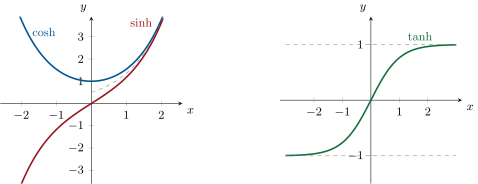
Left:  and , asymptotically glued to x/2 (dashed). Right: , increasing from -1 to 1.
Left: cosh⁡\cosh and sinh⁡\sinh, asymptotically glued to ex2\frac{\eu^x}{2} (dashed). Right: tanh⁡\tanh, increasing from −1-1 to 11.

উদাহরণ

Example 4.20 (The addition formula for tanh⁡\tanh)

Dividing the two addition formulas of Proposition 4.18 (3) by cosh⁡xcosh⁡y\cosh x\cosh y:

tanh⁡(x+y)=sinh⁡xcosh⁡y+cosh⁡xsinh⁡ycosh⁡xcosh⁡y+sinh⁡xsinh⁡y=tanh⁡x+tanh⁡y1+tanh⁡x tanh⁡y,\tanh(x + y) = \frac{\sinh x\cosh y + \cosh x\sinh y} {\cosh x\cosh y + \sinh x\sinh y} = \frac{\tanh x + \tanh y}{1 + \tanh x\,\tanh y} ,

the hyperbolic sibling of the tangent addition formula — with a ++ where trigonometry has a −-. A dividend: since ∣tanh⁡∣<1\abs{\tanh} < 1, the right-hand side is a “velocity addition” rule that never leaves (−1, 1)\intoo{-1}1: if u,v∈(−1, 1)u, v \in \intoo{-1}1 then u+v1+uv∈(−1, 1)\frac{u + v}{1 + uv} \in \intoo{-1}1 as well (write u=tanh⁡au = \tanh a, v=tanh⁡bv = \tanh b, possible by bijectivity, and read the formula backwards). Checking that algebraically, without hyperbolic functions, is a slightly painful exercise; parametrizing by tanh⁡\tanh makes it one line — the same strategy that circular functions provide for the unit circle.

Example 4.22 (Closed forms at work)

The solution of cosh⁡t=2\cosh t = 2 with t≥0t \geq 0 is, by the closed form, t=arcosh⁡2=ln⁡(2+3)≈1.317t = \operatorname{arcosh} 2 = \ln(2 + \sqrt3) \approx 1.317; the other solution is −t-t, by evenness — and indeed ln⁡(2−3)=ln⁡12+3=−ln⁡(2+3)\ln(2 - \sqrt3) = \ln\frac1{2 + \sqrt3} = -\ln(2 + \sqrt3): the two roots u=etu = \eu^t of the quadratic u2−4u+1=0u^2 - 4u + 1 = 0 are reciprocals, as their product 11 (Vieta) demands. This tiny computation displays the general pattern: hyperbolic equations convert to quadratics in et\eu^t, and the symmetry t↦−tt \mapsto -t appears as the symmetry u↦1/uu \mapsto 1/u of the quadratic — worth remembering when solving Exercise 4.7.

প্রসঙ্গসহ পড়ো →