
Mathematics · Glossary

What is Equivalent norms?

Definition 5.3 University Mathematics — Year 2 · Chapter 5 — Normed Vector Spaces

Two norms N1,N2N_1, N_2 on EE are equivalent when there are constants c,C>0c, C > 0 with

cN1N2CN1.c\,N_1 \leq N_2 \leq C\, N_1 .

Equivalent norms have the same open sets, the same convergent and Cauchy sequences, the same compact and complete subsets: the same analysis.
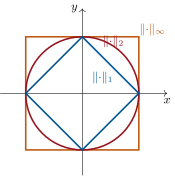
The unit balls of the three classical norms of ℝ2, nested as the inequalities of  dictate: smaller ball, larger norm. Roundness matters: the flat sides of the diamond and the square are exactly the failures of strict convexity exploited in ’s weekend problem and in this chapter’s (question 4).
The unit balls of the three classical norms of R2\R^2, nested as the inequalities of Example 5.5 dictate: smaller ball, larger norm. Roundness matters: the flat sides of the diamond and the square are exactly the failures of strict convexity exploited in Chapter 8’s weekend problem and in this chapter’s (question 4).

Examples

Example 5.4 (Non-equivalence in infinite dimension)

On C([0,1])C(\intcc{0}{1}): f1f\norm f_1 \leq \norm f_\infty always, but no reverse bound holds: fn(x)=xnf_n(x) = x^n has fn=1\norm{f_n}_\infty = 1 and fn1=1n+10\norm{f_n}_1 = \frac{1}{n+1} \to 0. So fn0f_n \to 0 for 1\norm\cdot_1 but not for \norm\cdot_\infty: the two norms disagree about convergence itself.

Example 5.5 (Explicit constants in dimension nn)

On KnK^n the three classical norms are equivalent with sharp constants:

xx2x1nx2nx,\norm x_\infty \leq \norm x_2 \leq \norm x_1 \leq \sqrt n\,\norm x_2 \leq n\,\norm x_\infty ,

the middle bound x1nx2\norm x_1 \leq \sqrt n\norm x_2 coming from Cauchy–Schwarz against the all-ones vector. Extremal vectors: e1e_1 makes the first two inequalities equalities, (1,1,,1)(1, 1, \dots, 1) the last two. The dimension nn sits visibly in the constants — the quantitative seed of the failure in infinite dimension: as nn \to \infty no uniform constant survives, which is exactly what Example 5.4 exhibits on function spaces.

Read in context →