University Mathematics — Year 2 · Bachelor Year 2
5Normed Vector Spaces
When the metric space is a vector space and the distance comes from a norm, topology and linear algebra begin to interact: linear maps are continuous exactly when they are bounded on the unit ball, finite dimension forces all norms to agree, and completeness turns absolutely convergent series into convergent ones. The finite/infinite dimension divide — crystallized in Riesz’s theorem — is the deepest lesson of the chapter.
Throughout, are vector spaces over or .
5.1 Norms
Definition 5.1
A norm on is a map with, for all , :
Then is a distance, and all of Chapter 4 applies. The reverse triangle inequality makes the norm itself -Lipschitz; addition and scalar multiplication are continuous (estimates , etc.).
Example 5.2
On :
( is a norm by Cauchy–Schwarz, Year 1 volume). On :
the last two being norms thanks to strict positivity of the integral and integral Cauchy–Schwarz (Year 1 volume). On matrices: any norm on ; the operator norms below are the structurally important ones.
Definition 5.3 (Equivalent norms)
Two norms on are equivalent when there are constants with
Equivalent norms have the same open sets, the same convergent and Cauchy sequences, the same compact and complete subsets: the same analysis.
Example 5.4 (Non-equivalence in infinite dimension)
On : always, but no reverse bound holds: has and . So for but not for : the two norms disagree about convergence itself.
Example 5.5 (Explicit constants in dimension )
On the three classical norms are equivalent with sharp constants:
the middle bound coming from Cauchy–Schwarz against the all-ones vector. Extremal vectors: makes the first two inequalities equalities, the last two. The dimension sits visibly in the constants — the quantitative seed of the failure in infinite dimension: as no uniform constant survives, which is exactly what Example 5.4 exhibits on function spaces.
5.2 Continuous linear maps
Theorem 5.6 (Characterization)
For a linear map between normed spaces, the following are equivalent:
- is continuous;
- is continuous at ;
- is bounded on the closed unit ball: ;
- there is with for all ;
- is Lipschitz.
The least such is the operator norm ; it makes the space of continuous linear maps a normed space, with
Proof. (1 2) trivial. (2 3): continuity at with gives with ; homogeneity then scales any with down into that ball and back:
since . (3 4): for , apply the bound to . (4 5): . (5 1) known.
Norm axioms for : homogeneity and separation are clear ( forces on the ball, hence everywhere); triangle inequality from . Submultiplicativity: . ∎
Example 5.7
On : evaluation has operator norm ; integration has norm ; the map has norm (upper bound by the triangle inequality for integrals; attained at ). But differentiation, from to , is not continuous: while the derivative has sup norm . Linear does not imply continuous in infinite dimension.
Example 5.8 (Two norms, two verdicts on one sequence)
On , let . Then
one sequence, three norms, three behaviours — convergence to zero, no convergence (norms stabilize at but the pointwise limit is ), and explosion. Mass concentrating near is invisible to , half-visible to , dominant for . In infinite dimension, “does it converge?” is not a question about a sequence: it is a question about a sequence and a norm.
Method 5.9 (Computing an operator norm)
Always in two moves. Upper bound: estimate by using triangle inequalities, Cauchy–Schwarz, or integral bounds — this proves . Witness: exhibit either a specific with (the bound is attained), or a sequence of unit vectors with (the bound is approached). Both moves are mandatory: an upper bound alone gives only , a witness alone only . In infinite dimension the witness may have to be a sequence — the supremum need not be attained (Exercise 5.8).
Example 5.10 (Diagonal operators see every norm alike)
For on with any of the norms : from coordinatewise, ; and (a maximizing index) attains it. So in all three cases: for diagonal maps, all reasonable norms tell the same story, the largest stretch factor. Everything difficult about operator norms is about non-diagonal behaviour — which is why the adapted norms of this chapter’s weekend problem (question 22) work by forcing a matrix to become diagonal first.
Example 5.11 (Column sums: the -norm twin of Exercise 5.4)
On , the operator norm of a matrix is the largest absolute column sum. Run the method: for ,
and the bound is attained at for a maximizing column — the tidiest witness imaginable. So for : , while too (rows) — a coincidence here, not a law: transpose the matrix entries asymmetrically and the two norms part company. Rows for , columns for : the mnemonic is that each norm’s unit vectors (sign patterns, resp. basis vectors) pick out the matching sums.
Proposition 5.12 (Bilinear maps)
A bilinear map is continuous iff for some ; then it is Lipschitz on bounded sets. (Same proof pattern; the product and matrix multiplication are the key examples.)
Proof. If the bound holds:
so : continuity at , and a Lipschitz bound where . Conversely, continuity at gives with on ; scale both variables. ∎
5.3 Finite dimension
Theorem 5.13 (Equivalence of norms in finite dimension)
On a finite-dimensional space, all norms are equivalent. Consequently, in finite dimension: convergence, openness, compactness, completeness are norm-independent notions; compact closed and bounded; the space is complete; and every linear (or multilinear) map from a finite-dimensional space is continuous.
Proof. Fix a basis and identify ; it suffices to compare any norm with .
One direction is algebra: with . This also shows is continuous on (it is -Lipschitz: ).
The other is topology: the unit sphere is closed and bounded in , hence compact (Theorem 4.16 (2), valid for ). The continuous function attains its minimum on ; since vanishes only at . Homogeneity spreads the bound: for all .
Consequences: all statements reduce to , where they are known (Theorem 4.9, Theorem 4.16); a linear from finite-dimensional satisfies : bound (4) of Theorem 5.6. ∎
Corollary 5.14
A finite-dimensional subspace of any normed space is closed.
Proof. It is complete for the induced norm (Theorem 5.13), and complete subsets are closed (Definition 4.7). ∎
Example 5.15 (A best approximation computed by symmetry)
In , how far is from the (closed, two-dimensional) subspace of affine functions ? By symmetry, replacing by leaves unchanged, and the midpoint does at least as well (triangle inequality on the average): it suffices to consider constants. For a constant :
minimized at : the distance is , attained by the constant . Note the error curve : it reaches alternately at — three extrema of alternating sign for a best approximation from a two-parameter family. That equioscillation pattern is no accident; it is the signature of optimality that this chapter’s weekend problem turns into Chebyshev’s theorem.
Example 5.16 (Closed versus dense subspaces)
In : each (polynomials of degree , restricted to ) is a finite-dimensional, hence closed, subspace — a uniform limit of polynomials of degree is one. But the union of all of them is dense in (the Weierstrass approximation theorem, proved in Chapter 10), and dense proper subspaces are as non-closed as can be. The moral: closedness of subspaces is a finite-dimensional privilege; stacking closed floors can build a dense skyscraper.
Theorem 5.17 (Riesz)
The closed unit ball of a normed space is compact if and only if .
Proof. Finite dimension: closed and bounded suffices (Theorem 5.13).
Conversely, suppose . Riesz’s lemma: for every proper closed subspace and , there is a unit vector with . Proof: pick , let ( closed), choose with , and set : for any ,
the numerator being a distance from to a point of .
Now build unit vectors inductively: is finite-dimensional, hence closed (Corollary 5.14) and proper; Riesz’s lemma with provides a unit with . The sequence satisfies for : no convergent subsequence — the unit ball is not compact. ∎
Example 5.18 (Riesz as a dimension detector)
Is finite-dimensional? Riesz answers without exhibiting any explicit infinite free family: the sequence lies in the closed unit ball and satisfies, for , at suitable points — quantified cleanly in this chapter’s weekend problem (question 16), where a subsequence stays at mutual distance . No convergent subsequence, so the ball is not compact, so by Theorem 5.17. Compactness of the unit ball is a perfect dichotomy: it holds in finite dimension, fails in infinite dimension, with no middle ground — geometry alone reads off the dimension type.
5.4 Banach spaces
Definition 5.19
A Banach space is a complete normed space. Examples: every finite-dimensional normed space (Theorem 5.13); (Theorem 4.9); for Banach (same proof pattern as for continuous functions). Non-example: (Exercise 5.7).
Example 5.20 (The operator norm of integration)
On , let (an endomorphism: is continuous). Run Method 5.9. Upper bound:
so . Witness: gives and : attained, . But note : indeed has , attained again at ; and generally — the submultiplicative bound is off by a factorial. This is exactly the phenomenon the iterate trick of Chapter 4’s weekend problem converts into global solvability of linear differential equations.
Theorem 5.21 (Absolute convergence in Banach spaces)
In a Banach space, if then converges, and . (The full theory of series in normed spaces is Chapter 7.)
Proof. Partial sums : for , , which tends to (Cauchy criterion for the real series of norms): is Cauchy, hence convergent. The inequality passes to the limit from the finite triangle inequality. ∎
Example 5.22 (Matrix exponential, first contact)
The matrix exponential: with any submultiplicative norm () is Banach (finite dimension). Then, for every ,
converges absolutely (, summable): well defined. Chapter 16 exploits it systematically.
Example 5.23 (A Neumann series that terminates)
For : in any operator norm built on Example 5.2’s norms, and , so the geometric series collapses:
verified by . Nilpotency truncates the series exactly as it truncated the exponential in Chapter 3; and the example calibrates expectations: the Neumann inverse is an infinite series in general, a polynomial precisely when the perturbation is nilpotent, and the error after terms is always bounded by the geometric tail .
Example 5.24 (The exponential of a rotation generator)
Take . Then , so the powers cycle with period four, and the series splits into even and odd parts:
all rearrangements being licensed by absolute convergence. The exponential of an antisymmetric generator is a rotation — computed here purely from the series, three chapters before the differential equation (Chapter 16) explains why: is uniform circular motion. The closing insight: identities among matrix series are proved exactly like scalar ones, once a submultiplicative norm certifies absolute convergence.
Example 5.25 (Sup norm means uniform: the dictionary)
The statement is uniform convergence: one number, , bounds the error at every point simultaneously. The dictionary in action on over : pointwise, on and ; in norm, , and indeed the pointwise limit is discontinuous, hence out of reach of a -limit in (which is closed under uniform limits, Theorem 4.9). On , : — uniform convergence restored by shrinking the domain. Every convergence statement of Chapter 10 is a statement about this one norm; keeping the dictionary in mind halves that chapter.
Remark 5.26 (Common pitfalls)
(i) An operator norm depends on both chosen norms: the same matrix has given by row sums (Exercise 5.4) and a different (column sums); quoting “the” norm of a matrix without naming the underlying norms is meaningless. (ii) is an inequality, usually strict — powers can shrink much faster than the bound suggests, which is the whole point of adapted norms (this chapter’s weekend problem, question 22). (iii) “Linear implies continuous” is a finite-dimensional privilege: differentiation on polynomials is linear and unbounded (Example 5.7). (iv) Absolute convergence of only helps when the space is complete (Exercise 7.9 builds the counterexample). (v) In infinite dimension a supremum over the unit ball is a genuine supremum: do not assume it is attained (Exercise 5.8).
Remark 5.27 (Perspectives within this volume)
Three appointments are now fixed. With Chapter 7: in a Banach space, absolutely convergent series converge, so the geometric and exponential series of operators become everyday tools — inverting , defining (Example 7.2). With Chapter 10 and Chapter 11: convergence of function sequences and power series is convergence in (Example 5.25), and the radius of convergence is a statement about which geometric series dominate. With Chapter 14: the norms and genuinely disagree on (Example 5.8), which is exactly why mean-square convergence of Fourier series and uniform convergence are two different theorems with two different prices.
Remark 5.28 (Where this chapter is used)
Operator norms and the geometric series drive the perturbation arguments of Chapter 15 (inverse function theorem) and the matrix exponential of Chapter 16; equivalence of norms silently authorizes every “choose your favourite norm” argument in Chapter 10 and beyond; and the finite/infinite divide of Riesz’s theorem — made quantitative in this chapter’s weekend problem — is the reason the Year 3 volume needs new tools (weak convergence, Arzelà–Ascoli, Hilbert space projections) where this volume could still extract convergent subsequences.
5.5 Exercises
Exercise 5.1 ★
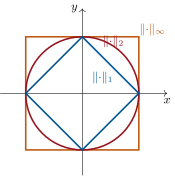
On , draw the unit balls of , , , and prove the inequalities with the best constants in dimension .
Solution
Solution of Exercise 5.1.
Unit balls: a diamond (), a disk (), a square (), nested in that order. Inequalities: (one square is at most the sum); (squaring: ); (two terms, each ). Sharpness: makes the first two equalities; makes and also shows and are the extreme ratios in the other direction.
Exercise 5.2 ★
Is a norm on ? Compare it with : one inequality holds, the other fails (exhibit).
Exercise 5.3 ★
Compute the operator norm of on , and of the shift on .
Solution
Solution of Exercise 5.3.
, with equality for : .
Shift: , equality at : (for ).
Exercise 5.4 ★★
On , prove that the operator norm of a matrix is (the largest absolute row sum). Compute it for .
Solution
Solution of Exercise 5.4.
Upper bound: for ,
so . Attained: let realize the max and take (modulus entries): then . Hence the formula. For the given matrix: row sums and : .
Exercise 5.5 ★★
Prove that is open in and that is continuous on it. Hint: for openness, if then with , and is invertible for by the geometric series (Theorem 5.21); for continuity, bound using the same series.
Solution
Solution of Exercise 5.5.
Geometric series: for , the series converges absolutely in the Banach (Theorem 5.21, ), and
by continuity of the product (Proposition 5.12), , so is invertible with inverse the sum (and ).
Openness: for invertible and : with : invertible. So a ball around stays in .
Continuity of inversion: with ,
of norm as .
Exercise 5.6 ★★
Let be a linear form on a normed space . Prove that is continuous if and only if is closed. (If is closed and , pick with and with ; deduce by a scaling argument on .)
Solution
Solution of Exercise 5.6.
Continuous closed kernel: preimage of the closed (Theorem 4.6).
Conversely, suppose closed and . Pick with ; since and the kernel is closed, some ball misses it. Now let with : the vector lies in , hence outside :
an inequality trivially true when as well: bound (4) of Theorem 5.6: continuous.
Exercise 5.7 ★★
Prove that is not complete: show that the functions , affine ramps from to over (value before, after), form a Cauchy sequence with no continuous -limit.
Solution
Solution of Exercise 5.7.
Let be on , affine up to value at , then on . For , is supported on an interval of length with values in : : Cauchy.
Suppose in with continuous. On (fixed ): for , so , and by strict positivity there — for every : on . Similarly on (the all equal there). By continuity at : , absurd. No limit exists: the space is not complete.
Exercise 5.8 ★★★
On with , consider
Prove that is a well-defined continuous linear form with , but that the supremum defining is not attained on the closed unit ball. (Upper bound: triangle inequality. Norm : build continuous with and for — the points are isolated from each other. Non-attainment: equality would force for every , incompatible with continuity of at since .)
Solution
Solution of Exercise 5.8.
Well defined and continuous: , so is a linear form with (the series converges absolutely for each ).
Norm : fix ; the points are pairwise distinct, so there is a continuous , , with for (piecewise affine interpolation, constant near ). Then
Not attained: if and , each term must contribute its maximum: for every (otherwise the strict deficit of one term cannot be compensated, all terms being ). So ; but and is continuous at , forcing the contradictory convergence of . Hence the supremum is not a maximum — impossible in finite dimension, where the closed unit ball is compact.
Exercise 5.9 ★★★
Let be a normed space in which the closed unit ball is compact. Re-derive, without quoting Theorem 5.17, that every bounded sequence has a convergent subsequence, and prove that every linear form on is continuous if and only if . (For infinite dimension, build a discontinuous form by defining it freely on a linearly independent normalized sequence and extending — admitting the existence of an algebraic complement.)
Solution
Solution of Exercise 5.9.
Bounded sequences: a bounded sequence lies in some closed ball , compact (image of the compact unit ball under the homeomorphism ): extract there.
Linear forms: if , every linear map from is continuous (Theorem 5.13). Conversely, suppose (which, by Theorem 5.17, is actually excluded by the compactness hypothesis — the point of this question is the implication between the two properties in general normed spaces): choose a normalized linearly independent sequence , complete it into an algebraic basis (admitted), and define , on the other basis vectors, extended linearly. Then with : unbounded on the unit ball, discontinuous. So “all forms continuous” forces finite dimension.
Exercise 5.10 ★★
On , prove (Cauchy–Schwarz for the first), and show with the family that neither inequality can be reversed up to a constant: the three norms are pairwise non-equivalent.
Solution
Solution of Exercise 5.10.
Cauchy–Schwarz with the constant function : . And . For :
Then and : no reverse inequalities, no pair is equivalent.
Exercise 5.11 ★★
(Distance to a hyperplane) Let be a nonzero continuous linear form on a normed space . Prove that
and check on Exercise 5.8 that the infimum need not be attained by any point of the hyperplane.
Solution
Solution of Exercise 5.11.
Lower bound for the distance: for , ; take the infimum over : .
Upper bound: we may assume . Given , pick a unit with and set : then and
Let : ; equality.
Non-attainment: take from Exercise 5.8 (, not attained) and any with . If some realized , the unit vector would satisfy : the operator norm would be attained — contradiction.
Exercise 5.12 ★★★
On (all polynomials), let and . Show that but that and are not equivalent; deduce that the identity is a continuous linear bijection whose inverse is discontinuous. Show finally that is not complete (Taylor partial sums of ). All three phenomena are impossible in finite dimension — say why.
Solution
Solution of Exercise 5.12.
is monotonicity of the sup in the domain, so the identity is -Lipschitz. For : (attained at ) while : a bound would give for all : impossible. So the norms are not equivalent and the inverse identity is a discontinuous linear bijection.
Incompleteness: let . For , : Cauchy for . If in , then pointwise on ; but a polynomial of degree cannot equal on an interval (differentiate times: the left side dies, does not). No limit in : not complete.
In finite dimension all three phenomena are impossible: all norms are equivalent, every normed space is complete, and the inverse of a linear bijection is linear from a finite-dimensional space, hence continuous (Theorem 5.13).
5.6 Problem: Best Approximation and Chebyshev’s Theorem
How well can a function be approximated by polynomials of a given degree, and which polynomial does it best? On the existence side, the answer belongs to this chapter: compactness in finite dimension makes best approximations exist. On the explicit side, one nontrivial case can be solved completely with bare hands — among all monic polynomials of degree , the one of smallest sup norm on is the (normalized) Chebyshev polynomial, of norm : Chebyshev’s extremal theorem. The problem proves both sides, then measures how badly compactness fails in infinite dimension: the unit ball of contains infinite constellations of points at mutual distance .
Problem 5.1
Weekend problem — Chebyshev’s extremal theorem and the geometry of the unit ball
Norms without subscript are sup norms on the indicated segment.
Part I — Best approximation in normed spaces.
- Let be a finite-dimensional subspace of a normed space and . Prove that the distance is attained (reduce to a closed bounded subset of and use Theorem 5.13).
- A norm is strictly convex when and imply . Show that on is strictly convex (parallelogram identity), and that and are not for .
- Prove that for a strictly convex norm, the best approximation of question 1 is unique.
- In , compute all best approximations of by the line : an interval of minimizers.
- In , show that the best approximation of by constants is unique, equal to , with distance ; compute both for on .
Part II — Chebyshev polynomials.
- Show there is exactly one polynomial with for all (recurrence from the cosine addition formula), that , and that its leading coefficient is for .
- Show on , with at the points (), and that the roots of are the points , interlacing the .
- Compute , and verify the alternation of at by direct evaluation.
For , prove
and deduce geometrically for fixed .
- Prove the composition law (check on and invoke the rigidity of polynomials).
Part III — Chebyshev’s extremal theorem. Write (monic, by question 6).
Let be monic of degree with . By evaluating at the points and counting sign changes, derive a contradiction. Conclude:
- (Equality case) Suppose with monic of degree , and let . Show for all ; show that each of the intervals contains a zero of , and that a zero shared by two consecutive intervals is an interior point where as well. Conclude that has zeros counted with multiplicity, hence : the minimizer is exactly — Chebyshev’s extremal theorem.
Restate the theorem as a distance: on ,
with unique best approximation ; and show by the affine substitution that on the distance becomes .
- (Optimal interpolation nodes) For nodes , the node polynomial is monic of degree . Deduce from question 12 which choice of nodes minimizes , the node-dependent factor of the classical interpolation error bound, and give the minimal value.
- Verify the case of the theorem by hand (find directly), and compute numerically the distance of question 13 on for . What does its size say about the graph of ?
Part IV — The unit ball of .
- Let . Show and for (evaluate at the point where ): an explicit bounded sequence with no convergent subsequence — the closed unit ball is not compact, by bare hands.
- (Riesz’s lemma, sharpened) Let be a finite-dimensional proper subspace of a normed space . Using question 1, produce a unit vector with exactly — not just as in Theorem 5.17’s lemma.
- Deduce: in every infinite-dimensional normed space there is a sequence of unit vectors with pairwise distances , and re-derive Riesz’s theorem from it.
- In , exhibit such a constellation explicitly: the tent functions supported on with peak value . Verify , for , and note that pointwise but not uniformly.
- (Total boundedness fails) Show that the closed unit ball of cannot be covered by finitely many balls of radius (each such ball contains at most one ) — contrast with the total-boundedness step in the proof of Theorem 4.20.
Part V — Norms at work on matrices, and synthesis.
- Prove that every eigenvalue of satisfies for every operator norm; apply Exercise 5.4 to bound the eigenvalues of and compare with their true modulus.
- (Adapted norms) Let be diagonalizable, . Show is a norm whose operator norm satisfies .
- Deduce: for diagonalizable , if and only if all eigenvalues satisfy — equivalence of norms makes the conclusion norm-independent. Check on .
- (Equivalence constants blow up) On , compare (coefficients) and : both are norms, so they are equivalent for each fixed ; but show, using the monic minimizer of question 13 on , that the best constant in satisfies . Conclude in one sentence why “all norms are equivalent” dies in infinite dimension.
- (Synthesis) One sentence each: where compactness of finite-dimensional balls worked (questions 1, 12); what strict convexity governs; what the constellation of questions 18–19 destroys; and how question 24 quantifies the failure. Name the summit (Chebyshev’s extremal theorem) and state where best approximation finds its modern home (the projection theorem on Hilbert spaces, Year 3 volume, where completeness replaces compactness).
Solution
Solution of Problem 5.1.
1. The candidates worth considering form : nonempty (), closed (preimage of a closed interval under the continuous , intersected with the closed , Corollary 5.14), bounded (). In the finite-dimensional , closed and bounded means compact (Theorem 5.13); the continuous function attains on its infimum, which equals the infimum over all of (any gives ).
2. Parallelogram identity in : (expand the squares of sums of coordinates). For unit :
Not strictly convex: for , take , : unit vectors with midpoint of norm ; for , take , : midpoint of norm .
3. Let . If : and the only minimizer is . If and both minimize: and are distinct unit vectors, so
with : contradicts the definition of . Unique minimizer.
4. , with equality iff : the minimizers form the segment , all at distance — uniqueness fails exactly because the square ball has flat sides (question 2).
5. Let , (attained: compactness). For any constant : , the last inequality because the two quantities average to ; equality in both forces , i.e. . Conversely . Unique best constant. For on : , distance .
6. From : the polynomials defined by , , satisfy by induction. Uniqueness: two polynomials agreeing on (infinitely many points) are equal. Induction again: with leading coefficient for (: coefficient ; the recurrence doubles it).
7. Every is , and . At : , and . Roots: iff : the distinct points , and since , each root lies strictly between two consecutive extrema.
8. , , . For : , , , : perfect alternation.
9. Let for : the roots of , with . The sequence satisfies (Newton-type recurrence from the quadratic), , : the same recurrence and initial values as , so for all . Since with for : and . (For use the parity , clear from the recurrence.)
10. For every : . The polynomials and agree on , hence are equal.
11. has degree (the monic leading terms cancel). At the extrema: by hypothesis. So takes nonzero values of alternating signs at the decreasing points : by the intermediate value theorem it has at least distinct roots, one in each open interval . A nonzero polynomial of degree cannot have roots; and contradicts the strict signs. Contradiction: for every monic of degree .
12. Now since . On each () the endpoint values of have opposite weak signs: the intermediate value theorem yields a zero in the closed interval. If the can be chosen pairwise distinct, of degree has roots: contradiction. Two consecutive intervals can only share the zero with (interior). There, means , an extremal value of on attained at an interior point: ; and is an interior extremum of too: . Hence : is a root of multiplicity , compensating the shared interval. In all cases has at least roots counted with multiplicity, degree , so : . Chebyshev’s extremal theorem is proved: the unique monic minimizer is , of sup norm .
13. Monic polynomials of degree are exactly the with , so
uniquely at . Substitution : if is monic of degree on , then is monic on with sup equal to : hence , with equality exactly for : on the distance is .
14. is monic of degree , so with equality iff , i.e. iff the nodes are the roots of : — the Chebyshev nodes. Minimal value: . Equidistant nodes are strictly worse; the interpolation error factor is minimized by clustering nodes near the endpoints.
15. by hand: ranges over , so , minimized at : minimal monic quadratic , value . For on : . Some polynomial of degree stays within two millionths of on the whole of : at this scale the two graphs are indistinguishable — the flatness of near lets lower degrees do all the work.
16. . For set , , and evaluate at (so ):
So for all : no subsequence is Cauchy, none converges. The closed unit ball of is not compact.
17. is closed (Corollary 5.14) and proper: pick , so . By question 1 the distance is attained at some . Set , a unit vector (). For every :
since . Hence ; and : exactly .
18. In an infinite-dimensional , build unit vectors inductively: arbitrary; given , the subspace is finite-dimensional, hence proper, and question 17 gives a unit with : in particular for . The sequence has pairwise distances : the unit ball contains a sequence with no convergent subsequence, hence is not compact — Riesz’s theorem, with the sharp constant .
19. Let be affine on each half of , from up to at the midpoint and back to , and zero elsewhere: continuous, . For the supports meet at most at a common endpoint, where both vanish; at the peak of , : exactly. For fixed : as soon as , and always: pointwise; but : not uniformly. An explicit constellation at mutual distance inside the unit ball.
20. A ball of radius has diameter , so it contains at most one of the (two are at distance ). Finitely many such balls contain finitely many of the infinitely many : they cannot cover the unit ball. Total boundedness — which compact metric spaces enjoy, by the proof of Theorem 4.20 — fails as badly as possible.
21. If with : , so . For : (Exercise 5.4), so every eigenvalue has modulus ; in fact gives of modulus : the bound is valid, not sharp.
22. is a norm: forces , so ; homogeneity and triangle inequality are inherited from through the linear . Operator norm: with and ,
so is the -operator norm of , which is its largest absolute row sum (Exercise 5.4): .
23. If all : with , so for every , and in any norm on (all equivalent in finite dimension, Theorem 5.13; convergence of for each is entrywise convergence). If some with eigenvector : . For : eigenvalues , both of modulus : .
24. Both are norms on the finite-dimensional , hence equivalent for each . Take the minimal monic of question 13 on : its coefficient of is , so , while . Hence
The equivalence constants explode with the dimension: on the union no single constant serves, which is exactly the non-equivalence seen in Exercise 5.12 — “all norms are equivalent” is a theorem about one dimension at a time, and infinite dimension is where it dies.
25. Compactness of closed bounded sets in finite dimension produced existence of best approximations (question 1) and powered the zero-counting at the extremal points (questions 11–12, via attained sups). Strict convexity governs uniqueness of best approximation — round balls give one minimizer, flat-sided balls give segments of them (questions 2–4). The constellation of unit vectors at mutual distance (questions 17–19) destroys compactness of the unit ball and total boundedness with it (question 20). Question 24 quantifies the collapse: the constants relating two norms on grow like , so no uniform comparison survives the passage to . The summit is Chebyshev’s extremal theorem (questions 11–12): the unique monic minimizer . Best approximation finds its modern home in Hilbert spaces, where the projection theorem replaces compactness by completeness plus the parallelogram identity — proved honestly in the Year 3 volume.