
সব বই

পেশাদার

1 Markets I: The Ecosystem and Exchange-Traded Marketsবাজার অনলাইন 2 Markets II: Rates, FX and Creditবাজার অনলাইন 3 Markets III: Commodities, Energy and Cryptoবাজার অনলাইন 4 Quantitative Methodsপদ্ধতি অনলাইন 5 Derivatives and Volatilityডেরিভেটিভস অনলাইন 6 Rates, Credit, XVA and Riskসুদহার, ঋণ ও ঝুঁকি অনলাইন 7 Research Craft: Predictors, Backtests, Measurement, Portfoliosগবেষণা অনলাইন 8 Strategies I: Equities and Futuresকৌশল অনলাইন 9 Strategies II: Volatility, Relative Value, Macro and the Bank Desksকৌশল অনলাইন 10 Microstructure and Executionএক্সিকিউশন অনলাইন 11 Market Making and High-Frequency Tradingমার্কেট মেকিং অনলাইন 12 Machine Learning for Marketsমেশিন লার্নিং অনলাইন 13 Low-Latency Softwareপ্রযুক্তি অনলাইন 14 Networks, Hardware and Trading Infrastructureপ্রযুক্তি অনলাইন 15 Research, Data and Risk Platformsপ্রযুক্তি অনলাইন 16 The Desk and the Firmপ্রতিষ্ঠান অনলাইন 17 The Industry: Firms, Roles and Careersক্যারিয়ার অনলাইন 18 Interviews I: Maths, Probability and Speedক্যারিয়ার অনলাইন 19 Interviews II: Markets, Trading Games and the Final Roundক্যারিয়ার অনলাইন 20 Interviews III: Codeক্যারিয়ার অনলাইন
অ্যাপ পরিচিতি Coach সাইন ইন পড়া শুরু করো

বইগুলো এখনো বাংলা ভাষায় পাওয়া যায় না — ইংরেজি সংস্করণ দেখানো হচ্ছে।

Mathematics · পরিভাষা

Euclidean domain কী?

অন্য নাম: principal ideal domain · unique factorization domain

Definition 2.13 University Mathematics — Year 3 · অধ্যায় 2 — Rings and Arithmetic

An integral domain AA is:

  • Euclidean if there is a map ν ⁣:A∖{0}→N\nu \colon A \setminus \{0\} \to \N (a Euclidean function) such that for all a,ba, b with b≠0b \ne 0 there exist q,rq, r with a=bq+ra = bq + r and (r=0r = 0 or ν(r)<ν(b)\nu(r) < \nu(b));
  • principal (a PID) if every ideal is of the form (a)(a);
  • factorial (a UFD) if every nonzero nonunit is a product of irreducibles, uniquely up to order and associates.
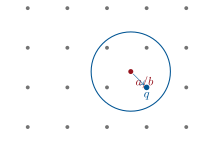
Division in the Gaussian integers: the exact quotient a/b ∈ ℂ lies within distance ≤ √2/2 < 1 of some lattice point q ∈ ℤ[ ]; then r = a - bq has N(r) = N(b)\,|a/b - q|2 < N(b). One Euclidean division, hence a whole arithmetic.
Division in the Gaussian integers: the exact quotient a/b∈Ca/b \in \C lies within distance ≤22<1\leq \frac{\sqrt2}{2} < 1 of some lattice point q∈Z[i]q \in \Z[\iu]; then r=a−bqr = a - bq has N(r)=N(b) ∣a/b−q∣2<N(b)N(r) = N(b)\,\abs{a/b - q}^2 < N(b). One Euclidean division, hence a whole arithmetic.

উদাহরণ

Example 2.15

Z\Z (with ν=∣⋅∣\nu = \abs\cdot) and K[X]K[X] (with ν=deg⁡\nu = \deg) are Euclidean — the Year 2 volume proved both divisions. So is Z[i]\Z[\iu], with ν=N\nu = N the square norm (Exercise 2.4); the geometry of the proof is in the figure below. A PID that is not Euclidean exists but is delicate to certify (the standard example is Z[1+i192]\Z\bigl[\frac{1+\iu\sqrt{19}}2\bigr]); a UFD that is not a PID is easy: K[X,Y]K[X, Y] (Exercise 2.6), or Z[X]\Z[X].

Example 2.20 (A ring without unique factorization)

None of the implications Euclidean ⇒\Rightarrow PID ⇒\Rightarrow UFD is an equivalence, and the failure of the last is worth seeing once in complete detail. In

A=Z[i5]={a+ib5:a,b∈Z},N(a+ib5)=a2+5b2,A = \Z[\iu\sqrt5] = \{a + \iu b\sqrt5 : a, b \in \Z\}, \qquad N(a + \iu b\sqrt5) = a^2 + 5b^2,

the norm is multiplicative and N(z)=1N(z) = 1 iff z∈A×={±1}z \in A^\times = \{\pm1\}. Consider

6=2⋅3=(1+i5)(1−i5).6 = 2 \cdot 3 = (1 + \iu\sqrt5)(1 - \iu\sqrt5).

All four factors are irreducible: their norms are 4,9,6,64, 9, 6, 6, and a proper factorization z=z1z2z = z_1z_2 would force N(z1)∈{2,3}N(z_1) \in \{2, 3\} — but a2+5b2a^2 + 5b^2 never equals 22 or 33 (b=0b = 0 leaves the non-squares 2,32, 3; ∣b∣≥1\abs b \geq 1 gives ≥5\geq 5). Yet 22 is associate to neither 1±i51 \pm \iu\sqrt5 (norms 4≠64 \neq 6): two genuinely different factorizations of 66 into irreducibles. Equivalently, irreducible ≠\neq prime here: 22 divides the product (1+i5)(1−i5)=6(1 + \iu\sqrt5)(1 - \iu\sqrt5) = 6 but neither factor (norms again). The ideal-theoretic repair of this failure — factorizing ideals rather than elements — is the birth of algebraic number theory; at our level, the example calibrates how special the Euclidean rings Z\Z, K[X]K[X], Z[i]\Z[\iu] of this chapter really are.

প্রসঙ্গসহ পড়ো →