Mathematics · Glossary

What is Fraction?

Definition 24.1 Primary & Middle School Mathematics · Chapter 24 — First Fractions

Cut a whole into equal parts and take some — that is a fraction:

343: how many parts are taken (the numerator);4: how many equal parts the whole is cut into (the denominator).\frac{3}{4} \quad \begin{array}{l} 3 \text{: how many parts are taken (the \emph{numerator});}\\ 4 \text{: how many equal parts the whole is cut into (the \emph{denominator}).} \end{array}

12\frac12 is a half, 13\frac13 a third, 14\frac14 a quarter, 110\frac{1}{10} a tenth.

Reading fractions on pictures. The parts must be equal: three unequal pieces do not make thirds!

Examples

Example 24.2 (Fractions of a collection)

13\frac13 of 1212 marbles: share the 1212 marbles into 33 equal groups of 44; one group is 13\frac13, so 13\frac13 of 1212 is 44 — and 23\frac23 of 1212 is two groups, 88.

Read in context →
Definition 39.1 Primary & Middle School Mathematics · Chapter 39 — Fractions: First Steps

Cut a unit into bb equal parts, and take aa of them: the quantity obtained is the fraction

aba: the numerator — how many parts we take;b: the denominator — into how many parts the unit is cut.\frac{a}{b} \qquad \begin{array}{l} a \text{: the \emph{numerator} --- how many parts we take;}\\ b \text{: the \emph{denominator} --- into how many parts the unit is cut.} \end{array}
Two fractions of the same bar. The denominator tells how fine the cutting is, the numerator how much we take.

Examples

Example 39.2

A fraction can be bigger than 11: 74\frac74 means seven quarters — one whole unit (four quarters) and three quarters more:

74=1+34.\frac74 = 1 + \frac34 .

Example 39.5

Three pizzas for four people: each person gets 34\frac34 of a pizza. Check with the theorem: 44 shares of 34\frac34 make 34×4=3\frac34 \times 4 = 3 pizzas. Some fractions are decimal numbers (34=0.75\frac34 = 0.75), others are not: 13=0.333\frac13 = 0.333\dots never stops. The fraction is the exact value; 0.330.33 is only an approximation.

Read in context →
Definition 63.1 Primary & Middle School Mathematics · Chapter 63 — Fractions and Powers

A fraction ab\dfrac ab (with b0b \neq 0) is the quotient of aa by bb. Two fractions are equal when one is obtained from the other by multiplying (or dividing) numerator and denominator by the same nonzero number:
ab=a×kb×k(k0).\frac ab = \frac{a \times k}{b \times k} \qquad (k \neq 0).
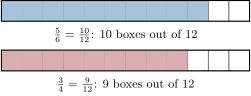
Why a common denominator: cutting both wholes into 12 equal boxes makes the fractions comparable and addable — together, 10 + 9 = 19 twelfths.
Why a common denominator: cutting both wholes into 1212 equal boxes makes the fractions comparable and addable — together, 10+9=1910 + 9 = 19 twelfths.

Examples

Example 63.2

Simplify 4256\dfrac{42}{56} step by step:

4256=42÷256÷2=2128=21÷728÷7=34.\frac{42}{56} = \frac{42 \div 2}{56 \div 2} = \frac{21}{28} = \frac{21 \div 7}{28 \div 7} = \frac34 .

(In Chapter 64 the greatest common divisor will do this in one step.)

Example 63.4

Compute 56+34\dfrac56 + \dfrac34. A common denominator of 66 and 44 is 1212:

56+34=5×26×2+3×34×3=1012+912=1912.\frac56 + \frac34 = \frac{5 \times 2}{6 \times 2} + \frac{3 \times 3}{4 \times 3} = \frac{10}{12} + \frac{9}{12} = \frac{19}{12}.

Compute 2372 - \dfrac37. Write 22 as a fraction over 77:

237=14737=117.2 - \frac37 = \frac{14}{7} - \frac37 = \frac{11}{7}.
Read in context →
