Primary & Middle School Mathematics · Grades 1–9
63Fractions and Powers
Fractions and powers are the everyday tools of computation: sharing quantities, comparing proportions, writing very large or very small numbers. This chapter consolidates the rules for computing with them — with every intermediate step written out — and introduces scientific notation.
63.1 Computing with fractions
Definition 63.1 (Fraction)
A fraction (with ) is the quotient of by . Two fractions are equal when one is obtained from the other by multiplying (or dividing) numerator and denominator by the same nonzero number:
Example 63.2
Simplify step by step:
(In Chapter 64 the greatest common divisor will do this in one step.)
Method 63.3 (Adding and subtracting fractions)
- Put both fractions over a common denominator (a common multiple of the two denominators);
- add or subtract the numerators, keeping the denominator;
- simplify the result if possible.
Example 63.4
Compute . A common denominator of and is :
Compute . Write as a fraction over :
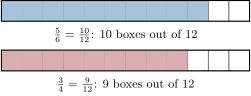
Method 63.5 (Multiplying and dividing fractions)
- To multiply, multiply numerators together and denominators together: (simplify before multiplying whenever possible);
- to divide, multiply by the inverse of the divisor: .
Example 63.6
where we simplified by the common factor , then by . And a division:
63.2 Powers
Definition 63.7 (Power)
For a real number and a positive integer , the power is the product of factors equal to :
By convention (for ), and negative exponents denote inverses:
Example 63.8
; but (the exponent binds before the minus sign); ; and .
Theorem 63.9 (Rules of exponents)
For all nonzero , and all integers , :
Proof. For positive exponents, count the factors. For the first rule: is factors followed by factors , in total factors. For the third: repeats times a block of factors, giving factors. The other two rules are similar; the extension to zero and negative exponents is checked from (and makes the convention the only consistent choice, since must be ). ∎
Example 63.10
Simplify step by step:
And with two letters: .
63.3 Powers of ten and scientific notation
Proposition 63.11 (Powers of ten)
For a positive integer : is written “ followed by zeros”, and with the in the -th decimal place. Multiplying a decimal number by (resp. ) shifts its decimal point places to the right (resp. left).
Definition 63.12 (Scientific notation)
The scientific notation of a positive decimal number is the unique way of writing it as
Example 63.13
The Earth–Sun distance is about km km. The size of a water molecule is about m m. To compute with such numbers, group the decimal parts and the powers of ten:
Method 63.14 (Putting a number in scientific notation)
- Move the decimal point just after the first nonzero digit; this gives the factor with ;
- count the number of places the point moved: that count is , positive if the original number was , negative if it was ;
- check: must reproduce the original number.
63.4 Exercises
Exercise 63.1 ★
Compute and give the result as a fully simplified fraction:
Solution
Solution of Exercise 63.1.
.
.
.
.
Exercise 63.2 ★
Compute and simplify:
Solution
Solution of Exercise 63.2.
(simplify by and by ).
.
(the s and s cancel).
Exercise 63.3 ★
Compute:
Solution
Solution of Exercise 63.3.
; ; ; ; ; .
Exercise 63.4 ★
Write as a single power:
Solution
Solution of Exercise 63.4.
; ; ; ; .
Exercise 63.5 ★
Write in scientific notation: ; ; ; ; twelve million.
Solution
Solution of Exercise 63.5.
; ; ; ; twelve million .
Exercise 63.6 ★★
Compute, giving the result in scientific notation:
Solution
Solution of Exercise 63.6.
.
.
.
Exercise 63.7 ★★
A tank is full. After adding liters it is full. What is the capacity of the tank? (Express the added fraction of the tank first.)
Exercise 63.8 ★★
Alice eats of a cake, then Ben eats of what remains, then Carla eats of what still remains. What fraction of the cake is left at the end? (Compute the remainder after each step.)
Solution
Solution of Exercise 63.8.
After Alice: of the cake remains. Ben eats , leaving . Carla eats half of that, , leaving of the cake.
Exercise 63.9 ★★
Light travels meters per second. The Sun is about m away. How long does sunlight take to reach us? Give the answer in seconds (scientific notation not needed), then in minutes and seconds.
Solution
Solution of Exercise 63.9.
Time seconds, i.e. minutes and seconds.
Exercise 63.10 ★★★
Which is larger, or ? (Hint: write both as powers with exponent using , and compare with .)
63.5 Problem: The secret code of repeating decimals
Problem 63.1
Weekend problem — every fraction has a decimal writing that stops or repeats, every repeating decimal is a fraction, and equals exactly
Divide by and the digits fall into a chant: forever. Divide by and the digits stop dead: . This problem proves that these are the only two possible behaviors for a fraction — and then reverses the machine: given any repeating decimal, it rebuilds the fraction hiding behind it. On the way it settles, once and for all, the most argued-about equality in school mathematics.
Part I — From fraction to decimal.
- Compute by long division the decimal writings of , , and . Which stop, which repeat, and with what repeating block?
- Explain why the decimal writing of any fraction must either stop or eventually repeat. (In the long division by , which values can the successive remainders take? What happens the moment a remainder shows up for the second time?)
- Push the division of by far enough to find the repeating block. How long is it, and how does that length compare with the bound promised by question 2?
- Some fractions stop because their denominator can be blown up to a power of ten: , . Explain the criterion, and why no whole-number multiplier can ever turn , or into , , (what digit would the product end in?).
- Without dividing, sort , and into “stops” and “repeats”, then give the decimal writing of the two that stop.
Part II — From repeating decimal back to the fraction.
- The shift trick. Let Compute , then , and deduce as a fraction. Check by dividing.
- Let Which power of ten shifts by exactly one repeating block? Use it to write as a fraction in lowest terms.
- A mixed case: (the alone repeats). Compute and deduce as a fraction in lowest terms.
- The famous one: apply the shift trick to What fraction — what number — do you find? Reconcile the result with your intuition, remembering the phantom neighbour of Problem 38.1 and the shrinking remainder of Problem 39.1: is “just below” , or another name for ?
- Convert and into fractions in lowest terms.
Part III — The dictionary completed.
- Questions 6–10 suggest a dictionary: a block of digits repeating from the decimal point equals that block over nines (). Use the dictionary to predict as a fraction, simplify — and marvel: which surprisingly simple fraction chants “”? Check it by division.
- Combine the dictionary with a shift: write as a fraction in lowest terms.
- The number (a , then one , then a , then two s, then a , then three s, and so on) never stops. Is it a repeating decimal? What does Part I then say about it — can it be a fraction? (You have just met your first provably irrational number; the most famous one is caught in Chapter 65.)
- Roughly how many digits does have? Use and the exponent rules (Theorem 63.9) to write in (approximate) scientific notation, and conclude. (Compare Exercise 63.10.)
- Finale: write as a fraction, and state the two-way moral of the whole problem: which decimal writings are fractions, and which fractions have which decimal writings?
Solution
Solution of Problem 63.1.
1. (stops); (block ); (block after the ); (block ).
2. At each step of the division by , the remainder is one of the values (Theorem 37.7). If a remainder appears, the division stops. Otherwise, after at most steps some remainder must appear a second time — there are more steps than possible remainders — and from that moment the division repeats exactly the sequence of digits it produced after the first appearance: the decimal writing cycles forever. Stop or repeat: no third behavior exists.
3. : the block has length . Question 2 promised a repetition within at most steps — here the remainders all appear before the returns: the longest possible chant for a division by .
4. stops exactly when some has denominator , , — that is, when the denominator can be multiplied up to a power of ten, as or . For and this is hopeless: a power of ten has digit sum , and every multiple of has a digit sum that is a multiple of — so no multiple of (hence none of ) is ever , , For : dividing , , , by always leaves a remainder (, , , ), never . Denominators that reach a power of ten stop; all others repeat.
5. : , stops: . : , stops: . : is a multiple of , repeats ().
6. , so (the tails cancel perfectly), and . Division check:
7. The block has two digits, so shift by : , hence and .
8. and ; subtracting, , so (divide by ). Indeed
9. , so and . Not “just below” : is the number , written in a second costume. Any number strictly below leaves a gap, and Problem 38.1 showed a gap always contains further numbers — while nothing fits between and . The endless nines are the chocolate remainder of Problem 39.1 shrunk below every positive amount: nothing is left.
10. . And (divide by ).
11. Dictionary: . Since , this simplifies to : the fraction chants “”. Division check:
12. (divide by ).
13. The blocks of zeros grow without end, so no fixed block can repeat forever: it is not a repeating decimal (and it never stops). By Part I, every fraction stops or repeats — so this number is no fraction at all: it is irrational, built to order. The superstar of irrationality, , is unmasked in Chapter 65.
14. : a number slightly above , hence with digits. (Exactly: .)
15. , already in lowest terms ( shares no factor with ). The completed dictionary: the fractions are exactly the decimals that stop or repeat — denominators of tens’ friends stop, all others chant a block; and conversely every chant, even your graduation year, is a fraction in disguise.