Definition 4.2University Mathematics — Year 1 · Chapter 4 — Standard Functions
For x>0 and α∈R: xα=eαlnx. For a>0, a=1, the logarithm to base a is logax=lnalnx, the inverse of x↦ax.
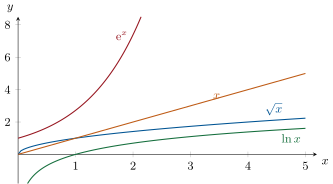
The growth scale of Proposition 4.6: near the right edge, lnx has barely passed 1.6 while ex has left the frame. Every ratio (log over power, power over exponential) tends to 0 — the picture only hints at what the substitutions in the proof make exact.
Examples
Example 4.3(Solving exponential equations)
Solve 2x=5x−1 in R. Both sides are positive, so take logarithms — a reversible step:
Next, solve x2=3 for x>0: raise to the power 21 (i.e. apply the reciprocal bijection): x=31/2=e(ln3)/2≈2.175. The insight: every equation mixing powers unwinds through ln and exp, because the definition xα=eαlnx reduces all power manipulations to arithmetic of exponents — but only on the domain x>0 where that definition lives.
Example 4.4(Doubling times)
A quantity grows by 3% per step: after n steps it is multiplied by (1.03)n. When does it double? Solve (1.03)n≥2:
nln(1.03)≥ln2⟺n≥ln1.03ln2=0.029560.6931≈23.4,
so the first doubling occurs at step 24. (The financiers’ “rule of 72”, which estimates the doubling time as 72 divided by the rate in percent, is this computation with the approximation ln(1+x)≈x, quantified in Chapter 16.) Exponential processes are best reasoned about through their logarithms: on that scale, growth is linear and questions become divisions.
Example 4.5(How long is 22026?)
The number of decimal digits of an integer N≥1 is ⌊log10N⌋+1 (indeed N has d digits exactly when 10d−1≤N<10d, i.e. d−1≤log10N<d). For N=22026:
log1022026=2026log102=2026×0.301030=609.887,
so 22026 has 610 digits. The fractional part carries a bonus: 100.887≈7.7, so the number begins with 7. One multiplication answered a question about a number no one will ever write out — logarithms compress multiplicative size into additive size, which is their whole historical point (Example 7.12 makes that sentence precise).
 Coach
Coach