University Mathematics — Year 1 · Bachelor Year 1
7Algebraic Structures
The same computation rules keep reappearing: integers, real numbers, complex numbers, congruence classes, and soon polynomials (Chapter 8), vectors and matrices (Chapters 18 and 21). Algebra extracts the common patterns and names them: group, ring, field. Proving a fact once, at the level of the structure, proves it for every example at once.
7.1 Laws of composition
Definition 7.1
A law of composition on a set is a map , written . It is associative when always, commutative when always. An element is an identity when for all ; then is an inverse of when .
Proposition 7.2 (Uniqueness)
A law has at most one identity; for an associative law with identity, each element has at most one inverse.
Proof. If and are identities: . If and invert : . ∎
7.2 Groups
Definition 7.3 (Group)
A group is a set with an associative law admitting an identity and in which every element has an inverse. The group is abelian when the law is commutative.
Example 7.4
, , , ; , , , (roots of unity, Definition 3.17); the set of bijections of a set onto itself, under composition — the symmetric group of , non-abelian as soon as . Not groups: (no inverses), (only invertible).
Proposition 7.5 (Computation rules)
In a group (written multiplicatively, identity ):
- cancellation: and ;
- and ;
- for , each equation and has a unique solution (, resp. ).
Proof. (1) Multiply by on the appropriate side, using associativity. (2) and symmetrically; uniqueness of the inverse concludes; the second point is Proposition 7.2 applied to . (3) Substitute and use (1) for uniqueness. ∎
Example 7.6 (The symmetries of a rectangle)
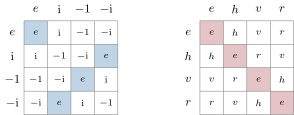
A (non-square) rectangle admits exactly four isometries onto itself: the identity , the horizontal-axis reflection , the vertical-axis reflection , and the half-turn about the center. Composition makes this four-element set a group: each element is its own inverse (), and the product of any two distinct non-identity elements is the third (: reflecting in both axes is the half-turn). The full table is symmetric, so the group is abelian — yet it is not the same group as the rotations of Example 7.15: there, has order , while here every element has order . Two groups of the same size can thus have genuinely different multiplication structures — the figure below displays both tables side by side. This four-element group returns as , and Exercise 7.7 explains why any group with all squares trivial must, like this one, be abelian.
Definition 7.7 (Subgroup)
A subset of a group is a subgroup (written ) when it contains , is stable under the law and under inversion. Then is itself a group.
Criterion: a nonempty is a subgroup if and only if
Proof of the criterion. A subgroup obviously satisfies it. Conversely, let satisfy it, and pick . Then ; for , ; and for , . ∎
Example 7.8
: nonempty, and for , . The subgroups of are exactly the (proved in Theorem 6.4). An intersection of subgroups is always a subgroup, but a union almost never is (Exercise 7.6).
Remark 7.9 (Common pitfalls with structures)
- Stability under the law is not enough. is stable under addition inside , contains , yet is no subgroup: inverses are missing. The criterion tests everything at once — but only after checking .
- Nonabelian reflexes. In a general group, , which is only when and commute; likewise , order reversed. Every identity imported from school algebra must be re-derived from the axioms or flagged as commutative.
- Kernel versus image. lives in the source, in the target; “ injective iff trivial” (Proposition 7.11) has no analogue with the image ( is surjectivity).
- Rings are not groups for . In a ring, most elements need not be invertible, and cancellation by requires to be a unit or the ring to be an integral domain: in , yet (Example 7.27).
Definition 7.10 (Group morphism)
Let and be groups. A map is a morphism when
Then and . The kernel and image of are
A bijective morphism is an isomorphism; its inverse map is then automatically a morphism.
Proof of the assertions. , and cancelling gives . Then identifies as the inverse. Kernel: ; if , ; the criterion applies. Image: same criterion with . Inverse of an isomorphism: for , write , ; then . ∎
Proposition 7.11 (Injectivity via the kernel)
Proof. If is injective, can only contain the one preimage of , which is . Conversely, if and , then , so , i.e. . ∎
Example 7.12
is a morphism (), bijective (Proposition 4.1): the additive and multiplicative structures are isomorphic — the historical raison d’être of logarithms. Another morphism: from onto the unit circle , with kernel .
Example 7.13 (The sign morphism)
The map sending to its sign is a morphism: the sign of a product is the product of the signs. Its kernel is (a subgroup, as Definition 7.10 promises), its image all of : surjective, massively non-injective. Two general lessons in miniature. First, a morphism may crush information: remembers nothing of but one bit, and that is its virtue — sign arguments are exactly the computations that factor through . Second, morphisms to are the simplest “invariants”: the signature of permutations, built in this chapter’s weekend problem, is the same phenomenon on the group , and the parity arguments it powers all descend through such a two-valued morphism.
Definition 7.14 (Powers, order of an element)
In a group (multiplicative notation), set , and for ; then for all , so is a morphism whose image is a subgroup, the subgroup generated by . The order of is the least with if one exists (then has exactly elements, and ), and otherwise.
Example 7.15
In : has order , with ; more generally has order and . In , every has infinite order. Why the claims in the definition hold: if has order , divide any by (, , Theorem 6.2): , so the powers cycle with period , the listed elements are pairwise distinct by minimality of , and forces . Orders of permutations are computed in the weekend problem below.
Example 7.16 (Orders inside )
What is the order of in , for ? One has iff , and writing , , with : (Gauss’s lemma, Theorem 6.8). The least such is . In for instance, has order (indeed ), while has order : it generates the whole group, though it is not the “standard” generator. Counting the generators — the with — recovers the coprime counts of Example 2.25: group theory and counting meet.
7.3 Rings and fields
Definition 7.17 (Ring)
A ring is a set with two laws such that: is an abelian group (identity ); is associative with an identity ; and distributes over on both sides. The ring is commutative when is. An element is invertible (a unit) when for some ; the units form a group .
Proof that the units form a group. Stability: if are units with inverses , then
symmetrically, so is a unit. The element is a unit (its own inverse), associativity is inherited from , and the inverse of a unit is itself a unit (with inverse ). So satisfies all group axioms. Every group in this book that is not built from permutations arises this way: , , , the units of below, and later the invertible matrices (Chapter 21). ∎
Example 7.18
are commutative rings; , . Later: polynomial rings (Chapter 8), matrix rings (non-commutative, Chapter 21), and below. In every ring, (from distributivity: ), and .
Example 7.19 (Idempotents: new phenomena in new rings)
In , the equation , i.e. , has only the solutions and . In , testing all classes: , , and — four idempotents. The two exotic ones come from zero divisors: with neither factor zero. Such computations calibrate one’s instincts: familiar facts about equations survive in integral domains and fields, but a general ring can and does behave differently — see also the Boolean rings of Exercise 7.10, where every element is idempotent.
Proposition 7.20 (Binomial theorem in a commutative ring)
If are elements of a commutative ring (more generally, if ), then for :
Proof. The proofs of Theorem 2.16 and of the geometric identity use only associativity, commutativity of the two elements, and distributivity — they apply verbatim. ∎
Example 7.21 (The binomial theorem in an unfamiliar ring)
Two quick payoffs of the generality. In ( prime), the middle binomial coefficients vanish (Theorem 6.23’s first step), so the theorem collapses to the freshman’s dream
a genuine identity there, however criminal it looks over . And in any commutative ring containing an element with , the theorem truncates: , all higher terms carrying a factor . The coefficient of is the derivative of — no accident, and a first hint that derivatives are algebra as much as analysis (compare the formal derivative of Chapter 8).
Definition 7.22 (Integral domain, field)
A commutative ring is an integral domain when it has no zero divisors: or . It is a field when every nonzero element is invertible. Every field is an integral domain ( and give ).
Example 7.23
, , are fields; is an integral domain but not a field. In an integral domain, cancellation holds for : and imply .
7.4 The ring
Definition 7.24
Fix . The congruence classes mod (Example 1.32) form a set of elements, written . The operations
are well defined — the classes of the results do not depend on the representatives, precisely because congruence is compatible with and (Definition 6.18) — and make a commutative ring.
Theorem 7.25 (Units of ; the fields )
Proof. (1) is Proposition 6.20 rewritten with classes.
(2) If is prime, every has , so : invertible by (1) — a field. If with , then with : zero divisors, so not even an integral domain; and gives the zero ring, excluded. ∎
Example 7.26 (How many square roots of ?)
Solve in and in . Testing the eight classes mod : , , , — four solutions , even though the polynomial has degree . In the field , by contrast, means , and a field has no zero divisors: , two solutions only. The failure mod is traceable: without either factor vanishing. Moral: the familiar rule “a degree- equation has at most roots” is a theorem about integral domains (Corollary 8.8 proves it over fields); in rings with zero divisors it silently fails — which is exactly why the pairing proof of Wilson’s theorem (Exercise 6.11) needed prime.
Example 7.27 (Computing in )
In : the units are (the classes coprime to ), and each is its own inverse (, , ). The equation has three solutions (): without invertibility, no cancellation. In by contrast, every equation with has exactly one solution.
Example 7.28 (Group axioms as a solving license)
In the group , solve . By Proposition 7.5 (3) the solution exists, is unique, and equals ; since , the inverse of is , so
The point is less the answer than the guarantee: in a group, every such equation is solvable uniquely before any computation, so a solving procedure can never run into “no solution” or “several”. Compare in above, where the guarantee fails — knowing which structure one is in is knowing what one may take for granted.
Example 7.29 (Direct products)
If and are groups, the product set with the componentwise law is a group: axioms are checked coordinate by coordinate, with identity and inverses . Orders combine by the lcm: is the identity iff the order of and the order of both divide . Thus in (additive) every nonzero element has order — this is exactly the rectangle group of Example 7.6 in coordinates — while has an element of order : a second, computation-free proof that the two groups of size are not isomorphic (an isomorphism preserves orders). Products are the easiest way to manufacture new groups from old, and the plane of Chapter 18 is the construction’s most important instance.
Remark 7.30 (Fermat, structurally)
In the field , the nonzero classes form a multiplicative group with elements, and Fermat’s little theorem (Theorem 6.23) says: every element of this group satisfies . This is an instance of a general fact about finite groups (Lagrange’s theorem), proved in the second year; the pairing proof of Wilson’s theorem (Exercise 6.11) already had this group-theoretic flavor.
Remark 7.31 (Interlude: what abstraction buys)
It is fair to ask what was gained by proving, say, Proposition 7.2 for an abstract law rather than for numbers. The answer is leverage. That two-line argument now covers, at once: inverses of functions under composition (Theorem 1.24, whose uniqueness proof it repeats word for word), inverses mod (Proposition 6.20), inverses of nonzero reals, of units in any ring, and — sight unseen — of the invertible matrices of Chapter 21, where uniqueness of will not need a single line of proof. The same economy holds for Proposition 7.11 (one injectivity criterion, reused for linear maps in Chapter 20) and for the subgroup criterion. Abstraction here is not generality for its own sake: it is the refusal to prove the same lemma five times under five names. The price — keeping track of which axioms each statement really used — is exactly what the exercises of this chapter train.
Remark 7.32 (Where this chapter is used)
The vocabulary of this chapter is the grammar of the rest of the volume. Rings and fields organize Chapter 8 ( is a ring imitating ) and Chapter 9 ( is its field of fractions); vector spaces (Chapter 18) are abelian groups with a field acting on them; matrices (Chapter 21) form the volume’s first seriously non-commutative ring, and their invertible elements a group whose study is linear algebra itself. Morphisms and kernels return as linear maps and null spaces in Chapter 20 — Proposition 7.11 is the injectivity criterion of that chapter, proved once and for all here. The symmetric group, star of the weekend problem below, supplies the signature on which determinants are built in Chapter 22.
7.5 Exercises
Exercise 7.1 ★
On , define . Prove that is an abelian group. (Identify the identity and the inverse of ; check stability: why is ?)
Solution
Solution of Exercise 7.1.
Stability: , impossible for . Indeed the key identity is
the map sends to with — a bijective morphism. All axioms now transport: associativity and commutativity follow from those of ; the identity is (check: ); the inverse of is (which is ). So is an abelian group.
Exercise 7.2 ★
Which of the following are groups?
- ;
- ;
- ;
- the set of odd integers under addition.
Solution
Solution of Exercise 7.2.
- Yes: product of positives is positive, identity , inverse , associativity inherited from .
- No: not stable ().
- Yes: the standard example.
- No: not stable (odd odd even), and no identity ( is even).
Exercise 7.3 ★
Write the composition table of the symmetric group of (six bijections: identity, three transpositions, two -cycles), and exhibit two elements that do not commute.
Solution
Solution of Exercise 7.3.
Write , the transpositions (swapping the two named points), and the cycles (i.e. ) and . The table of (row , column , apply first):
Non-commuting pair: while . (To check one entry: sends , , : that is , the cycle .)
Exercise 7.4 ★
Prove that is a subgroup of , and that is another; is a subgroup?
Solution
Solution of Exercise 7.4.
: ; for , : the criterion applies. : same, replaced by positivity. Union: and , but has modulus and is not a positive real: , so the union is not stable — not a subgroup (as predicted by Exercise 7.6, neither subgroup contains the other).
Exercise 7.5 ★★
Let , . Prove that is a morphism, compute and , and deduce from Proposition 7.11 that is not injective. Restrict the domain to make it injective on an interval as large as possible.
Solution
Solution of Exercise 7.5.
Morphism: (Theorem 3.7). Kernel: , so : not injective. Image: every unit complex number is for some (polar form), so , the unit circle. The restriction of to a half-open interval of length , such as or , is injective (two angles with the same image differ by a multiple of , and only one representative of each class fits in the interval); no interval of greater length works, since it contains two points at distance .
Exercise 7.6 ★★
Let be subgroups of . Prove that is a subgroup, and that is a subgroup only when or . (If and , where can live?)
Exercise 7.7 ★★
A group satisfies for all . Prove that is abelian. (Expand .)
Solution
Solution of Exercise 7.7.
Note first that means for every . Then for :
using Proposition 7.5 (2). So is abelian.
Exercise 7.8 ★★
In : list the units and find the inverse of ; solve ; solve and .
Solution
Solution of Exercise 7.8.
Units of : classes coprime to : . Inverse of : , so .
: multiply by : (since ). Unique solution.
: the equation means . But is odd, while is even: an even number cannot divide an odd one. No solution.
: : solutions — six of them.
Exercise 7.9 ★★
Prove that the set is a ring (a subring of ), and that is a unit of it with infinitely many distinct powers — so is infinite, unlike .
Solution
Solution of Exercise 7.9.
contains and , and is stable under subtraction and product:
so it is a subring of (commutativity, associativity, distributivity are inherited). Unit: , so is invertible with inverse . Its powers are strictly increasing (the base is ), hence pairwise distinct, and each is a unit (): the group of units is infinite.
Exercise 7.10 ★★★
(Boolean rings) Let be a ring in which for every . Prove that for all , and that is commutative. (Expand and .) Give an example of such a ring with , taking the symmetric difference as addition and intersection as multiplication.
Solution
Solution of Exercise 7.10.
— so , giving , i.e. (each element is its own additive inverse). Then
so , i.e. (using ). Hence is commutative.
Example: on , define (symmetric difference) and . One checks: is an abelian group with identity and each set its own inverse; is associative, commutative, with identity ; distributivity holds (an element lies in the left side iff it is in and in exactly one of ). And : every element is idempotent, as required.
Exercise 7.11 ★★★
Let be a group in which, for some fixed , , and for all . Prove that is abelian. (From the three identities, derive first , then , and conclude.)
Solution
Solution of Exercise 7.11.
Write the hypothesis for and :
Equating: ; cancel on the left and on the right: . The same computation one degree higher ( and ) gives . Then
and cancelling on the right of : . So is abelian.
Exercise 7.12 ★★
- Determine all group morphisms from to .
- Prove that the only group morphism from to is the zero morphism. (For and , compare and .)
Solution
Solution of Exercise 7.12.
7.6 Problem: The symmetric group and the 8-puzzle
Problem 7.1
The group of permutations of is the oldest group in mathematics and still the most instructive. This problem builds its structure theory from scratch — cycles, generation by transpositions, the signature morphism (whose existence is genuinely nontrivial), and the alternating group generated by -cycles — then cashes it in on a classical puzzle: in the sliding-tile game, no sequence of moves can swap two tiles and leave everything else in place. Permutations act on ; products mean “apply first”; denotes the permutation sending to .
Part I — Cycles and transpositions.
- Justify (Theorem 2.12). In , compute both products of and , and conclude that is not abelian.
- A -cycle (, the pairwise distinct) sends and fixes everything else; its support is . Prove that two cycles with disjoint supports commute.
- Prove that every is a product of cycles with pairwise disjoint supports, and that this decomposition is unique up to the order of the factors. (Consider, for each , the sequence : it must return to ; the resulting orbits partition , and acts on each as a cycle.)
- Decompose into disjoint cycles. Defining the order of as in Definition 7.14, prove that the order of a product of disjoint cycles is the lcm of their lengths, and compute the order of this .
Prove the telescoping identity
and conclude that every permutation is a product of transpositions. Write the of question 4 as such a product.
Show further that the adjacent transpositions suffice: for ,
a product of adjacent transpositions — an odd number (this parity will matter twice below).
Part II — The signature exists. For , let
be its number of inversions, and set .
- Compute and for the identity, for a transposition , and for .
- Prove that for every and every adjacent transposition : . (Composing with on the right swaps the values in positions and ; exactly one pair changes its inversion status.)
- Deduce, using question 6, that for any transposition , ; conclude that if is a product of transpositions, then — in particular the parity of depends only on , not on the chosen factorization — and that is a group morphism.
- Show that a -cycle has signature , and that in general , where is the number of orbits of (fixed points included).
- The alternating group is . Justify that it is a subgroup, and prove for . (Fix a transposition and consider .)
- Consistency check on : compute three ways — by counting inversions, from the cycle type via question 10, and from your transposition count in question 5.
Part III — is generated by -cycles.
Let be pairwise distinct. Verify the two identities
- Prove that for , every element of is a product of -cycles. (An even permutation is a product of an even number of transpositions; absorb them two at a time.)
- Write and the -cycle explicitly as products of -cycles.
Prove the conjugation formula: for every ,
Part IV — The 8-puzzle. Tiles slide in a frame with one empty cell; a move slides a tile adjacent to the empty cell into it. Number the cells (row by row; the solved position has tile in cell and the empty cell at cell ). Treat the empty cell as a ninth tile, so a position is a permutation (tile sits in cell ).
- Show that a move replaces by where is the transposition of the two cells involved; deduce that each move flips .
Let be the taxicab distance (rows plus columns) between the empty cell’s current cell and its home cell . Show that each move changes by , so each move also flips . Conclude that
is invariant under every move.
- Prove the puzzle’s classical impossibility: the position that swaps tiles and and leaves everything else (including the empty cell) in place cannot be reached from the solved position.
- We admit the converse (its proof is an instructive but lengthy induction): every position with is reachable. Deduce that exactly half of the positions with the empty cell at home are solvable, i.e. .
- Deduce from question 20 that the reachable tile arrangements with the empty cell at home form exactly the subgroup .
- Applications of the invariant: can one reach (a) the position where tiles are cyclically permuted and everything else, empty cell included, is at home? (b) the position where tile and the empty cell have exchanged places and all other tiles are at home? Justify both answers with .
Part V — Synthesis.
- Prove that for the only group morphisms are the constant morphism and . (Using question 16 and commutativity of , show takes the same value on all transpositions.)
- Where exactly did the problem use: (i) the morphism concept and Proposition 7.11; (ii) the counting principles of Chapter 2; (iii) the well-definedness issue that questions 8–9 resolve? One sentence each.
- Synthesis, in a short paragraph: one parity function, proved well defined once, simultaneously organizes the internal structure of (the subgroup ), decides a physical puzzle, and — through the formula — will define determinants in Chapter 22. Comment on the recurring pattern: invariants turn “try all sequences of moves” into one computation.
Solution
Solution of Problem 7.1.
1. A permutation is a bijection of , i.e. an -arrangement of objects: there are of them (Theorem 2.12). With , : sends , , : ; and sends , , : .
2. Let have disjoint supports . For : and , so . Symmetrically for ; and both sides fix every . So .
3. For , the values live in a finite set, so for some ; injectivity gives : the sequence returns to . Call orbit of the set with minimal such that . Two orbits meeting in one point coincide (both are the forward -images of that point), so the orbits partition ; acts on each orbit of size as the -cycle and fixes the singletons. The product of these disjoint cycles agrees with everywhere. Uniqueness: in any decomposition into disjoint cycles, the cycle through must be — the cycles are forced to be the orbits with their induced action.
4. Following the orbits: , , :
If with disjoint cycles of lengths , commutation (question 2) gives , and since the supports are disjoint, iff each iff for all (a -cycle has order : sends to ). The least such is . Here: .
5. Apply the right-hand side to each point, rightmost factor first. by , then every later factor fixes : net . For : is untouched until sends it to , and the very next factor sends to , after which nothing moves it: net . Finally is fixed by all factors but the leftmost, which sends it to . This is exactly the cycle. Since every permutation is a product of cycles (question 3), it is a product of transpositions. For question 4’s :
five transpositions.
6. Induction on . For the identity is trivial ( factor). For , verify directly that : the right side sends , , , and fixes the rest. By induction is a palindromic product of adjacent transpositions, so is one of : an odd number.
7. , . For , the only inverted pair is : , . For : the inverted pairs are (values ) and (values ): , .
8. The value lists of and differ only by the swap of positions and . For a pair of positions not involving , nothing changes. For , the two pairs and exchange their inversion statuses (the same two values are compared with , in the other order of positions): their total contribution is unchanged; likewise for . The one remaining pair flips its status. Hence .
9. Let be any transposition: by question 6 it is a product of an odd number of adjacent transpositions, so right-multiplying by changes by an odd total (question 8, applied repeatedly): . Now if (transpositions), build it up from the identity by right-multiplications: . Since is defined by inversions — independently of any factorization — the parity of is an invariant of . Morphism: writing with and with transpositions, uses of them: .
10. A -cycle is a product of transpositions (question 5): . For general with orbits of sizes () plus fixed points, and , so
11. is a subgroup as the kernel of a morphism (Definition 7.10). Fix a transposition (exists for ). The map is a bijection of (its own inverse) exchanging with the set of odd permutations (question 9). The two sets partition and have equal size: .
12. Inversions of : from value : over : three; from : over : two; from : over : one; from : over : one. , . Cycle type: orbits, : . Transposition count: five transpositions in question 5: . All three agree.
13. (rightmost first): ; ; : the -cycle . And : ; ; ; : that is , as claimed.
14. Let : by question 9, with an even number of transpositions. Group them in consecutive pairs : if the two are equal, the pair is the identity and disappears; if they share exactly one point, the first identity of question 13 writes the pair as one -cycle; if they are disjoint, the second identity writes it as two -cycles. Hence is a product of -cycles (or the identity, an empty product — and for also ).
15. (question 13 with ). For the -cycle: by question 5, , and pairing: , :
(Check on : sends , then sends : net , correct.)
16. Apply both sides to an arbitrary point. For : the left side gives (indices mod ), which is what the right side does to . For not of this form: is outside the support, so the left side fixes , and so does the right side. Equal everywhere.
17. Sliding the tile of cell into the empty cell swaps the contents of cells and (tile , the blank, moves to ). If tile sat in cell , the new position is : same contents except that cells read each other’s former contents. By question 9, .
18. A move sends the empty cell to an adjacent cell: its row or its column changes by exactly , so the taxicab distance to cell changes by , and flips. Since each move flips both and , their product is unchanged by every move: an invariant.
19. The solved position has , : . The target (tiles swapped, blank home) is the transposition of the contents of cells and : , : . Since is invariant and the two values differ, no sequence of moves joins them.
20. A position with the blank at home is a permutation of the tiles among cells , i.e. an element of ; it has , so . Reachable forces , i.e. ; the admitted converse says all of is reached. Count: (question 11).
21. By question 20 the reachable blank-at-home arrangements form exactly — in particular a subgroup of : composing two solvable scrambles, or inverting one, stays solvable, which is far from obvious by pure puzzle reasoning.
22. (a) A -cycle of tiles with blank home: (question 10), , so : reachable (by the admitted converse) — one can cycle three tiles. (b) Tile and the blank exchanged: the position is the transposition of the contents of cells and , so ; the blank sits at the center, at taxicab distance from home, so and : unreachable. One cannot simply “park the blank in the middle” leaving the tiles otherwise sorted.
23. Let be a morphism. For any two transpositions , question 16 provides with (map the two moved points onto the two others; guarantees room to do so, though even is trivial here). Then since is abelian: is constant on transpositions. If that constant is , then on all products of transpositions, i.e. everywhere (question 5). If it is , then on a product of transpositions. So .
24. (i) The morphism property of and the kernel machinery gave its subgroup structure and its size, and Proposition 7.11-style reasoning runs through questions 11 and 21. (ii) Counting: , the halving argument of question 11, and the count of question 20 are Chapter 2 at work. (iii) Questions 8–9 resolve a genuine well-definedness problem — “the parity of the number of transpositions” presupposes that this parity does not depend on the factorization, exactly as ’s operations required representative-independence in Definition 7.24.
25. The signature is a single -valued computation, proved once to be well defined, and it does three jobs at once: internally, it cuts in half and isolates with its -cycle generators; externally, it decides in one line a question (“can these two tiles be swapped?”) that naive search could never settle, since no finite list of failed move sequences proves impossibility; and structurally, it is the alternating-sign engine inside the formula of Chapter 22. The pattern — find a quantity conserved by every elementary move, compute it at the start and at the target — is the mathematician’s standard weapon against “is it possible?” questions, and it will return whenever a group acts on a set of states.