Mathematics · Glossary

What is isometry?

Definition 23.15 University Mathematics — Year 1 · Chapter 23 — Euclidean Spaces

An endomorphism uu of a Euclidean space is an isometry (or orthogonal map) when it preserves the norm: u(x)=x\norm{u(x)} = \norm x for all xx — equivalently (polarization) it preserves the inner product; equivalently its matrix AA in an orthonormal basis satisfies ATA=IA^{\mathsf T} A = I. Isometries form a group, the orthogonal group O(E)O(E).

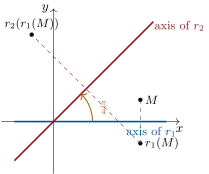
Two reflections make a rotation: reflecting M = (2, 0.5) in the x-axis, then in the line y = x, lands at (-0.5, 2) — the image of M under the rotation of angle π2 about the origin, twice the angle π4 between the axes. The weekend problem turns this picture into the composition law of all plane isometries.
Two reflections make a rotation: reflecting M=(2,0.5)M = (2, 0.5) in the xx-axis, then in the line y=xy = x, lands at (0.5,2)(-0.5, 2) — the image of MM under the rotation of angle π2\frac\pi2 about the origin, twice the angle π4\frac\pi4 between the axes. The weekend problem turns this picture into the composition law of all plane isometries.

Examples

Example 23.16 (Recognizing an isometry at sight)

Is A=15(3443)A = \dfrac15\begin{pmatrix} 3 & -4\\ 4 & 3\end{pmatrix} orthogonal? Columns: norms 159+16=1\frac15\sqrt{9 + 16} = 1 and 1516+9=1\frac15\sqrt{16 + 9} = 1; product 125(3(4)+43)=0\frac1{25}(3\cdot(-4) + 4\cdot3) = 0. Yes — and detA=9+1625=1\det A = \frac{9 + 16}{25} = 1, so it is the rotation RθR_\theta with cosθ=35\cos\theta = \frac35, sinθ=45\sin\theta = \frac45 (the “33-44-55 rotation”, whose angle is no remarkable fraction of π\pi). By contrast B=12(1101)B = \frac{1}{\sqrt2}\begin{pmatrix} 1 & 1\\ 0 & 1\end{pmatrix} has unit determinant-scaled look but non-unit first column (12\frac1{\sqrt2}): not orthogonal — determinant ±1\pm1 alone certifies nothing, the columns must be checked.

Read in context →