Adding an inner product to a real vector space buys the geometric notions — lengths, angles, orthogonality, distances — and one theorem that towers over the chapter: every subspace admits an orthogonal projection, computable by Gram–Schmidt, realizing the shortest distance. The plane isometries close the chapter and the year’s geometry.
An inner product on E is a map⟨⋅,⋅⟩:E×E→R that is bilinear, symmetric, and positive definite (⟨x,x⟩>0 for x=0). A finite-dimensional space so equipped is a Euclidean space. The norm of x is ∥x∥=⟨x,x⟩, and d(x,y)=∥x−y∥.
Example 23.2
On Rn: the canonical product ⟨x,y⟩=∑xiyi. On C([a,b]): ⟨f,g⟩=∫abfg (positive definiteness is Theorem 15.7 (4)). On Rn[X]: ⟨P,Q⟩=∫01PQ, or ∑iP(xi)Q(xi) over n+1 distinct points.
Example 23.3(The angle between two polynomials)
Once an inner product is chosen, any two nonzero vectors have an angle, via cosθ=∥x∥∥y∥⟨x,y⟩ (a legitimate cosine by Cauchy–Schwarz). For X and X2 in ∫01:
an angle of about 14.5 degrees — on [0,1], the graphs of x and x2 are “nearly parallel” in the quadratic-mean sense, which is why removing that shared direction (Gram–Schmidt, below) leaves only the small correction X2−X+61.
Theorem 23.4(Cauchy–Schwarz; norm properties)
For all x,y∈E:
∣⟨x,y⟩∣≤∥x∥∥y∥,
with equality iff x,y are proportional. Consequently ∥⋅∥ satisfies the triangle inequality ∥x+y∥≤∥x∥+∥y∥ (and ∥λx∥=∣λ∣∥x∥, ∥x∥=0⟺x=0). Moreover:
∥x+y∥2=∥x∥2+2⟨x,y⟩+∥y∥2,⟨x,y⟩=41(∥x+y∥2−∥x−y∥2).
Proof. If y=0, everything is trivial. Otherwise the quadratic t↦∥x+ty∥2=∥x∥2+2t⟨x,y⟩+t2∥y∥2 is ≥0 for all t: its discriminant is ≤0, which is Cauchy–Schwarz; equality means a double root t0, i.e. x+t0y=0 (definiteness): proportionality. Triangle inequality: expand,
the middle step being Cauchy–Schwarz; equality forces ⟨x,y⟩=∥x∥∥y∥, the positive equality case, i.e. proportionality with nonnegative ratio — geometrically, the triangle degenerates only when the two vectors point the same way. The last two identities are direct expansions (the second, the polarization identity, recovers the product from the norm). ∎
23.2 Orthogonality
Definition 23.5
x⊥y when ⟨x,y⟩=0. A family is orthogonal when its vectors are pairwise orthogonal, orthonormal when moreover each has norm 1. The orthogonal complement of a subspaceF is
Proof. Pythagoras: expand. Freeness: take ⟨⋅,xj⟩ of a null combination: λj∥xj∥2=0. Coordinates: write x=∑λiei and take the product with ej: λj=⟨x,ej⟩; the two formulas follow by bilinearity. ∎
Example 23.7(Orthonormal coordinates, with a Parseval check)
Certification by the norm formula of the proposition:
29+625+316=627+25+32=14=∥x∥2=1+4+9.
This sum-of-squared-coordinates check (a finite Parseval identity) costs seconds and catches sign and normalization errors with near certainty — make it a habit whenever an orthonormal expansion is computed; its infinite-dimensional version, for the Fourier coefficients of Example 23.14, is a theorem of the Year 3 volume.
produces an orthonormalbasis(e1,…,en) with Vect(e1,…,ek)=Vect(v1,…,vk) for every k.
Proof. Induction on k. Assuming (e1,…,ek−1)orthonormal spanning Vect(v1,…,vk−1): the vector wk is orthogonal to each ej (j<k) by construction (⟨wk,ej⟩=⟨vk,ej⟩−⟨vk,ej⟩), and wk=0 since vk∈/Vect(v1,…,vk−1). Normalizing keeps orthogonality; the spanstatement holds since ek is a combination of vk and earlier ei’s, invertibly. ∎
Example 23.9(Gram–Schmidt on polynomials, in full)
Orthonormalize (1,X,X2) in R2[X] with ⟨P,Q⟩=∫01PQ. Step 1: ∥1∥2=1, so e1=1. Step 2: w2=X−⟨X,1⟩1=X−21, and ∥w2∥2=∫01(x−21)2dx=121: e2=12(X−21). Step 3: ⟨X2,e1⟩=31 and
Its norm was computed in Exercise 23.9: ∥w3∥2=1801, whence e3=180(X2−X+61). The polynomials1, X−21, X2−X+61 are, up to scale, the first Legendre polynomials of the interval[0,1]; the construction continues one degree at a time, each new polynomialorthogonal to all its predecessors. Note how the algorithm recycles earlier work: the projection subtracted at step 3 is exactly the best affine approximation of X2 found in Example 23.12 — Gram–Schmidt is iterated orthogonal projection.
and the associated projectionpF onto F (the orthogonal projection) is given, in any orthonormalbasis(e1,…,ek) of F, by pF(x)=∑i⟨x,ei⟩ei. It realizes the distance to F: for all y∈F,
∥x−pF(x)∥≤∥x−y∥,
with equality only for y=pF(x); one writes d(x,F)=∥x−pF(x)∥.
Proof. Take an orthonormalbasis(ei)i≤k of F (Theorem 23.8 inside F) and set π(x)=∑⟨x,ei⟩ei∈F. Then x−π(x)⊥ej for each j (same cancellation as above), hence x−π(x)∈F⊥: E=F+F⊥. And F∩F⊥={0}: such a vector satisfies ⟨x,x⟩=0. So the sum is direct and π=pF.
Distance: for y∈F, decompose x−y=(x−pF(x))+(pF(x)−y), orthogonal pieces (F⊥ and F); Pythagoras:
∥x−y∥2=∥x−pF(x)∥2+∥pF(x)−y∥2≥∥x−pF(x)∥2,
equality iff y=pF(x). ∎
Example 23.11(Projections never lengthen)
Applying Pythagoras to the split x=pF(x)+(x−pF(x)):
∥pF(x)∥2=∥x∥2−∥x−pF(x)∥2≤∥x∥2,
with equality iff x∈F. In an orthonormalbasis(e1,…,ek) of F this reads ∑i≤k⟨x,ei⟩2≤∥x∥2 (a Bessel inequality): however many orthonormal directions one measures, the squared coordinates never exceed the squared length — compare the exact equality of Example 23.7 when the family is a full basis. This one-line inequality is what makes Fourier coefficients summable in the Year 3 volume; here it already explains why adding more basis functions to a least squares fit can only decrease the residual.
Example 23.12(Best quadratic approximation)
In C([0,1]) with ⟨f,g⟩=∫01fg, the polynomial of degree ≤1 closest to f(x)=x2 in the associated (quadratic mean) distance is pF(f) where F=R1[X]. Gram–Schmidt on (1,X): e1=1, w2=X−21, ∥w2∥2=∫01(x−21)2=121, e2=12(X−21). Then
using ∫01x2(x−21)dx=41−61=121. The “least squares” idea in one line of linear algebra.
Method 23.13(Three routes to a distance d(x,F))
Orthonormalbasis of F: then pF(x)=∑i⟨x,ei⟩ei and, by Pythagoras,
d(x,F)2=∥x∥2−∥pF(x)∥2=∥x∥2−i∑⟨x,ei⟩2,
often cheaper than computing x−pF(x) itself.
Normal equations: with any generating family of F, solve ⟨x−p,vj⟩=0 for the coefficients of p (Exercise 23.5) — no orthonormalization needed.
Through the complement: if F⊥ is smaller than F (e.g. F a hyperplane, F⊥ a line Vect(n)), project onto F⊥ instead:
d(x,F)=∥pF⊥(x)∥=∥n∥∣⟨x,n⟩∣,
which is the classical distance-to-a-plane formula (Exercise 25.8 uses it).
Route 3 is a special case of a general reflex: always project onto whichever of F, F⊥ has the smaller dimension.
Example 23.14(Trigonometric orthogonality: a Fourier preview)
On C([0,2π]) with ⟨f,g⟩=π1∫02πfg, the family
(21,cosx,sinx,cos2x,sin2x,…)
is orthonormal: for instance ⟨cospx,cosqx⟩=π1∫02πcospxcosqxdx=0 for p=q (linearize the product into 21[cos(p−q)x+cos(p+q)x] and integrate over full periods), while π1∫02πcos2pxdx=1. The orthogonal projection onto the span of the first 2N+1 of these functions therefore has coordinates⟨f,ei⟩ — integrals against cosines and sines. These are the Fourier coefficients of f, and the projection is its best quadratic-mean trigonometric approximation; the Year 3 volume studies their convergence. Orthogonality is doing all the work: the formulas for the coefficients are Theorem 23.10 verbatim.
Is A=51(34−43)orthogonal? Columns: norms 519+16=1 and 5116+9=1; product 251(3⋅(−4)+4⋅3)=0. Yes — and detA=259+16=1, so it is the rotation Rθ with cosθ=53, sinθ=54 (the “3-4-5 rotation”, whose angle is no remarkable fraction of π). By contrast B=21(1011) has unit determinant-scaled look but non-unit first column (21): not orthogonal — determinant ±1 alone certifies nothing, the columns must be checked.
Theorem 23.17(Plane isometries)
In an orthonormalbasis of a Euclidean plane, the matrices of isometries are exactly
Rθ=(cosθsinθ−sinθcosθ)(rotation of angle θ,det=1),
Sθ=(cosθsinθsinθ−cosθ)(det=−1),
the latter being the reflection in the line making angle 2θ with the first basis vector.
Proof. Let A=(abcd) with ATA=I: columns are unit and orthogonal. The first column is (cosθ,sinθ) for some θ; the second, unit and orthogonal to it, is ±(−sinθ,cosθ). The sign + gives Rθ; the sign − gives Sθ. One checks Sθ2=I and that the vector (cos2θ,sin2θ) is fixed while its orthogonal is reversed: a reflection. (And RαRβ=Rα+β: the rotation group is the angle group — compare Theorem 3.7.) ∎
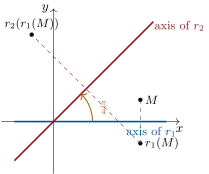
Two reflections make a rotation: reflecting M=(2,0.5) in the x-axis, then in the line y=x, lands at (−0.5,2) — the image of M under the rotation of angle 2π about the origin, twice the angle 4π between the axes. The weekend problem turns this picture into the composition law of all plane isometries.
Remark 23.18(Common pitfalls)
The projection formula needs an orthonormalbasis: for a merely generating family (vi) of F, the sum ∑i⟨x,vi⟩vi is notpF(x) (test F=R2, v1=e1, v2=e1+e2); with a non-orthonormal family, solve the normal equations instead (Method 23.13 (2)). Orthogonal families must avoid 0 to be free: the zero vector is orthogonal to everything, including itself — freeness in Proposition 23.6 requires nonzero vectors. F⊥ depends on the inner product: in R1[X], the complement of Vect(X) for ∫01PQ is not the constants but Vect(1−23X) — compute ∫01x(1−23x)=21−21=0; “perpendicular” is meaningless until the product is named. Do not expand ∥x+y∥ linearly: the correct identity is ∥x+y∥2=∥x∥2+2⟨x,y⟩+∥y∥2; the cross term vanishes only under orthogonality (Pythagoras), and the triangle inequality is an inequality. Sending unit vectors to unit vectors is not enough: u(x,y)=(x+y,0)maps both canonical basis vectors to the unit vector (1,0), yet ∥u(1,1)∥=2=2: no isometry. The definition demands ∥u(x)∥=∥x∥ for allx; in matrix terms ATA=I, i.e. columns that are unit and pairwise orthogonal — both conditions, checked together.
Remark 23.19(Where the inner product goes)
Orthogonal projection is the most applied theorem of the chapter: it underlies least squares (the weekend problem of Chapter 25 builds regression lines on it), Fourier coefficients (Example 23.14), and the normal equations of Exercise 23.5, which numerical analysis solves at scale. The classification Rθ/Sθ is completed below: the weekend problem classifies all distance-preserving transformations of the plane, linear or not, and their finite groups — the mathematics of rosettes and regular polygons. In the Year 2 volume the inner product meets eigenvalue theory (symmetric matrices, quadratic forms); in Year 3, infinite-dimensional Euclidean geometry becomes Hilbert space theory.
Remark 23.20(Perspectives inside Book 3)
Two bridges leave this chapter. Backward, to the linear algebra: the Gram matrix of Exercise 23.11 packages inner products into the determinant machinery of Chapter 22, and orthogonal projection is the special projector of Chapter 20 whose kernel is F⊥ — all its algebra (p2=p, s=2p−id) applies verbatim, now with the bonus that ∥x−p(x)∥ is a distance. Forward, to analysis: Chapter 24 measures arc length with this chapter’s norm and classifies nothing without its isometries; Chapter 25 reads the gradient through Cauchy–Schwarz (steepest ascent) and closes the volume with least squares, which is Theorem 23.10 applied to a data vector in Rn. The inner product is the point where the book’s algebra and its analysis finally meet.
23.4 Exercises
Exercise 23.1★
In R3 canonical: compute ⟨u,v⟩, ∥u∥, ∥v∥ and the angle between u=(1,2,2) and v=(2,−2,1). Verify Cauchy–Schwarz numerically.
Solution
Solution of Exercise 23.1.
⟨u,v⟩=2−4+2=0; ∥u∥=∥v∥=3. The vectors are orthogonal: the angle is 2π. Cauchy–Schwarz: ∣0∣≤9, comfortably.
Exercise 23.2★
Prove the parallelogram identity ∥x+y∥2+∥x−y∥2=2∥x∥2+2∥y∥2 in any Euclidean space, and use it to show that the sup norm on R2, ∥(x,y)∥∞=max(∣x∣,∣y∣), does not come from an inner product.
Solution
Solution of Exercise 23.2.
Expand both squared norms with the identity of Theorem 23.4 and add: the cross terms cancel.
Sup norm: take x=(1,0), y=(0,1). Then ∥x+y∥∞=∥x−y∥∞=1 and the identity would require 1+1=2(1)+2(1)=4: false. A norm violating the parallelogram identity comes from no inner product.
Exercise 23.3★
Apply Gram–Schmidt to ((1,1,0),(1,0,1),(0,1,1)) in canonical R3.
Solution
Solution of Exercise 23.3.
e1=21(1,1,0).
w2=(1,0,1)−⟨(1,0,1),e1⟩e1=(1,0,1)−21(1,1,0)=(21,−21,1); ∥w2∥=23, so e2=61(1,−1,2).
(Check: pairwise products vanish; each has norm 1.)
Exercise 23.4★
In R3, let F=Vect((1,1,1)). Determine F⊥ (equation and basis), the matrix of pF in the canonical basis, and d((1,2,3),F).
Solution
Solution of Exercise 23.4.
F⊥={(x,y,z):x+y+z=0}, basis((1,−1,0),(1,0,−1)). With e=31(1,1,1): pF(x)=⟨x,e⟩e=3x1+x2+x3(1,1,1), so
Mat(pF)=31111111111.
For x=(1,2,3): pF(x)=(2,2,2) and d(x,F)=∥(1,2,3)−(2,2,2)∥=∥(−1,0,1)∥=2.
Exercise 23.5★★
(Normal equations) Let F=Vect((1,0,1),(0,1,1))⊆R3 and x=(1,1,4). Compute pF(x) by solving ⟨x−p,v⟩=0 for the two generators (p=α(1,0,1)+β(0,1,1)), then d(x,F). Why is Gram–Schmidt unnecessary here?
Solution
Solution of Exercise 23.5.
Let p=α(1,0,1)+β(0,1,1)=(α,β,α+β). Orthogonality of x−p to the generators:
i.e. 2α+β=5 and α+2β=5: α=β=35. So pF(x)=(35,35,310) and
d(x,F)=∥x−p∥=(−32,−32,32)=32.
Gram–Schmidt is unnecessary because the defining property of the projection — x−p⊥F — is itself a linear system (“normal equations”) on the coefficients in any generating family.
with the case of equality, as an instance of Cauchy–Schwarz in C([0,1]). Then prove (∑i=1nai)2≤n∑ai2 for reals ai.
Solution
Solution of Exercise 23.6.
Cauchy–Schwarz with g=1:
(∫01f⋅1)2≤∫01f2⋅∫0112=∫01f2,
equality iff f is proportional to 1, i.e. constant. Discrete version: in Rn with x=(a1,…,an), y=(1,…,1): (∑ai)2≤∥x∥2∥y∥2=n∑ai2, equality iff all ai equal.
By Theorem 23.10, E=F⊕F⊥, so dimensions add: dimF⊥=dimE−dimF. Inclusion F⊆(F⊥)⊥ is immediate (vectors of F are orthogonal to everything in F⊥). Dimensions: dim(F⊥)⊥=dimE−dimF⊥=dimF; an inclusion with equal (finite) dimensions is an equality (Theorem 19.14).
Exercise 23.8★★
Identify the plane isometries of matrices
A=21(11−11),B=51(344−3)
(type, angle or axis). Compute A8 and B2 without multiplying matrices.
Solution
Solution of Exercise 23.8.
A: columns unit, determinant +1: a rotation, with cosθ=21, sinθ=21: θ=4π. Hence A8=R8π/4=R2π=I.
B: determinant 251(−9−16)=−1: a reflection Sθ with cosθ=53, sinθ=54; its axis makes the angle 2θ with the x-axis, i.e. the line directed by (cos2θ,sin2θ) — concretely the axis is Vect((2,1)), since B(2,1)T=51(6+4,8−3)T=(2,1)T. As a reflection, B2=I.
Expand: ∫01(x2−x+61)2=∫01(x4−2x3+34x2−31x+361)dx=51−21+94−61+361=1801. So the minimum equals 1801.
Exercise 23.10★★★
Let u be an isometry of a Euclidean spaceE. Prove that ker(u−id)⊥im(u−id), and deduce E=ker(u−id)⊕im(u−id). (Compute ⟨x−u(x),y⟩ for u(y)=y, using preservation of the product.)
Solution
Solution of Exercise 23.10.
Let y∈ker(u−id) (i.e. u(y)=y) and x∈E. Then, using preservation of the inner product (⟨u(a),u(b)⟩=⟨a,b⟩):
every vector of im(u−id) is orthogonal to every fixed vector.
Therefore im(u−id)⊆ker(u−id)⊥, and by rank–nullity plus Exercise 23.7, both have dimension dimE−dimker(u−id): they are equal. Then E=ker(u−id)⊕ker(u−id)⊥=ker(u−id)⊕im(u−id).
Exercise 23.11★★
(Gram matrix) For vectors v1,…,vk of a Euclidean space, let G=(⟨vi,vj⟩)1≤i,j≤k be their Gram matrix.
Prove that (v1,…,vk) is free if and only if G is invertible. (If Gc=0, compute ∥∑icivi∥2.)
Compute the Gram matrix of (1,X,X2) in R2[X] with ⟨P,Q⟩=∫01PQ, recognize the Hilbert matrixH3 of the weekend problem of Chapter 22, and conclude freeness from detH3=21601=0.
Solution
Solution of Exercise 23.11.
Suppose Gc=0 for a column c=(c1,…,ck)T. Then
i∑civi2=i,j∑cicj⟨vi,vj⟩=cTGc=0,
so ∑icivi=0. If the family is free this forces c=0: G is invertible. Conversely, a nontrivial relation ∑jcjvj=0 gives, taking the product with each vi, the nontrivial relation Gc=0: G singular. Freeness ⟺detG=0.
⟨Xi−1,Xj−1⟩=∫01xi+j−2dx=i+j−11: the Gram matrix of (1,X,X2) is exactly the Hilbert matrixH3, whose determinant 21601 was computed in the weekend problem of Chapter 22: nonzero, so the monomials are free — as expected, but now certified by a number.
Show A2=I, and deduce (via Theorem 20.15) that E=ker(u−id)⊕ker(u+id).
Show that the two subspaces are orthogonal, so that u is the orthogonal symmetry with respect to F=ker(u−id): reflection through F. (For u(x)=x and u(y)=−y, compute ⟨x,y⟩ two ways.)
Classify the plane case: which matrices of Theorem 23.17 are symmetric, and what are the corresponding maps?
Solution
Solution of Exercise 23.12.
A2=AA=ATA=I, so u2=id: u is a symmetry, and Theorem 20.15 (2) gives E=ker(u−id)⊕ker(u+id).
Let u(x)=x and u(y)=−y. Since u preserves the inner product,
⟨x,y⟩=⟨u(x),u(y)⟩=⟨x,−y⟩=−⟨x,y⟩,
so ⟨x,y⟩=0: the two eigenspaces are orthogonal, ker(u+id)=F⊥ for F=ker(u−id), and u is the orthogonal symmetry with respect to F.
Rθ is symmetric iff −sinθ=sinθ, i.e. θ∈{0,π}: the maps±id (identity and central symmetry). Every Sθ is symmetric: the line reflections. These are exactly the orthogonal symmetries of the plane, with F equal to the whole plane, {0}, or the reflection axis.
23.5 Problem: plane isometries and Leonardo’s theorem
Problem 23.1
An isometry of the plane is any mapf:R2→R2 preserving distances: ∥f(x)−f(y)∥=∥x−y∥ for all x,y — no linearity assumed. This problem proves that such maps are exactly the translations, rotations, reflections and glide reflections (the classification of plane isometries), computes their compositions, and determines all their finitegroups: Leonardo’s theorem, the mathematics behind rosette patterns. From Part II on we identify R2 with C (Chapter 3): the canonical inner product is ⟨z,w⟩=Re(zw) and the norm is the modulus.
Check that translations ta(x)=x+a, linear isometries, and all their compositions are isometries, and that the isometries form a group under composition.
Let f be an isometry with f(0)=0. Show that f preserves norms, then — by polarization, Theorem 23.4 — that ⟨f(x),f(y)⟩=⟨x,y⟩ for all x,y.
Still with f(0)=0: expand ∥f(x+y)−f(x)−f(y)∥2 and ∥f(λx)−λf(x)∥2 using question 2, and conclude that f is linear: f∈O(R2).
Deduce that every isometryf writes uniquely as f=ta∘g with a=f(0) and g a linearisometry (the linear part of f).
Call fdirect if detg=1, indirect if detg=−1. Show that the linear part of a composition is the composition of the linear parts, and state the resulting sign rule (direct/indirect compose like +1/−1).
Part II — The four types. Via Theorem 23.17, the linear isometries of C are z↦az and z↦az with ∣a∣=1; so every plane isometry is
f(z)=az+b(direct)orf(z)=az+b(indirect),∣a∣=1.
Verify the dictionary: Rθ is z↦eiθz and Sθ is z↦eiθz (check both on 1 and i).
(Direct case) Let f(z)=az+b, ∣a∣=1. Show: if a=1, f is a translation; if a=1, f has the unique fixed point z0=b/(1−a) and f(z)−z0=a(z−z0): a rotation of center z0 and angle arga.
(Indirect case) Let f(z)=az+b, and v=ab+b. Show f∘f=tv and f∘tv=tv∘f. If v=0: show that the midpoint of z and f(z) is a fixed point, and that f is a reflection in a line. If v=0: show that r=t−v/2∘f is a reflection whose axis is parallel to v, so that f=tv/2∘r is a glide reflection. Conclude: every plane isometry is a translation, a rotation, a reflection or a glide reflection (the classification of plane isometries).
(Compositions) Show: the composition of rotations of angles α and β is a rotation of angle α+β (a translation if α+β∈2πZ); the composition of two reflections is a rotation of angle twice the angle between the axes (a translation if the axes are parallel).
Deduce that every plane isometry is a composition of at most three reflections.
Let f be the rotation of angle 2π about 0 and g the rotation of angle 2π about 1. Compute g∘f in the form z↦az+b and identify it (type, center, angle).
Let r1(z)=z (reflection in the real axis) and r2(z)=iz (reflection in the line y=x). Compute r2∘r1 and check question 9 on this example.
Part IV — Finite groups: Leonardo’s theorem. Let G be a finitegroup of plane isometries.
Show that isometries preserve barycenters: if λ1+⋯+λm=1 and f=ta∘g (glinear), then f(∑iλixi)=∑iλif(xi).
Set c=∣G∣1∑g∈Gg(x0) for any chosen x0. Show that every h∈G fixes c: a finite group of isometries has a common fixed point.
Deduce that, after conjugating by t−c, one may assume G⊆O(R2). Let G+={g∈G:detg=1}; show that either G=G+ or G+ has exactly index 2 in G (exhibit a bijection G+→G∖G+).
Show that a finite group of rotations about c is cyclic: among its elements pick the rotation Rθ0 of smallest angle θ0∈(0,2π), and use euclidean division of angles to prove that it generates; conclude θ0=n2π and G+={Rθ0k}≅Cn.
Suppose G=G+ and pick a reflection s∈G. Show G=G+∪sG+, that srs=r−1 for every rotation r∈G+, and that all n elements of sG+ are reflections: G is the dihedral groupDn of order 2n.
Conclude (Leonardo’s theorem): every finite group of isometries of the plane is cyclic Cn or dihedral Dn.
Part V — Dividends, and synthesis.
Show directly that a finite group of isometries can contain no translation and no glide reflection other than the identity (consider the powers of such an element).
Let Pn be the regular n-gon with vertices the n-th roots of unity (n≥3). Show that its symmetry group is exactly Dn: the n rotations z↦ωkz and the n reflections z↦ωkz, ω=e2iπ/n, and no others.
Exhibit plane figures whose symmetry groups are C1, D1, D2 and C3 respectively.
List the eight elements of the symmetry group of the square with vertices ±1,±i as mapsz↦ωkz or z↦ωkz, and give the axis of each of the four reflections.
Let f,g be rotations of the same angle θ∈/2πZ about distinct centers c1=c2. Compute f∘g−g∘f pointwise and show f∘g=g∘f; show moreover that (f∘g)∘(g∘f)−1 is a nontrivial translation, so that any group containing f and g is infinite — a second explanation of the single center in Leonardo’s theorem.
Synthesis, in four sentences: which two structural results reduce arbitrary isometries to linear algebra (questions 3–4) and arbitrary finite groups to subgroups of O(2) (question 15); what the complete list of plane isometries is and which invariants (direct/indirect, fixed points) separate the four types; why the composition rules of question 9 make reflections the generators of everything; and what Leonardo’s theorem adds on the finite scale. Name the two theorems proved in Parts II and IV.
Solution
Solution of Problem 23.1.
1.∥ta(x)−ta(y)∥=∥x−y∥; a linearisometry preserves norms, hence distances (∥g(x)−g(y)∥=∥g(x−y)∥=∥x−y∥); and a composition of distance-preserving maps preserves distances. Every isometry is injective (distinct points stay at positive distance) and, by the classification below, bijective; identity and inverses are isometries: a group.
as a direct check shows; similarly ∥f(λx)−λf(x)∥2=∥λx∥2−2λ⟨λx,x⟩+λ2∥x∥2=0. So f(x+y)=f(x)+f(y) and f(λx)=λf(x): f is linear, and norm-preserving: f∈O(R2).
4. Set a=f(0) and g=t−a∘f: an isometry fixing 0, hence a linearisometry (question 3), and f=ta∘g. Uniqueness: ta∘g=ta′∘g′ evaluated at 0 gives a=a′, then g=g′.
5.(ta∘g)∘(ta′∘g′)=ta+g(a′)∘(g∘g′), since gta′=tg(a′)g for linearg. So the linear part of a composition is g∘g′, and det(gg′)=detgdetg′: direct∘direct = indirect∘indirect = direct, direct∘indirect = indirect — the sign rule of ±1.
6.z↦eiθz sends 1 to (cosθ,sinθ) and i to ieiθ=(−sinθ,cosθ): the columns of Rθ. And z↦eiθz sends 1 to (cosθ,sinθ) and i to −ieiθ=(sinθ,−cosθ): the columns of Sθ.
7.a=1: f=tb. a=1: the fixed-point equation az0+b=z0 has the unique solution z0=b/(1−a), and then
f(z)−z0=az+b−(az0+b)=a(z−z0):
in the frame centered at z0, f is the multiplication by a=eiarga: the rotation of center z0 and angle arga.
8.f(f(z))=a(az+b)+b=aaz+ab+b=z+v: f2=tv. Commutation: f(z+v)=az+av+b and av=a(ab+b)=b+ab=v, so f∘tv=tv∘f.
Case v=0: f2=id. For any z, the midpoint m=2z+f(z) satisfies (isometries being affine, Part I) f(m)=2f(z)+f2(z)=m: fixed points exist. Conjugating by the translation to a fixed point, f becomes a linear indirect isometry, i.e. some Sθ (Theorem 23.17): a reflection in a line.
Case v=0: r=t−v/2∘f is indirect and
r2=t−v/2ft−v/2f=t−v/2t−v/2f2=t−vtv=id
(using the commutation), so r is a reflection, and f=tv/2∘r. Its axis is parallel to v: r commutes with tv (both f and tv/2 do), so tvmaps the axis (the fixed line of r) to itself, forcing v to direct it. Hence f is a glide reflection with glide vector v/2. Every isometry is now classified: translation or rotation (direct), reflection or glide reflection (indirect).
9. Rotations f(z)=az+b, g(z)=a′z+b′ with a=eiα, a′=eiβ: g∘f(z)=a′az+(a′b+b′) has linear coefficient ei(α+β): a rotation of angle α+β by question 7, or a translation when ei(α+β)=1. Reflections ri(z)=aiz+bi with ai=eiθi (axis at angle θi/2):
r2∘r1(z)=a2a1z+(a2b1+b2),
direct with angle θ2−θ1=2(2θ2−2θ1): twice the angle between the axes; parallel axes (θ1=θ2) give a translation.
10. A rotation of center c and angle θ is the product of two reflections in lines through c making angle θ/2 (question 9, read backwards); a translation tv is the product of two reflections in parallel lines orthogonal to v at distance ∥v∥/2; a reflection is one reflection; a glide reflection is a reflection composed with a translation, hence three. Maximum: three.
11.a=i, b=1+i: v=ab+b=i(1−i)+1+i=(1+i)+(1+i)=2+2i=0: a glide reflection with glide vector v/2=1+i. The reflection r=t−(1+i)∘f is r(z)=iz, whose axis is the line at angle 21argi=4π: the line y=x. So f is the glide reflection of axis y=x and vector (1,1).
12.f(z)=iz and g(z)=1+i(z−1)=iz+1−i, so
g∘f(z)=i(iz)+1−i=−z+1−i:
linear coefficient −1=eiπ, a rotation of angle π (a half-turn), of center z0=1−(−1)1−i=21−i.
13.r2∘r1(z)=iz=iz: the rotation of angle 2π about 0. The axes (the real axis, angle 0; the line y=x, angle 4π) meet at angle 4π, and twice that is 2π: question 9 confirmed.
15. For h∈G, using question 14 (the coefficients ∣G∣1 sum to 1):
h(c)=∣G∣1g∈G∑h(g(x0))=∣G∣1g′∈G∑g′(x0)=c,
because g↦hg is a bijection of G onto itself.
16. The conjugates t−cgtc (g∈G) form a group of isometries fixing 0, hence of linear isometries (question 3): a finite subgroup of O(R2). If some s∈G is indirect, the mapg↦sg sends G+injectively into G∖G+ and h↦s−1h is its inverse (sign rule of question 5): ∣G∣=2∣G+∣; otherwise G=G+.
17. If G+={id}, it is C1. Otherwise write its elements as Rθ, θ∈[0,2π), and let θ0 be the smallest positive angle occurring. For Rθ∈G+, euclidean division θ=kθ0+ρ with 0≤ρ<θ0 gives Rρ=RθRθ0−k∈G+, so ρ=0 by minimality: G+=⟨Rθ0⟩. Dividing 2π by θ0 the same way shows 2π=nθ0: G+≅Cn, generated by the rotation of angle n2π.
18.G=G+∪sG+ by the counting of question 16. With s(z)=az and r(z)=ωz (linear forms, after question 16; ∣a∣=∣ω∣=1):
srs(z)=aωaz=aωaz=ωz=r−1(z).
Each element srk of sG+ is indirect and satisfies (srk)2=(srks)rk=r−krk=id: an involutive indirect isometry fixing c, i.e. a reflection. So G consists of n rotations and n reflections with the relations rn=s2=id, srs=r−1: the dihedral groupDn.
19. Combining: a finite group of plane isometries fixes a point c (question 15), reduces to a finite subgroup of O(2) (question 16), and is Cn if it contains only rotations (question 17), Dn otherwise (question 18): Leonardo’s theorem.
20. A translation tv=id has powers tkv, all distinct (kv pairwise distinct for v=0): infinite order. A glide reflectionf has f2=tv with v=0: again infinite order. Neither fits in a finite group — consistently with questions 15–19, which produced only rotations and reflections.
21. The 2nmaps preserve the vertex set: ωkωj=ωk+j and ωkωj=ωk−j; being isometries, they preserve the polygon (segments go to segments). Conversely, a symmetry preserves the barycenter 0 of the vertices (question 14), hence is linear, and permutes the vertices (they are the points of the polygon at maximal distance from 0). A linearisometry sending the vertex 1 to ωk is z↦ωkz if direct, z↦ωkz if indirect (its matrix is determined by one column and the sign): at most 2n symmetries, so exactly the Dn above.
22.C1: a scalene triangle (no nontrivial symmetry). D1: an isoceles, non-equilateral triangle (one reflection). D2: a non-square rectangle (identity, the half-turn about the center, the two axis reflections). C3: a triskelion — three congruent bent arms attached at 120-degree intervals; the bend kills every reflection but leaves the rotations of order 3.
23. With ω=i: the rotations z↦z, iz, −z, −iz (angles 0,2π,π,23π), and the reflections
z↦z(axis y=0),iz(y=x),−z(x=0),−iz(y=−x):
the two diagonals and the two medians of the square — the dihedral groupD4, of order 8.
24. Write a=eiθ=1: f(z)=az+c1(1−a) and g(z)=az+c2(1−a). Then
so fg=gf. Both compositions have linear coefficient a2, so (fg)∘(gf)−1 has linear coefficient 1: it is the translation by fg(z)−gf(z), the nonzero constant above. A group containing f and g contains this translation and all its powers: it is infinite. Two rotation centers are one too many for a finite group — the geometric heart of Leonardo’s theorem.
25. (i) Questions 3–4 show every distance-preserving map is affine with orthogonallinear part, and question 15 pins every finite group to a fixed point: both results convert metric geometry into linear algebra at the origin. (ii) The complete list is translation, rotation, reflection, glide reflection; the determinant of the linear part separates direct from indirect, and the existence of fixed points separates the two types within each parity. (iii) By question 9, two reflections compose to any rotation or translation, so reflections generate the whole group — at most three suffice for any isometry. (iv) On the finite scale only two families survive, the cyclic and dihedral groups, which is why rosette ornaments come in exactly two kinds (with or without mirror axes). Part II proved the classification of plane isometries; Part IV proved Leonardo’s theorem.