 Coach
CoachA group is a set with an associative law admitting an identity and in which every element has an inverse. The group is abelian when the law is commutative.
Examples
Example 7.4
, , , ; , , , (roots of unity, Definition 3.17); the set of bijections of a set onto itself, under composition — the symmetric group of , non-abelian as soon as . Not groups: (no inverses), (only invertible).
Example 7.6 (The symmetries of a rectangle)
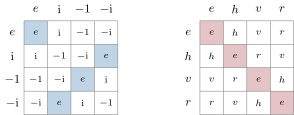
A (non-square) rectangle admits exactly four isometries onto itself: the identity , the horizontal-axis reflection , the vertical-axis reflection , and the half-turn about the center. Composition makes this four-element set a group: each element is its own inverse (), and the product of any two distinct non-identity elements is the third (: reflecting in both axes is the half-turn). The full table is symmetric, so the group is abelian — yet it is not the same group as the rotations of Example 7.15: there, has order , while here every element has order . Two groups of the same size can thus have genuinely different multiplication structures — the figure below displays both tables side by side. This four-element group returns as , and Exercise 7.7 explains why any group with all squares trivial must, like this one, be abelian.
Example 7.13 (The sign morphism)
The map sending to its sign is a morphism: the sign of a product is the product of the signs. Its kernel is (a subgroup, as Definition 7.10 promises), its image all of : surjective, massively non-injective. Two general lessons in miniature. First, a morphism may crush information: remembers nothing of but one bit, and that is its virtue — sign arguments are exactly the computations that factor through . Second, morphisms to are the simplest “invariants”: the signature of permutations, built in this chapter’s weekend problem, is the same phenomenon on the group , and the parity arguments it powers all descend through such a two-valued morphism.