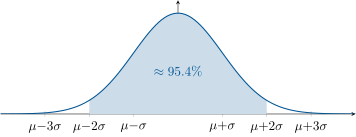
Definition 35.8 High School Mathematics · Chapter 35 — Continuous Random Variables XXX follows the standard normal distribution N(0,1)\mathcal N(0, 1)N(0,1) if its density on R\RR is φ(t)=12π e−t2/2\varphi(t) = \frac{1}{\sqrt{2\pi}}\,\eu^{-t^2/2}φ(t)=2π1e−t2/2 (the bell curve). More generally, X∼N(μ,σ2)X \sim \mathcal N(\mu, \sigma^2)X∼N(μ,σ2) if X−μσ∼N(0,1)\dfrac{X - \mu}{\sigma} \sim \mathcal N(0,1)σX−μ∼N(0,1); then E(X)=μ\E(X) = \muE(X)=μ and V(X)=σ2\V(X) = \sigma^2V(X)=σ2. The normal density: about 68.3%68.3\%68.3% of the mass lies within σ\sigmaσ of the mean, 95.4%95.4\%95.4% within 2σ2\sigma2σ, 99.7%99.7\%99.7% within 3σ3\sigma3σ. Read in context →