Mathematics · Glossary

What is Parabola?

Definition 10.14 High School Mathematics · Chapter 10 — Quadratic Functions and Equations

The graph of a quadratic function f(x)=a(xα)2+βf(x) = a(x-\alpha)^2+\beta is a parabola with vertex S(α,β)S(\alpha, \beta). It opens upward if a>0a > 0, downward if a<0a < 0, and is symmetric about the vertical line x=αx = \alpha.

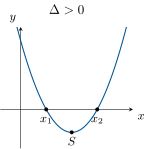
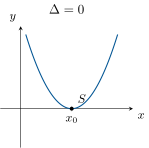
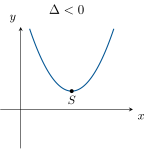
The three positions of an upward parabola (a > 0) relative to the x-axis: two roots, one double root, no root. The vertex S has abscissa = -b/2a. The three positions of an upward parabola (a > 0) relative to the x-axis: two roots, one double root, no root. The vertex S has abscissa = -b/2a. The three positions of an upward parabola (a > 0) relative to the x-axis: two roots, one double root, no root. The vertex S has abscissa = -b/2a.
The three positions of an upward parabola (a>0a > 0) relative to the xx-axis: two roots, one double root, no root. The vertex SS has abscissa α=b2a\alpha = -\frac{b}{2a}.
Read in context →