Quadratic functions are the simplest functions after the linear ones, and the first whose graphs are genuinely curved. This chapter develops the complete toolbox for them: the canonical form, the discriminant, the sign of a quadratic expression, and the geometry of the parabola.
Proof. We complete the square. Since a=0, factor it out of the first two terms:
ax2+bx+c=a(x2+abx)+c.
Now x2+abx is the beginning of the square (x+2ab)2=x2+abx+4a2b2, so x2+abx=(x+2ab)2−4a2b2. Substituting:
f(x)=a(x+2ab)2−4ab2+c=a(x−α)2+β,
with α=−2ab and β=c−4ab2. Evaluating at x=α kills the squared term, so β=f(α). Uniqueness: expandinga(x−α)2+β and identifying the coefficients of x forces α=−2ab, and then β is determined. ∎
Example 10.3
Let f(x)=2x2−8x+3. Then α=−2×2−8=2 and β=f(2)=8−16+3=−5, so
f(x)=2(x−2)2−5.
Check by expanding: 2(x2−4x+4)−5=2x2−8x+8−5=2x2−8x+3.
If a<0, the variations are reversed: f has a maximumβ at x=α.
Proof. Suppose a>0 and let α≤u<v. Then
f(v)−f(u)=a((v−α)2−(u−α)2)=a(v−u)((v−α)+(u−α)).
Each factor is positive: a>0, v−u>0, and (v−α)+(u−α)>0 since v>α and u≥α. So f(v)>f(u): f is increasing on [α,+∞). For u<v≤α the last factor is negative, so f(v)<f(u): f is decreasing there. Finally f(x)−f(α)=a(x−α)2≥0 for all x, so β=f(α) is the minimum. The case a<0 follows by applying the above to −f. ∎
Example 10.5
A farmer has 100 meters of fence to enclose a rectangular field against a straight wall (no fence needed along the wall). If x is the width, the enclosed area is A(x)=x(100−2x)=−2x2+100x. Here α=−2×(−2)100=25 and A(25)=25×50=1250: the area is largest for a width of 25 m, giving 1250 m2.
10.2 Roots and factorization
Definition 10.6(Root, discriminant)
A root of the trinomial ax2+bx+c is a solution of the equationax2+bx+c=0. The discriminant of the trinomial is the number
A product is zero exactly when one of its factors is zero, giving the two roots, distinct because Δ=0.
2. If Δ=0, the bracket is (x+2ab)2, which vanishes only at x0=−2ab.
3. If Δ<0, then −4a2Δ>0, so the bracket is a square plus a positive number: it never vanishes, and the equation has no real solution. A factorization a(x−x1)(x−x2) would produce roots, so none exists. ∎
Example 10.8
Solve 2x2−8x+3=0. Here Δ=(−8)2−4×2×3=64−24=40>0, so there are two roots:
x1,2=48±40=48±210=2±210.
For x2+x+1=0: Δ=1−4=−3<0, no real solution.
Proposition 10.9(Sum and product of the roots)
If Δ≥0 and x1,x2 are the roots (equal when Δ=0), then
x1+x2=−ab,x1x2=ac.
Conversely, two numbers with sum s and product p are the solutions of x2−sx+p=0.
Identifying the coefficients with ax2+bx+c gives −a(x1+x2)=b and ax1x2=c. For the converse, if u+v=s and uv=p, then (x−u)(x−v)=x2−sx+p, so u and v are its roots. ∎
Example 10.10
Find two numbers with sum 10 and product 21. They solve x2−10x+21=0; Δ=100−84=16, roots210±4=7 and 3. Quick root spotting: since the coefficients of x2−5x+4 satisfy 1−5+4=0, the number 1 is a root, and the other one is ac=4 (their product must be ac).
10.3 Sign of a quadratic
Theorem 10.11(Sign of a trinomial)
Let f(x)=ax2+bx+c with a=0.
If Δ>0, with rootsx1<x2: f(x) has the sign of a outside [x1,x2], and the sign of −a on (x1,x2).
If Δ=0: f(x) has the sign of a for all x=x0, and vanishes at x0.
If Δ<0: f(x) has the sign of a for all x.
In short: a trinomial has the sign of a, except between its roots.
Proof.1. Write f(x)=a(x−x1)(x−x2) and follow the signs of the factors. If x<x1: both x−x1 and x−x2 are negative, their product is positive, so f(x) has the sign of a. If x1<x<x2: the factors have opposite signs, the product is negative, and f(x) has the sign of −a. If x>x2: both factors are positive and f(x) has the sign of a again.
2.f(x)=a(x−x0)2 and (x−x0)2>0 for x=x0.
3. From the proof of Theorem 10.7, f(x)=a[(x+2ab)2+(−4a2Δ)], and the bracket is always positive. ∎
read off the solution interval(s), paying attention to whether the roots themselves are included (wide inequality) or not (strict).
Example 10.13
Solve −x2+3x+4≥0. Here Δ=9+16=25, and the roots are −2−3±5, that is x1=−1 and x2=4. Since a=−1<0, the trinomial is negative outside the roots and positive between them. With the wide inequality, the solution set is [−1,4].
10.4 The parabola
Definition 10.14(Parabola)
The graph of a quadratic functionf(x)=a(x−α)2+β is a parabola with vertexS(α,β). It opens upward if a>0, downward if a<0, and is symmetric about the vertical line x=α.
Remark 10.15
The symmetry is easy to check: for any h, f(α+h)=ah2+β=f(α−h), so two points at equal horizontal distance from the line x=α have the same height.
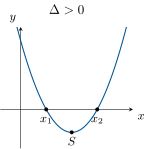
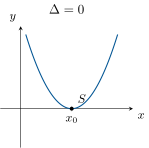
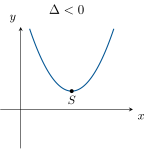
The three positions of an upward parabola (a>0) relative to the x-axis: two roots, one double root, no root. The vertex S has abscissaα=−2ab.
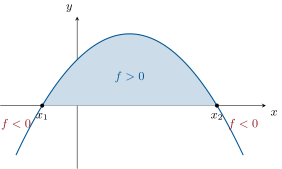
Sign of a downward trinomial (a<0) with two roots: the sign of −a between the roots (shaded), the sign of a outside.
Method 10.16(Reading a parabola)
To sketch f(x)=ax2+bx+c: find the orientation (sign of a), the vertex (−2ab,f(−2ab)), the intersection(0,c) with the y-axis, and the roots, if any. The axis of symmetry x=−2ab then places every computed point twice.
Example 10.17
For f(x)=x2−4x+3: upward, vertex (2,−1), crosses the y-axis at (0,3), roots1 and 3 (spotted: 1−4+3=0). By symmetry, the point (4,3) is also on the curve, mirroring (0,3).
x2−3x−10: Δ=9+40=49, roots23±7=−2 and 5; positive leading coefficient, so the trinomial is negative strictly between the roots: the solution set is (−2,5).
2x2+x+3: Δ=1−24=−23<0 and a=2>0: always positive, the solution set is R.
−x2+6x−9=−(x−3)2: it is ≥0 only where (x−3)2≤0, that is at x=3. The solution set is {3}.
Exercise 10.4★
Without computing Δ, find one obvious root, then the other:
x2−7x+6=0,2x2+5x−7=0,x2+4x−5=0.
(Hint: test x=1 and x=−1, then use the product of the roots.)
Solution
Solution of Exercise 10.4.
x2−7x+6: 1−7+6=0, so 1 is a root; the product of the roots is 6, so the other root is 6.
2x2+5x−7: 2+5−7=0, so 1 is a root; the product is ac=−27, so the other root is −27.
x2+4x−5: 1+4−5=0, so 1 is a root; the product is −5, so the other root is −5.
Exercise 10.5★★
Find two numbers whose sum is 14 and whose product is 45. Then find the dimensions of a rectangle of perimeter 34 and area 60.
Solution
Solution of Exercise 10.5.
The two numbers solve x2−14x+45=0 (Proposition 10.9); Δ=196−180=16, roots214±4=9 and 5.
For the rectangle: half the perimeter gives length + width =17, and the area gives their product 60. They solve x2−17x+60=0; Δ=289−240=49, roots217±7=12 and 5. The rectangle is 12×5.
Exercise 10.6★★
Let f(x)=x2+(m−2)x+1, where m is a real parameter. For which values of m does the equationf(x)=0 have exactly one solution? No solution?
Solution
Solution of Exercise 10.6.
Δ=(m−2)2−4. Exactly one solution when Δ=0: (m−2)2=4, so m−2=±2, i.e. m=0 or m=4. No solution when Δ<0: (m−2)2<4, i.e. −2<m−2<2, that is 0<m<4.
Exercise 10.7★★
A ball is thrown upward; its height after t seconds is h(t)=−5t2+20t+1 (in meters). What is the maximal height reached, and at what time? During which time interval is the ball at least 16 m high?
Solution
Solution of Exercise 10.7.
The vertex is at t=−2×(−5)20=2, and h(2)=−20+40+1=21: maximal height 21 m, reached after 2 seconds.
h(t)≥16 means −5t2+20t−15≥0, i.e. (dividing by −5, which reverses the inequality) t2−4t+3≤0. The roots of t2−4t+3 are 1 and 3 (1−4+3=0, product 3), so t2−4t+3≤0 exactly on [1,3]: the ball is at least 16 m high between the times t=1 s and t=3 s.
Exercise 10.8★★
Solve the equationx4−13x2+36=0 by setting X=x2 (a biquadraticequation).
Solution
Solution of Exercise 10.8.
With X=x2: X2−13X+36=0, Δ=169−144=25, so X=213±5=9 or 4. Back to x: x2=9 gives x=±3, and x2=4 gives x=±2. The solution set is {−3,−2,2,3}.
Exercise 10.9★★
For which values of x is the point M(x,x2) of the parabolay=x2 strictly below the line y=x+2? Interpret on a sketch.
Solution
Solution of Exercise 10.9.
The condition is x2<x+2, i.e. x2−x−2<0. Since x2−x−2=(x+1)(x−2) (roots−1 and 2), the inequality holds strictly between the roots: x∈(−1,2). On a sketch, the parabolay=x2 dips below the line y=x+2 exactly between their two intersection points (−1,1) and (2,4).
Exercise 10.10★★
The sum of a positive number and its reciprocal is 613. Find the number. (Reduce to a quadratic equation.)
Solution
Solution of Exercise 10.10.
Let x>0 satisfy x+x1=613. Multiplying by 6x>0: 6x2+6=13x, i.e. 6x2−13x+6=0. Then Δ=169−144=25 and x=1213±5, giving x=23 or x=32. Both are positive and are reciprocals of each other, as expected: the number is 23 (or 32).
Exercise 10.11★★★
Let P be the parabolay=x2 and let dm be the line y=mx−1, where m is a real parameter.
For which values of m do P and dm intersect in two points? One point? No point?
When they touch in exactly one point, compute the contact point. (In Chapter 12 you will recognize dm as the tangent to P at that point.)
Solution
Solution of Exercise 10.11.
1.Intersections correspond to solutions of x2=mx−1, i.e. x2−mx+1=0, whose discriminant is Δ=m2−4. Two points when ∣m∣>2; exactly one when m=±2; none when −2<m<2.
2. For m=2: x2−2x+1=(x−1)2=0, so the unique contact point is (1,1). For m=−2: (x+1)2=0, contact point (−1,1). In both cases the line meets the parabola at a single point without crossing it — it is the tangent there, and indeed its slopem=±2 equals the value at x=±1 of the derivative 2x of x2 (Chapter 12).
10.6 Problem: The parabola’s secret point
Problem 10.1
Weekend problem — focus and directrix: why satellite dishes, headlights and suspension bridges all draw the same curve, of which there is essentially only one
Every satellite dish on every balcony aims its receiver at one precise interior point; every headlight hides its bulb at the same special spot. That point — the focus — is a secret the parabola has kept since Greek geometry, and the distance formula is enough to extract it. Along the way, this problem drills the discriminant, throws projectiles over walls, suspends a bridge, and proves an astonishing final fact: up to zoom, there is only one parabola in the world.
Part I — Trinomial fluency.
Solve x2−5x+6=0, then 2x2+x−6=0, then x2+x+1=0 (Theorem 10.7).
Write 2x2−4x−6 in factored form and in canonical form (Theorem 10.2). Together with the expanded form, you now hold three costumes of one function: say which feature each displays at a glance (roots, vertex, y-intercept).
Solve −x2+4x−3≥0 with the sign rule (Theorem 10.11).
Viète as detective (Proposition 10.9, continuing Babylon in Problem 2.1): find two numbers with sum 7 and product 12 by writing their equation. Then: one root of x2−5x+c=0 equals 2; find c and the other root without solving anything.
For which values of m does x2+mx+9=0 have a double root? No root? Two roots?
Part II — The focus unveiled. Work on the parabolay=x2, the point F(0,41) and the horizontal line δ of equationy=−41.
For a point P(x,x2) of the parabola, expand PF2=x2+(x2−41)2 and show it is the perfect square (x2+41)2. Deduce PF.
Compute the distance from P to the line δ, and conclude: every point of the parabola is exactly as far from F as from δ. (F is the focus, δ the directrix.)
Prove the converse: a point P(x,y) with PF=dist(P,δ) must satisfy y=x2. (Square both distances and simplify.) The parabola is thus a locus, exactly as the circle was in Problem 5.1: equidistance from a point and a line, instead of from one point.
For the wider parabolay=4fx2 (with f>0), adapt question 6 to show the focus is (0,f) and the directrixy=−f. Application: a satellite dish is 60 cm wide and 9 cm deep — its rim passes through (30,9). Find f: how high above the vertex must the receiver hang?
The reason dishes work: rays arriving parallel to the axis all reflect through the focus (and a bulb at the focus throws a parallel beam — headlights are dishes run backwards). Explain why question 7’s equidistance makes this plausible (think of the rays as marching wavefronts), and say which tool, coming in Chapter 12 (see Exercise 10.11), turns plausibility into proof.
A ball follows the trajectory y=x−20x2 (x and y in meters). Find where it lands, the horizontal position of its highest point, and the maximal height (Proposition 10.4).
On the same trajectory, a wall stands at x=4. Compute the ball’s height there: does it clear a 3 m wall? A 4 m wall?
A parabolic arch spans 40 m with maximal height 10 m: in centered coordinates, y=10−40x2. Can a truck 7 m tall pass at 10 m from the center? At 15 m?
A theater’s revenue at ticket price p euros is R(p)=p(120−2p) (demand falls as price rises). Find the price maximizing revenue, and the maximum.
The Golden Gate’s main cables are parabolic to excellent accuracy (a uniform deck load produces a parabola — a freely hanging chain does not: its curve, the catenary, needs the exponential of grade 12). With span 1280 m and sag 143 m, the cable follows y=143(640x)2 from the center. How high is the cable above its lowest point at x=320 m?
Part IV — Lines, tangents, and the last surprise.
Complete Exercise 10.11: the lines y=mx−1 through the external point (0,−1) meet y=x2 according to the sign of a discriminant. Find the two tangent lines from (0,−1) and their contact points.
Now the lines y=mx+1 through the interior point (0,1): compute the discriminant of the intersectionequation and show every such line cuts the parabola twice. Moral: from inside, no tangents — just as for a circle.
The focal chord: intersect y=x2 with the horizontal line through the focus, y=41. What is the chord’s length? Check the general rule (worth remembering for dishes): for y=4fx2, the chord through the focus parallel to the directrix has length 4f.
The last surprise: apply the zoom (x,y)↦(kx,ky) to the parabolay=x2 and show the image is exactly y=kx2. Conclude: every parabolay=4fx2 is a magnified unit parabola — unlike circles and ellipses of different proportions, all parabolas are similar.
Finale: the parabola’s portrait in five lines — an equation with three costumes (question 2), a locus (questions 7–8), an engineer’s reflector (questions 9, 10), a projectile’s path and a bridge’s cable (questions 11–15), and a single curve up to zoom (question 19). One sentence each.
Solution
Solution of Problem 10.1.
1.x2−5x+6: Δ=1, roots2 and 3. 2x2+x−6: Δ=1+48=49, roots4−1±7: 23 and −2. x2+x+1: Δ=−3<0: no real solution.
2.Δ=16+48=64: roots3 and −1, so 2x2−4x−6=2(x−3)(x+1); canonical form2(x−1)2−8. The factored form shows the roots, the canonical form the vertex (1,−8), the expanded form the y-intercept −6.
3.Roots1 and 3, leading coefficient negative: the trinomial is ≥0between the roots: x∈[1,3].
4. The numbers are the roots of x2−7x+12=0: 3 and 4. If 2 is a root of x2−5x+c, the other rootr satisfies 2+r=5 (sum), so r=3, and c=2×3=6 (product): Viète reads it off.
5.Δ=m2−36: double root for m=±6 (root∓3); no root for −6<m<6; two roots for ∣m∣>6.
7. The distance from P(x,x2) to the horizontal line y=−41 is x2+41 — exactly PF. Every point of the parabola is equidistant from the focus and the directrix.
8.PF2=x2+(y−41)2 and dist2=(y+41)2. Equality gives x2+y2−2y+161=y2+2y+161, so x2=y: the locus is exactly the parabola. One point and one line generate the curve, as one point and one distance generated the circle.
9. For y=4fx2, the same expansion with F(0,f) gives PF2=x2+(4fx2−f)2=(4fx2+f)2: distance to F equals distance to y=−f. Dish: 9=4f302 gives 4f=100, f=25 cm: the receiver hangs a quarter meter above the vertex — outside the 9 cm bowl, as real dishes show.
10. A wavefront arriving parallel to the axis has travelled equal distances to reach the directrix’s level; equidistance converts “equal distance to the directrix” into “equal distance to F”: all the reflected signals arrive at Fin step, reinforcing — that is where to listen. The honest proof needs the tangent’s slope at each point — the derivative of Chapter 12, glimpsed in Exercise 10.11.
11.y=x(1−20x): lands at x=20 m. Vertex midway: x=10, height y(10)=10−5=5 m.
12.y(4)=4−2016=3.2 m: clears 3 m with room, smacks into a 4 m wall.
13.y(10)=10−40100=7.5 m >7: the truck passes at 10 m off-center. y(15)=10−40225=4.375 m: not at 15 m.
14.R(p)=−2p2+120p: vertex at p=4120=30 euros, revenue R(30)=30×60=1800 euros.
15.y(320)=143×(640320)2=4143≈36 m above the lowest point.
16.x2=mx−1 gives x2−mx+1=0, Δ=m2−4: two points for ∣m∣>2, none for ∣m∣<2, tangency for m=±2 with contact x=2m=±1: tangents y=2x−1 at (1,1) and y=−2x−1 at (−1,1).
17.x2=mx+1 gives Δ=m2+4>0 for every m: two intersections always. From an interior point, every line crosses the curve twice — tangents are drawn only from outside, exactly as for circles.
18.y=41 meets y=x2 at x=±21: chord length 1. For y=4fx2: y=f gives x2=4f2, x=±2f: length 4f — the focal width is four times the focal distance (dish designers call it the latus rectum).
19. A point of y=x2 is (a,a2); its image is (X,Y)=(ka,ka2), and kX2=kk2a2=ka2=Y: the image curve is exactly y=kx2. Choosing k=4f reaches every parabola: they are all magnifications of one master curve. (Circles are all similar too — but ellipses are not: squash matters, zoom does not.)
20. An equation with three readable costumes; the locus of equidistance from a point and a line; the reflector that gathers parallel rays at its focus and the cable that carries a uniform deck; the path of every thrown ball; and, up to magnification, a single curve — one parabola, everywhere.