A parametrized curve is a mapf:I→R2, t↦M(t)=(x(t),y(t)), with x,y of class C1 (at least) on the intervalI. The velocity vector is f′(t)=(x′(t),y′(t)); the point M(t0) is regular when f′(t0)=(0,0), and the tangent there is the line through M(t0) directed by f′(t0).
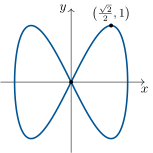
The Lissajous curve (sint,sin2t): a double point at the origin, where two regular branches cross with velocities (1,2) and (−1,2), and horizontal tangents at the four summits. Symmetry reduced all the work to a quarter-period.
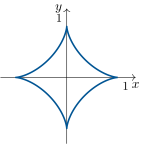
The astroid (cos3t,sin3t): four arcs meeting at four cusps. It is the curve traced by a point of a circle of radius 41 rolling inside the unit circle.
Examples
Example 24.3(Asymptotic branches, worked)
x(t)=t, y(t)=t+t1 on (0,+∞). As t→0+: x→0 while y→+∞ — the curve climbs along the vertical asymptotex=0 (finite limit for one coordinate, infinite for the other). As t→+∞: both coordinates blow up, so test a line: the difference
y(t)−x(t)=t1⟶0+
exhibits the oblique asymptotey=x, approached from above. In between, y′=1−t21 vanishes at t=1: the point (1,2) is the low point of the branch, and x′=1>0 throughout, so the curve always advances rightward. One arc, two asymptotes, one minimum: a complete picture from three computations — with the general recipe visible underneath: when x,y→∞ together, examine y/x for a candidate slope (here →1), then y−(slope)x for the intercept and the side of approach.
Example 24.4(The astroid)
x(t)=cos3t, y(t)=sin3t. Symmetries: M(t+2π)=M(t) (study a period); M(−t) is the reflection of M(t) in the x-axis; M(π−t) in the y-axis; M(2π−t) in the diagonal y=x: it suffices to study t∈[0,4π] and unfold.
Velocity: f′(t)=3sintcost(−cost,sint). On (0,2π) all points are regular with tangent directed by (−cost,sint); at t=0 (the point (1,0)) the velocity vanishes: a cusp, where the curve reverses along the tangent direction (−1,0)⋅(±) — by symmetry the four cusps sit at (±1,0),(0,±1).
Example 24.5(A figure-eight, studied in full)
x(t)=sint, y(t)=sin2t (a Lissajous curve). Symmetries: M(t+π)=(−x(t),y(t)) (reflection in the y-axis), M(−t)=(−x(t),−y(t)) (central symmetry), M(π−t)=(x(t),−y(t)) (reflection in the x-axis): it suffices to study t∈[0,2π] and unfold. Variations: x′=cost≥0 throughout, while y′=2cos2t is positive before t=4π and negative after: the arc climbs rightward to the summit (22,1) at t=4π (horizontal tangent), then descends rightward to (1,0) at t=2π, where x′=0=y′: vertical tangent. Double point: M(0)=M(π)=(0,0), with two different velocities
f′(0)=(1,2),f′(π)=(−1,2):
two regular branches crossing at the origin at distinct angles — a double point, not a singular point: each passage is perfectly smooth, the two passages merely share their location. The whole curve is the figure-eight below.
 Coach
Coach