Primary & Middle School Mathematics · Grades 1–9
43Perimeter, Area, Volume
How long is the fence, how big is the field, how much water fits in the tank? Three different questions, three different quantities — perimeter, area, volume — each with its own units. Confusing them is the most common mistake in geometry; this chapter sorts them out for good.
43.1 Lengths and perimeter
Definition 43.1 (Perimeter)
The perimeter of a figure is the total length of its border. It is measured in units of length: millimeters (mm), centimeters (cm), meters (m), kilometers (km), with
Example 43.2
A rectangle of length and width has perimeter
For a cm by cm rectangle: cm. A square of side has perimeter .
Proposition 43.3 (Circumference of a circle)
The perimeter (or circumference) of a circle of radius is
where is the same number for every circle.
Proof. Admitted at this level. ∎
Example 43.4
A circular pond has radius m. Its border measures m. Keep the exact value as long as possible; round only at the end.
43.2 Areas
Definition 43.5 (Area)
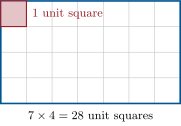
The area of a figure measures the surface it covers: how many unit squares fit inside. Units: cm (a square of side cm), m, km, … Careful:
— one square meter is a cm by cm square, so each step of the units ladder is worth , not .
Proposition 43.6 (Basic area formulas)
| figure | area |
|---|---|
| rectangle () | |
| square (side ) | |
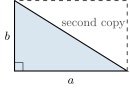
| [4pt] right triangle (legs , ) | |
| [4pt] disk (radius ) |
Proof for the right triangle. Two copies of a right triangle with legs and , glued along the hypotenuse, form an rectangle. So the triangle’s area is half the rectangle’s: . (The rectangle formula is the unit-square counting above; the disk formula is admitted, see Chapter 53.) ∎
Example 43.7 (Composite figures)
An L-shaped room is a m m rectangle with a m m square corner removed. Its area, step by step:
- full rectangle: m;
- removed square: m;
- remaining area: m.
Its perimeter is not anything: walking around the L, the border still measures m — the two cuts of the corner replace two equal pieces of wall. Same number by coincidence, but square meters for one, meters for the other!
Remark 43.8 (Same perimeter, different areas)
Two figures can have the same perimeter and very different areas: a square and a rectangle both have perimeter , but areas and . Perimeter and area are truly independent quantities.
43.3 Volumes
Definition 43.9 (Volume)
The volume of a solid measures the space it fills: how many unit cubes fit inside. Units: cm, m, … with m cm (each step of the ladder is worth ). For liquids one also uses the liter:
Proposition 43.10 (Volume of a box)
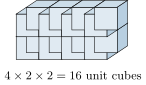
A rectangular box (a rectangular prism) of length , width and height has volume
Proof. The bottom layer contains unit cubes (Definition 43.5 picture, with cubes), and there are such layers. ∎
Example 43.11
An aquarium measures cm by cm by cm (height). Volume:
Step by step for the conversion: cm make one liter, and .
43.4 Exercises
Exercise 43.1 ★
Convert: m into cm; mm into cm; km into m; m into km.
Solution
Solution of Exercise 43.1.
m cm; mm cm; km m; m km.
Exercise 43.2 ★
Compute the perimeter of: a rectangle cm cm; a square of side cm; a triangle with sides cm, cm and cm.
Solution
Solution of Exercise 43.2.
Rectangle: cm. Square: cm. Triangle: cm.
Exercise 43.3 ★
A circular running track has radius m. How long is one lap (exact value with , then rounded to the meter)? How many laps make at least km?
Solution
Solution of Exercise 43.3.
One lap: m. For km m: , so full laps are needed ( laps only make about m).
Exercise 43.4 ★
Compute the area of: a rectangle cm cm; a square of side m; a right triangle with legs cm and cm; a disk of radius cm (exact value, then rounded to the cm).
Exercise 43.5 ★
Convert: m into cm; cm into m; L into cm; L into m.
Solution
Solution of Exercise 43.5.
m cm; cm m; L cm; L m.
Exercise 43.6 ★
A rectangular field is m long and m wide. How many meters of fence are needed to enclose it? What is its area?
Exercise 43.7 ★
Compute the volume of a box cm cm cm, and of a cube of edge cm.
Exercise 43.8 ★
Draw two different rectangles with perimeter cm, and compute their areas. Which of your rectangles has the larger area?
Exercise 43.9 ★★
A T-shaped figure is made of a horizontal rectangle on top of a vertical one (measurements in cm). Compute its area, then its perimeter (walk around the border carefully, adding every edge).
Exercise 43.10 ★★
A swimming pool is a rectangular box m long, m wide and m deep.
- How many cubic meters of water does it hold when full?
- How many liters is that?
- The pool is filled at L per hour. How long does the filling take?
Solution
Solution of Exercise 43.10.
1. m.
2. m L.
3. hours.
Exercise 43.11 ★★
A garden is a square of side m containing a circular pond of radius m. What area of grass is there (exact value, then rounded to the m)?
Solution
Solution of Exercise 43.11.
Garden: m. Pond: m. Grass: m.
Exercise 43.12 ★★★
A chocolate bar measures cm cm cm. The maker doubles all three dimensions.
43.5 Problem: Queen Dido’s fence
Problem 43.1
Weekend problem — with a fixed length of fence, which shape encloses the most land? The square beats every rectangle, the circle beats the square, and a barn wall changes everything
Legend says that queen Dido, landing on the coast of Africa, was granted “as much land as an ox hide can enclose” — so she cut the hide into one immensely long thin strip and enclosed enough ground to found the city of Carthage. Her problem is now yours: a farmer owns exactly m of fence. Exercise 43.8 showed that two pens with the same perimeter can have different areas; this problem finds the best pen — and discovers that the answer changes completely when a barn wall lends a free side.
Part I — Twenty meters of fence.
- The pen must be a rectangle using all m of fence. Check that a pen and a pen both qualify, and compute their areas.
- Explain why the length and width of every qualifying pen add up to m. Then make the complete table of the whole-number pens ( up to ) with their areas. Which is best?
- Are decimal sides worth trying? Compute the areas of the pen and of the pen, and compare with the square. What do you conjecture?
- Question 2 turned the fence problem into a pure number question: among all pairs of numbers adding up to , which pair has the largest product? Answer it from your table, and state the general rule you observe.
- Here is why moving away from the square always loses, with scissors instead of algebra: start from the pen and change it into the pen by removing a strip and gluing another one back. Which strip is removed, which is added, and why does the exchange lose exactly one square meter? Explain why a further step (to ) loses even more.
Part II — The barn, and the circle.
- The pen is now built against a long barn wall: the wall replaces one length of the pen, and the m of fence cover only the other three sides. Make a table of the whole-number pens (width , length along the wall, ) and their areas. Which pen wins now — and is it a square?
- Explain the winner with a mirror (Chapter 42): reflect the pen across the barn wall and consider the doubled pen. How much fence does the doubled pen use, which doubled pen is best by Part I, and what does that make the original pen?
- Dido did not build a rectangle. Bend the m of fence into a circle: using , compute its radius (to the cm), then its area (to the m) (Proposition 43.3, Proposition 43.6). Compare with the square.
- The reverse problem: a pen of area exactly m is wanted, with as little fence as possible. Compare the rectangles , , , and : perimeters? Which shape is cheapest, and how is this question the mirror image of Part I?
- In one sentence: why are cans, pipes and water tanks so often round?
Part III — Perimeter and area are strangers.
- Find a rectangle whose perimeter exceeds m but whose area is less than m. (Very long and very thin. Decimals allowed.)
- True or false: “of two figures, the one with the larger perimeter has the larger area.” Give a counterexample from this problem.
- Take the rectangle and cut a square notch into the middle of one long side (the notch opens outwards, like a missing tooth). Compute the area and the perimeter of the notched figure, and compare both with the original. What happened to each?
- Mapmakers know a strange fact: the more detailed the map, the longer a coastline measures — every zoom reveals new little notches, and question 13 shows what each notch does. Explain in one or two sentences why “the length of the coast of Brittany” is a slippery number, while “the area of Brittany” is not.
- The farmer’s exam. With m of fence and the barn wall available, find the best rectangular pen (use the mirror of question 7), give its area, and compare with the best pen built with m in open field. How much does the barn wall earn the farmer?
Solution
Solution of Problem 43.1.
1. : perimeter m, area m. : perimeter m, area m.
2. The perimeter is twice (length width) (Example 43.2), so length width m. The table:
| pen | |||||
|---|---|---|---|---|---|
| area (m) |
The square is best.
3. and : closer and closer to , but still below. Conjecture: the square beats every rectangle of perimeter , decimal sides included.
4. From the table: the product of two numbers with sum is largest when the two numbers are equal ( and ). General rule: for a fixed sum, the product is largest for equal parts — the more unequal the pair, the smaller the product.
5. From the square, remove the top row — a strip of unit squares — leaving a pen; then glue a column of unit squares onto one end, making the pen . Five squares were taken away and only four came back: the added strip lies along the -side, which is shorter than the -side the removed strip covered. Net loss: one square meter (). The next step, from to , trades a row of for a column of and loses three more (): the further the pen is from the square, the longer the strip it gives up and the shorter the one it gets back.
6. With , i.e. :
The winner is , of area m — twice as long (along the wall) as it is wide: not a square.
7. Reflect the pen across the wall: pen plus mirror image form a doubled pen using the fence twice, m of fence all around (the wall side is interior now). By Part I, the best rectangle with perimeter is the square, , of area m. The best real pen is half of that best doubled pen: m along the wall, m deep, area m — exactly the table’s winner, now explained.
8. Circumference , so m. Area: m — comfortably more than the square’s m. Dido knew what she was doing: for a given length of border, the circle encloses the most.
9. Perimeters: : m; : m; : m; : m; : m. The square again — least fence for the given area. It is Part I backwards: fixed perimeter, biggest area, or fixed area, smallest perimeter: both crown the square (and, beyond all rectangles, the circle).
10. A round wall is the shortest border for the space it encloses (question 8), so a round can, pipe or tank holds the most content for the least metal — material is money.
11. For instance m m: perimeter m, area m. Long and thin: kilometers of border, hardly any land.
12. False. The pen of question 11 has perimeter m and area m, while the pen has perimeter m and area m: larger perimeter, far smaller area.
13. Area: one unit square is missing, cm. Perimeter: walking around, the notch replaces cm of straight wall by three sides of the little square, cm: the perimeter grows from cm to cm. Removing material lengthened the border.
14. Every zoom on a real coast reveals new bays, rocks and creeks — notches upon notches, and question 13 shows that each notch adds border length while barely changing the area. So the measured length keeps growing with the level of detail (“the coastline paradox”), while the measured area settles down: perimeter and area are truly independent quantities.
15. Mirror argument: the doubled pen would use m of fence, and the best rectangle of perimeter is the square. So the best pen is m along the wall and m deep: fence check m, area m. In open field, the best is the square, area m. The barn wall exactly doubles the farmer’s land.