Primary & Middle School Mathematics · Grades 1–9
62Pyramids and Cones
After the prisms and cylinders of Chapter 53 — solids with constant cross-section — come the solids with a point: pyramids and cones. Their volume formula carries a famous factor , which this chapter makes plausible and uses; the study of solids continues with spheres and sections in Chapter 70.
62.1 Describing pyramids and cones
Definition 62.1 (Pyramid, cone)
- A pyramid has a polygon as its base and a point, the apex, joined to every vertex of the base by triangular faces. Its height is the distance from the apex to the plane of the base.
- A cone is the same construction over a disk: a base disk, an apex, and a curved lateral surface.
A pyramid is regular when its base is a regular polygon (square, equilateral triangle, …) and its apex sits vertically above the center of the base.
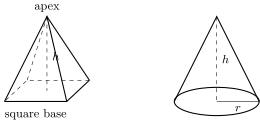
Example 62.2 (Counting faces, edges, vertices)
A pyramid with a square base has faces ( square triangles), edges and vertices. With an -sided base: faces, edges, vertices. Check Euler’s little pattern: faces vertices edges .
62.2 Volume
Theorem 62.3 (Volume of a pyramid or cone)
For a pyramid or a cone with base area and height :
— one third of the prism or cylinder with the same base and height. For a cone of base radius : .
Proof. Admitted at this level. ∎
Remark 62.4 (Why one third?)
Fill a hollow pyramid with water and pour it into the prism of same base and height: it takes exactly three fills. Even better: a cube can be cut into three identical pyramids, each having a face of the cube as base and one vertex of the cube as apex (try to picture it!). A general proof uses integration, a tool of the High School volume.
Example 62.5
A pyramid has a square base of side cm and height cm:
An ice-cream cone of radius cm and height cm:
Example 62.6 (Careful with the height)
For a cone, do not confuse the height (apex to center of the base, perpendicular) with the slant height (apex to the rim). They are related by Pythagoras (Theorem 58.1) in the right triangle apex–center–rim:
Method 62.7 (Volume problems)
62.3 Nets
Example 62.8 (Net of a pyramid)
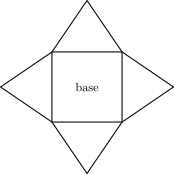
Unfolding a regular square-based pyramid flattens it into its net: the square base with four identical isosceles triangles attached to its sides. The triangles’ equal sides are the lateral edges of the pyramid — their length is neither nor the slant height of a face, so label carefully before cutting cardboard.
62.4 Exercises
Exercise 62.1 ★
How many faces, edges and vertices has a pyramid with a triangular base (a tetrahedron)? With a hexagonal base?
Exercise 62.2 ★
Compute the volume of a pyramid with base area cm and height cm; of a pyramid with rectangular base cm and height cm.
Solution
Solution of Exercise 62.2.
cm.
Rectangular base: cm, so cm.
Exercise 62.3 ★
Compute the volume of a cone of radius cm and height cm (exact with , then rounded to the cm).
Solution
Solution of Exercise 62.3.
cm.
Exercise 62.4 ★
A cylinder and a cone have the same radius cm and the same height cm. Compute both volumes. What is their ratio?
Exercise 62.5 ★
A pyramid has volume cm and height cm. What is its base area? (Write the volume formula and solve.)
Solution
Solution of Exercise 62.5.
, so cm.
Exercise 62.6 ★
Sketch the net of a cone (a disk for the base, and a sector of a larger disk for the lateral surface). Which measurement of the cone is the radius of that sector: the height or the slant height ?
Exercise 62.7 ★★
The Louvre pyramid has a square base of side about m and a height of about m. Estimate its volume, to the nearest hundred cubic meters.
Solution
Solution of Exercise 62.7.
m — about cubic meters.
Exercise 62.8 ★★
A cone has slant height cm and base radius cm. Compute its height, then its volume (exact with ).
Exercise 62.9 ★★
A conical glass of radius cm and height cm is filled to the brim, then poured into a cylindrical glass of radius cm. What height does the liquid reach in the cylinder?
Exercise 62.10 ★★
An hourglass is made of two identical cones (radius cm, height cm) joined at their apexes. All the sand fills exactly one cone. Compute the volume of sand (exact, then in cm rounded to the tenth), and the fraction of the hourglass’s total inner volume occupied by the sand.
Exercise 62.11 ★★★
A square-based pyramid with base side cm has its apex directly above a corner of the base, at height cm.
- Does the formula still apply? (It does — the apex need not be centered. Compute .)
- Compute the length of the longest lateral edge, from the apex to the opposite corner of the base (two Pythagoras steps: the base diagonal first).
Solution
Solution of Exercise 62.11.
1. Yes: the formula holds for any position of the apex, as long as is the perpendicular distance to the base plane. cm.
2. Base diagonal: cm. The longest lateral edge is the hypotenuse of a right triangle with legs (in the base plane) and (vertical):
62.5 Problem: A cube cut into three pyramids
Problem 62.1
Weekend problem — where the factor comes from, and what happens to a pyramid cut at half height
The remark after Theorem 62.3 claims that a cube can be cut into three identical pyramids — “try to picture it!”. This problem pictures it precisely, gets the famous factor out of it honestly, then cuts the cube a second way into six pyramids, and finishes by slicing a pyramid at half its height — with a result few people guess right on the first try.
Throughout, is a cube of side : base , top face , with above , above , above and above .
Part I — Three pyramids sharing an apex.
- The vertex belongs to three faces of the cube. List the three faces that do not contain , and describe the three pyramids obtained by taking each of them as a base, with apex every time. How many faces, edges and vertices has each pyramid (Example 62.2)?
- Explain why turning the cube by a third of a turn around its long diagonal leaves the cube unchanged but shuffles the three bases of question 1 in a cycle — and why the three pyramids are therefore identical copies of one another.
- Admitting that the three pyramids fill the cube without overlapping (a cardboard model is quite convincing), deduce the volume of each one.
- Check this against the formula of Theorem 62.3: the pyramid with base and apex has its apex directly above a corner of its base, exactly as in Exercise 62.11. Identify its height, apply the formula, and compare.
- For a cube of side cm, give the volume of each of the three pyramids — and explain what this decomposition has to do with the water-pouring experiment of the chapter (three fills of the pyramid for one prism).
Part II — Six pyramids sharing the center. Now let be the center of the cube, and join to the four vertices of each of the six faces.
- Describe the six pyramids obtained, and explain why they are identical copies of one another. What is the height of each one?
- Deduce, by sharing the cube’s volume, the volume of each of the six pyramids.
- Recompute that volume with the formula , and check the two answers agree.
- The two decompositions confirm the factor for some very special pyramids. Explain why they do not yet prove Theorem 62.3 for every pyramid and cone — and say how the chapter deals with that gap: which statement is admitted, which experiment supports it, and in which volume of the series is it honestly proved.
- A cube of side cm is cut into its six center pyramids. Compute the volume of each, both ways.
Part III — Cutting a pyramid at half height. is a regular square-based pyramid: base side , height , apex above the center of the base. Cut it by the plane through the midpoints of the four lateral edges , , , .
- Apply the midpoint theorem (Theorem 59.1) in the triangle : what are the direction and length of the segment joining the midpoints of and ? Deduce that the cut is a square of side , parallel to the base, at height .
- The piece above the cut is itself a square-based pyramid. Give its base side and height, and show that its volume is exactly one eighth of the original volume .
- Deduce the volume of the lower piece (the frustum, the shape of an unfinished pyramid). In what ratio does the half-height cut share the volume?
- The Louvre pyramid (Exercise 62.7: base side m, height m) is cleaned in two campaigns: the glass above half height, then the glass below. What fraction of the volume sits below half height? Estimate it in cubic meters, to the nearest hundred.
- The general moral: if all the dimensions of a pyramid are multiplied by , what happens to its volume? By what factor does the volume grow when every dimension is multiplied by — and how does this explain, in one line, the “one eighth” of question 12?
Solution
Solution of Problem 62.1.
1. belongs to the top face and to the two side faces and . The three faces not containing are the bottom , the front and the left face (they all share the vertex , the corner opposite ). The three pyramids are , and : each has a square face of the cube as base and the far vertex as apex. Each is a square-based pyramid: faces, edges, vertices (Example 62.2).
2. The long diagonal joins the only two vertices belonging to none of the three bases. A third-of-a-turn rotation about the line sends the cube to itself (the three edges leaving — towards , , — are shuffled in a cycle, and so are the three edges arriving at ). It carries the base to , then to , and back: apexes fixed at , bases cycling. Each pyramid is thus carried onto the next one: the three are identical copies.
3. Three identical pieces filling the cube share its volume equally:
4. The pyramid has base , of area , and its apex sits vertically above the corner , at height (a vertical edge of the cube). As in Exercise 62.11, the formula applies with the perpendicular height :
in perfect agreement with question 3 — the decomposition and the formula confirm each other.
5. For : cm each. The water-pouring experiment is this decomposition made liquid: the prism over the base with height is the cube itself, and it holds exactly three pyramid-fills — here the three fills even assemble geometrically into the cube.
6. Joining the center to the four corners of each face produces six pyramids, one per face: square base, apex . The center is equally placed with respect to the six faces (any rotation or symmetry of the cube fixes and permutes the faces), so the six pyramids are identical. The height of each is the distance from to a face: half the side, .
7. Six identical pieces share the cube: each.
8. Formula: base area , height :
The two answers agree.
9. Both decompositions concern pyramids of very special proportions carved from a cube; a slender pyramid, a lopsided one, or a cone cannot be assembled this way (no three cones fill a cylinder). This is why Theorem 62.3 is admitted at this level: the decompositions and the water-pouring experiment make the entirely believable, and the honest general proof — integration — is given in the High School volume.
10. cm; and by the formula, cm. They agree.
11. In the triangle , the midpoints of the sides and are joined by a segment parallel to and of length (Theorem 59.1). The same holds on each lateral face, so the four midpoints form a square of side , with sides parallel to the base. On the vertical line through the apex, the cut passes at the midpoint of the height (midpoint theorem again, in a triangle through , the base center and a base vertex): the cutting plane sits at height .
12. The top piece is a regular square-based pyramid of base side and height (its base is the cut, its apex is ). Its volume is
one eighth of the original — not one half.
13. The frustum keeps the rest: . The half-height cut shares the volume in the ratio — the humble-looking bottom slab holds seven times the volume of the pointed top.
14. Below half height lies of the volume. With m (Exercise 62.7):
to the nearest hundred — the “lower half” campaign cleans almost eight times the glass volume of the upper one.
15. Doubling every dimension multiplies the base area by and the height by , hence the volume by . Scaling by multiplies areas by and one more length by : volumes grow by the factor . The top piece of question 12 is a scaled copy of the whole pyramid with , so its volume is of the whole — the one-line explanation.