Primary & Middle School Mathematics · Grades 1–9
35Cubes and Boxes
Leaving the flat page: solids are the shapes of the real world — dice, cereal boxes, cans, balls. This chapter learns to name them, count their faces and edges, unfold them into nets, and measure their volume by counting little cubes. (Volume formulas come in Chapter 43.)
35.1 The solid family
Definition 35.1 (Solids and their vocabulary)
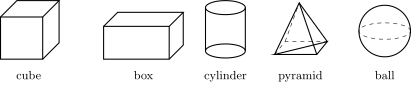
A solid occupies space. Flat sides are faces; faces meet along edges; edges meet at vertices. The family portraits:
- the cube: square faces, edges, vertices;
- the box (rectangular prism): rectangular faces, edges, vertices;
- the cylinder: two disk faces and one rolled face (a can);
- the pyramid: a polygon base and triangles meeting at an apex;
- the ball (sphere): one perfectly round surface, no face, no edge.
Example 35.2 (Counting on the cube)
Check on a die: faces (the numbers to ), vertices (the corners), edges (run a finger along them: on top, at the bottom, vertical). And — the same curious pattern holds for the box and the pyramid (Example 62.2 returns to it).
35.2 Nets
Definition 35.3 (Net)
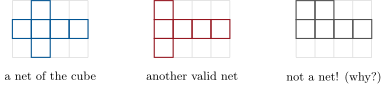
A net of a solid is a flat drawing of all its faces, attached along edges, that folds up into the solid — the solid unwrapped like a cardboard box flattened for recycling.
Example 35.4 (Reading a net)
On a die, opposite faces add up to . On a net, opposite faces are the ones separated by exactly one square in a row (or around a corner) — not the neighbors! Marking the pairs on the net before folding is a great exercise in seeing space flat.
35.3 Volume: counting cubes
Definition 35.5 (Volume by counting)
The volume of a solid built from unit cubes is the number of cubes it contains. The unit can be the centimeter cube (cm) or the meter cube (m).
Example 35.6 (Counting a box layer by layer)
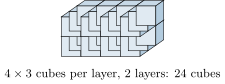
A box cubes long, wide, high: the bottom layer holds cubes, and there are layers:
Counting by layers always works — and it quietly proves the formula of Chapter 43.
Example 35.7 (Same cubes, different shapes)
Eight unit cubes can build a cube, a stick, or a slab: three different solids, one volume ( cubes). Volume counts the material, not the shape.
35.4 Exercises
Exercise 35.1 ★
Name a real object shaped like: a cube; a box; a cylinder; a ball; a pyramid.
Exercise 35.2 ★
How many faces, edges and vertices has a box? Check the pattern faces vertices edges .
Exercise 35.3 ★
Which faces of a box are identical? (Group the six faces in pairs.) What is special about the cube’s faces?
Exercise 35.4 ★
Draw a net of a cube of side cm (use the cross-shaped model of the chapter), cut it out and fold it.
Solution
Solution of Exercise 35.4.
Cross-shaped net: four cm squares in a row, one above and one below the second square. Folding the ring of four makes the sides; the two extra squares close the top and bottom.
Exercise 35.5 ★
On the cross-shaped net of a die, place the numbers to so that opposite faces sum to . (Use Example 35.4 to find the opposite pairs first.)
Solution
Solution of Exercise 35.5.
On the cross net (four squares in a row, one above, one below the second), the opposite pairs are: squares and of the row; squares and of the row; the top and bottom squares. One correct labelling: row ; top ; bottom — then , , all make .
Exercise 35.6 ★
Count the unit cubes: a box long, wide, high; a cube of side ; an L-shaped stack made of a slab with a slab on top.
Exercise 35.7 ★
A box holds exactly unit cubes in one layer. Give two possible layer shapes (), and for each, the box’s volume if it has such layers.
Exercise 35.8 ★
With unit cubes, what cube can you build? With ? (Think of the layer counting backwards.)
Exercise 35.9 ★★
Sugar cubes of side cm come in a box cm long, cm wide, cm high (interior sizes). How many sugar cubes fit? If a family uses cubes a day, for how many days does one box last (round sensibly)?
Exercise 35.10 ★★
A cube is painted red on the outside, then cut into unit cubes. How many small cubes have paint on exactly faces? On ? On ? On none? (Check: the four counts must add up to .)