Mathematics · Glossary

What is Sum, direct sum?

Also known as: direct sum · supplementary subspaces

Definition 18.7 University Mathematics — Year 1 · Chapter 18 — Vector Spaces

For subspaces F,GF, G of EE:

F+G={u+v:uF, vG}F + G = \{\,u + v : u \in F,\ v \in G\,\}

is a subspace (the smallest containing FGF \cup G). The sum is direct, written FGF \oplus G, when every element of F+GF + G decomposes uniquely as u+vu + v; equivalently (see below) when FG={0}F \cap G = \{0\}. When E=FGE = F \oplus G, the subspaces are supplementary in EE.

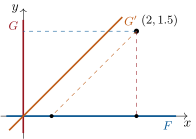
Two decompositions of the same point of ℝ2 along F (the x-axis): with supplementary G (vertical drop) and with supplementary G' (oblique drop). The F-components differ: a projection depends on the direction of descent.
Two decompositions of the same point of R2\R^2 along FF (the xx-axis): with supplementary GG (vertical drop) and with supplementary GG' (oblique drop). The FF-components differ: a projection depends on the direction of descent.

Examples

Example 18.8 (A sum of two lines)

In R3\R^3, let F=Vect((1,0,1))F = \operatorname{Vect}\bigl((1,0,1)\bigr) and G=Vect((0,1,1))G = \operatorname{Vect}\bigl((0,1,1)\bigr). Their sum is

F+G={a(1,0,1)+b(0,1,1)}={(a, b, a+b)}={(x,y,z):z=x+y},F + G = \{\,a(1,0,1) + b(0,1,1)\,\} = \{(a,\ b,\ a + b)\} = \{(x, y, z) : z = x + y\},

the plane through the origin containing both lines. It is strictly bigger than the union FGF \cup G (the mere cross of the two lines): the vector (1,1,2)=(1,0,1)+(0,1,1)(1, 1, 2) = (1,0,1) + (0,1,1) lies in the sum but on neither line. And FG={0}F \cap G = \{0\} (a common vector requires a(1,0,1)=b(0,1,1)a(1,0,1) = b(0,1,1), whose first two coordinates force a=b=0a = b = 0): the sum is direct, and FGF \oplus G is exactly that plane.

Example 18.11

In F(R,R)\mathcal{F}(\R, \R), the even functions P\mathcal{P} and the odd functions I\mathcal{I} are supplementary: any ff writes

f(x)=f(x)+f(x)2even+f(x)f(x)2odd,f(x) = \underbrace{\frac{f(x) + f(-x)}{2}}_{\text{even}} + \underbrace{\frac{f(x) - f(-x)}{2}}_{\text{odd}},

and a function both even and odd is zero. (Applied to exp\exp, this is the pair (cosh,sinh)(\cosh, \sinh) of Chapter 4.)

Example 18.12 (A supplementary pair in Kn[X]K_n[X])

Fix aKa \in K and set F={PKn[X]:P(a)=0}F = \{P \in K_n[X] : P(a) = 0\}, G=Vect(1)G = \operatorname{Vect}(1) (the constants). Then Kn[X]=FGK_n[X] = F \oplus G. Indeed FGF \cap G consists of the constants vanishing at aa, i.e. {0}\{0\}; and every PP decomposes as

P=(PP(a))F+P(a)G.P = \underbrace{\bigl(P - P(a)\bigr)}_{\in F} + \underbrace{P(a)}_{\in G} .

The decomposition is worth memorizing: subtracting the value at a point is the standard way to project onto “functions vanishing at aa”. Note that FF is a large subspace and GG a small one; a supplementary pair need not be balanced in any sense.

Read in context →