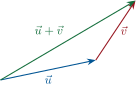
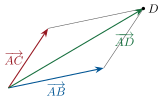
The sum is the displacement obtained by performing then .
Examples
Example 6.7 (Simplifying with Chasles)
Simplify : chaining the displacements gives . Simplify : rewrite the difference as a sum with the opposite vector,
 Coach
Log in
Start reading
Coach
Log in
Start reading
Mathematics · Glossary
Also known as: vector sum
The sum is the displacement obtained by performing then .
Example 6.7 (Simplifying with Chasles)
Simplify : chaining the displacements gives . Simplify : rewrite the difference as a sum with the opposite vector,