A vector encodes a displacement: a direction and a length, regardless of the starting point. Vectors give clean proofs of geometric facts and, once coordinates enter the picture, reduce them to small computations. They will be a key tool in Chapter 7 and, later, for the scalar product in Chapter 16.
6.1 Translations and vectors
Definition 6.1(Vector)
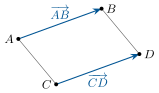
Given two points A and B, the vectorAB represents the displacement from A to B: it has a direction (the direction of the line (AB), together with the way of traveling along it, from A towards B) and a length (the distance AB, also written AB). Two vectors are equal when they encode the same displacement: AB=CD means that applying the two displacements to any point gives the same result.
Proposition 6.2(Equal vectors and parallelograms)
AB=CD exactly when ABDC (in this order!) is a parallelogram, possibly a flattened one — equivalently, when [AD] and [BC] have the same midpoint.
Proof.Admitted at this level.∎
Equal vectorsAB=CD: same direction, same way, same length. The quadrilateral ABDC is a parallelogram.
Notation 6.3
A vector is often named by a single letter, u or v, when the endpoints do not matter. The zero vector0=AA is the displacement that does not move anything. The opposite of AB is BA: same length, opposite way. We write BA=−AB.
6.2 Adding vectors
Definition 6.4(Sum of two vectors)
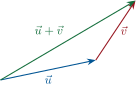
The sumu+v is the displacement obtained by performing u then v.
Theorem 6.5(Chasles’ relation)
For any three points A, B, C:
AB+BC=AC.
Proof. Going from A to B, then from B to C, is a displacement that takes A to C: it is the displacement encoded by AC. ∎
Remark 6.6(Parallelogram rule)
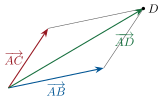
To add two vectors drawn from the same point, AB+AC, complete the parallelogram ABDC: the sum is the diagonal AD. Indeed AC=BD, so AB+AC=AB+BD=AD by Chasles’ relation.
Two pictures of the sum: tip-to-tail (Chasles’ relation, left) and the parallelogram rule (right).
Example 6.7(Simplifying with Chasles)
Simplify MN+NP+PQ: chaining the displacements gives MQ. Simplify AB−AC: rewrite the difference as a sum with the opposite vector,
AB−AC=AB+CA=CA+AB=CB.
6.3 Multiplying a vector by a number
Definition 6.8(Scalar multiple)
Let u be a nonzero vector and k a real number. The vectorku has the same direction as u, length ∣k∣×∥u∥, and points the same way as u if k>0, the opposite way if k<0. For k=0, 0u=0.
Definition 6.9(Collinearity)
Two vectorsu and v are collinear when they have the same direction, i.e. when v=ku for some real k (or one of them is 0).
Remark 6.10
Collinearity is the vector language for parallelism and alignment:
the lines (AB) and (CD) are parallel exactly when AB and CD are collinear;
the points A, B, C are aligned exactly when AB and AC are collinear.
Proof. 1–3 restate, coordinate by coordinate, what the displacements do: for instance performing u then v moves a point horizontally by a then c, hence by a+c in total. Point 4 is the distance formula of Theorem 5.4 applied to a segment representing u. ∎
Proof. If v=ku, then c=ka and d=kb, so ad−bc=a(kb)−b(ka)=0. The same holds if u=kv or if either vector is zero.
Conversely, suppose ad−bc=0 with u=0, say a=0 (the case b=0 is similar). Set k=ac; then c=ka, and ad=bc=b(ka) gives, after dividing by a=0, d=kb. So v=ku. ∎
Example 6.14
Are u(3,−2) and v(−6,4)collinear? Compute ad−bc=3×4−(−2)×(−6)=12−12=0: yes, and indeed v=−2u. For u(3,−2) and w(1,5): 3×5−(−2)×1=17=0: not collinear.
Let A(0,2), B(4,0), C(6,3). Find the coordinates of the point D such that ABCD is a parallelogram, i.e. such that AB=DC.
Solution
Solution of Exercise 6.5.
AB(4,−2), and DC(6−xD,3−yD). The condition AB=DC gives 6−xD=4 and 3−yD=−2, so D(2,5).
Exercise 6.6★★
Let A(−2,1), B(1,3), C(4,−1).
Compute the coordinates of the point M such that AM=AB+AC.
What is the quadrilateral ABMC? Justify.
Solution
Solution of Exercise 6.6.
1.AB(3,2) and AC(6,−2), so AB+AC=(9,0) and M=(−2+9,1+0)=(7,1).
2. By the parallelogram rule, AM=AB+AC means that ABMC is a parallelogram (M is the fourth vertex opposite A). One can check: AB(3,2) and CM(7−4,1−(−1))=(3,2) are equal.
Exercise 6.7★★
Let A(1,−1), B(4,1), C(10,5). Are the points A, B, C aligned? Same question for A(0,3), B(2,2), C(8,−1).
Solution
Solution of Exercise 6.7.
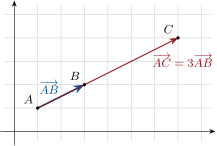
First triple: AB(3,2), AC(9,6); 3×6−2×9=0: aligned (AC=3AB).
Second triple: AB(2,−1), AC(8,−4); 2×(−4)−(−1)×8=−8+8=0: aligned as well (AC=4AB).
Exercise 6.8★★
Let A(1,2), B(5,4), C(6,1), D(2,−1). Show that (AB) and (CD) are parallel, then that ABCD is a parallelogram. Which verification implies the other?
Solution
Solution of Exercise 6.8.
AB(4,2) and DC(6−2,1−(−1))=(4,2): the two vectors are equal, so ABCD is a parallelogram, and in particular (AB)∥(CD). The parallelogram property is the stronger one: it implies the parallelism (collinearity of the vectors), not conversely.
Exercise 6.9★★
Let ABC be a triangle, and let I be the point defined by AI=32AB. With A(0,0), B(6,3), C(2,5) (so that computations stay simple):
let J be such that CJ=32CB; compute the coordinates of J;
show that (IJ) is parallel to (AC).
Solution
Solution of Exercise 6.9.
1.AB(6,3), so AI=32AB=(4,2) and I(4,2).
2.CB(6−2,3−5)=(4,−2), so CJ=32CB=(38,−34) and J(2+38,5−34)=(314,311).
3.IJ(314−4,311−2)=(32,35) and AC(2,5). Collinearity criterion:
32×5−35×2=310−310=0:
the vectors are collinear, so (IJ) is parallel to (AC). (Both I and J sit one third of the way from the side towards B: the small triangle IBJ is a reduction of ABC.)
Exercise 6.10★★★
Let ABCD be any quadrilateral, and let I, J, K, L be the midpoints of [AB], [BC], [CD], [DA]. Using coordinatesA(xA,yA), etc., show that IJ=LK, and conclude that the midpoints of the sides of any quadrilateral form a parallelogram.
and the same computation works for the second coordinates. So IJ=LK (both equal 21AC), and IJKL is a parallelogram, whatever the quadrilateral ABCD looks like.
6.6 Problem: The algebra of arrows
Problem 6.1
Weekend problem — Chasles gymnastics, the centroid re-proved in two lines, and forces in equilibrium: what vectors are really for
Grade 8 proved that the medians of a triangle meet at two thirds of their length — with an ingenious parallelogram hidden inside the triangle (the centroid weekend problem of the Middle School volume). Vectors reprove it in two lines, and hand out the concurrency for free. That is what this new algebra is for: theorems become computations with arrows. This problem trains the computation (Chasles above all), delivers the two-line proof, extends Varignon (Exercise 6.10), and ends where vectors were born: forces and velocities.
Part I — Chasles gymnastics.
Simplify using Chasles’ relation (Theorem 6.5): AB+BC+CD; MA−MB; AB+CD+BC+DA.
The origin trick: show that for any point O, AB=OB−OA.
Prove the two characterizations of the midpointI of [AB]:
IA+IB=0andOI=21(OA+OB)for any O.
Using AB=DC, re-find the fourth vertex D of the parallelogram ABCD with A(−1,2), B(3,4), C(6,0) — and compare with the midpoint-trick answer of Problem 5.1.
Adding a fixed vectoru to every point of the plane performs which transformation — the one discovered with two mirrors in the two-mirrors weekend problem of the Middle School volume and two half-turns in the half-turns weekend problem of the Middle School volume? Compute the image of (1,2) under u=(3,−1).
Part II — The centroid, third proof. Define the point G of a triangle ABC by the elegant condition
GA+GB+GC=0.
Using the origin trick, show that this condition determines G uniquely: OG=31(OA+OB+OC) for any O — so the coordinates of G are the averages of the vertices’ (the centroid weekend problem of the Middle School volume saw it numerically).
Prove AG=31(AB+AC), and, writing K for the midpoint of [BC], AK=21(AB+AC). Conclude: AG=32AK — the two-thirds theorem, re-proved.
Why do the medians from B and from C pass through the sameG with no further computation? Compare the three available proofs of this theorem — grade 8’s hidden parallelogram, coordinates, vectors — in one sentence each.
Numerical check: A(1,1), B(5,2), C(3,6). Compute G, then K, then verify AG=32AK with the collinearity criterion (Theorem 6.13).
Physics reads G as the balance point of three equal masses at the vertices. Double the mass at A (masses 2,1,1): the balance point becomes OG′=42OA+OB+OC. Compute G′ for the triangle of question 9 and compare its position with G.
Part III — Collinearity at work.
Are u(3,−2) and v(−6,4)collinear? And w(2,5), z(4,9)? Decide with the determinant criterion.
Are the points A(1,2), B(3,5), C(7,11) aligned?
Beyond Varignon (Exercise 6.10): in any quadrilateral ABCD, the bimedians join the midpoints of opposite sides ([IK] and [JL]). Using position vectors (OI=21(OA+OB), etc.), show that both bimedians have the same midpoint, of position vector41(OA+OB+OC+OD): the centroid of the quadrilateral.
Thales in one line: M and N are the points defined by AM=31AB and AN=31AC. Compute MN in terms of BC and conclude parallelism and ratio.
Generalize question 14 to an arbitrary ratio k, and state in one sentence how the vector calculus absorbs the midpoint theorem (the midpoint theorem) and Thales (Thales’ theorem) at once.
Part IV — Forces and velocities.
A boat is pushed by a current of 3 km/h due east while rowing at 4 km/h due north. Give the resultant velocity vector, its magnitude, and describe the actual course. (A very old triple appears.)
Three forces act on a ring: u(2,1), v(−3,2), w(1,−3). Compute the resultant. What does the ring do? And why is the sum of the arrows along any closed polygon always 0 (Chasles)?
Two forces u(4,−1) and v(−1,3) act on a hook. What third force holds the hook in equilibrium?
A swimmer crosses a river heading straight across at 2 m/s; the current runs at 1.5 m/s. Give the resultant velocity and its magnitude. The river is 50 m wide: how long does the crossing take, and how far downstream does the swimmer land?
Finale: one object, three costumes — displacement arrow, coordinate pair, force or velocity. List the three classical theorems this problem re-proved with vector algebra, and name the one geometric quantity the vectors of this chapter still cannot measure — the tool that fixes it arrives with the scalar product, in grade 11.
Solution
Solution of Problem 6.1.
1.AB+BC+CD=AD; MA−MB=MA+BM=BA; AB+BC+CD+DA=AA=0 (reordering the third sum).
2.OB−OA=AO+OB=AB by Chasles.
3.I is the midpoint of [AB] exactly when IA=−IB, i.e. IA+IB=0. Then, for any O: 0=IO+OA+IO+OB, so 2OI=OA+OB — and conversely.
4.AB=(4,2), and D satisfies DC=AB: D=C−(4,2)=(2,−2) — the same D as Problem 5.1, one line faster.
5. The translation of vectoru — exactly the transformation produced by two parallel mirrors or two half-turns. Image of (1,2): (4,1).
6.Expanding each GX as GO+OX: 3GO+OA+OB+OC=0, so OG=31(OA+OB+OC): one and only one such point, whose coordinates are the averages of the three vertices’.
7.AB+AC=(AG+GB)+(AG+GC)=2AG+(GB+GC)=2AG−GA=3AG, whence AG=31(AB+AC). The midpoint formula (question 3, seen from A) gives AK=21(AB+AC). Comparing: AG=32AK — G lies on the median [AK], two thirds of the way from A.
8. The defining condition treats A, B, C identically, so the same computation from B or from C places the sameG at two thirds of those medians: concurrency costs nothing. The parallelogram proof was ingenious but ad hoc; coordinates compute but obscure; vectors make the symmetry visible and the proof two lines.
9.G(31+5+3,31+2+6)=(3,3); K(4,4); AG=(2,2) and AK=(3,3): determinant 2×3−2×3=0, collinear, and indeed AG=32AK.
10.G′(42+5+3,42+2+6)=(2.5,2.5): pulled from G(3,3) towards the doubled vertex A(1,1), as a balance point should be.
11.3×4−(−2)(−6)=12−12=0: collinear (v=−2u). 2×9−5×4=−2=0: not collinear.
13.OI=21(OA+OB) and OK=21(OC+OD), so the midpoint of [IK] has position vector21(OI+OK)=41(OA+OB+OC+OD) — and the computation for [JL] gives the very same vector. The two bimedians (and, by Varignon, the parallelogram IJKL’s diagonals) all share this center: the quadrilateral’s centroid.
14.MN=AN−AM=31AC−31AB=31BC: so (MN)∥(BC) and MN=31BC.
15. With AM=kAB and AN=kAC: MN=kBC — one line containing the midpoint theorem (k=21) and Thales (any k): the ratio passes through the subtraction untouched.
16. Resultant (3,4), magnitude 9+16=5 km/h: the boat actually travels north-east-by-north along the 3–4–5 triangle’s hypotenuse.
17.u+v+w=(0,0): the ring stays put — equilibrium. Along a closed polygon A1A2…AnA1, Chasles telescopes the sum to A1A1=0: going around brings you back.
18.w=−(u+v)=−(3,2)=(−3,−2).
19. Resultant (1.5,2), magnitude 2.25+4=2.5 m/s. Crossing: 50 m at 2 m/s across: 25 s; drift: 1.5×25=37.5 m downstream.
20. Re-proved this weekend: the centroid’s two-thirds theorem (question 7), the bimedian/Varignon center (question 13), Thales–midpoint (questions 14–15). What arrows still cannot do: measure angles (and hence lengths in arbitrary directions) — the scalar product of grade 11 is precisely the missing instrument.