
Mathematics · Glossary

What is Vector?

Definition 6.1 High School Mathematics · Chapter 6 — Vectors

Given two points AA and BB, the vector AB\vect{AB} represents the displacement from AA to BB: it has a direction (the direction of the line (AB)(AB), together with the way of traveling along it, from AA towards BB) and a length (the distance ABAB, also written AB\norm{\vect{AB}}). Two vectors are equal when they encode the same displacement: AB=CD\vect{AB} = \vect{CD} means that applying the two displacements to any point gives the same result.
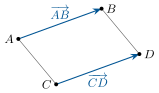
Equal vectors AB = CD: same direction, same way, same length. The quadrilateral ABDC is a parallelogram.
Equal vectors AB=CD\vect{AB} = \vect{CD}: same direction, same way, same length. The quadrilateral ABDCABDC is a parallelogram.

Examples

Example 6.7 (Simplifying with Chasles)

Simplify MN+NP+PQ\vect{MN} + \vect{NP} + \vect{PQ}: chaining the displacements gives MQ\vect{MQ}. Simplify ABAC\vect{AB} - \vect{AC}: rewrite the difference as a sum with the opposite vector,

ABAC=AB+CA=CA+AB=CB.\vect{AB} - \vect{AC} = \vect{AB} + \vect{CA} = \vect{CA} + \vect{AB} = \vect{CB}.
Read in context →