 Coach
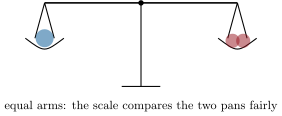
CoachA balance scale is a lever built for fairness: two pans hanging at exactly equal distances from the pivot. With equal distances, the products match exactly when the weights match — so the scale tips toward the heavier pan, and hangs level when the two pans hold equally heavy loads.
Examples
Example 17.7 (Weighing by comparing)
For thousands of years, merchants sold flour, gold and pepper with balance scales: goods in one pan, little metal reference blocks in the other, adding blocks until the pans hung level. The scale does not know any numbers — it only answers “heavier”, “lighter” or “equal”. But comparing with well-chosen blocks is all a fair market needs — and, as the last chapter of this part will show, it is the road to measuring mass itself.