Primary & Middle School Physics · Grades 1–9
17Levers and Balance Scales
Last year, on the seesaw, we found that weight and distance both count — and we promised a precise rule with real numbers in it. Time to keep the promise. Along the way we will lift stones far too heavy for our arms, and meet the instrument that weighed the world’s goods for thousands of years.
17.1 The lever
Definition 17.1 (Lever and pivot)
A lever is a stiff bar resting on a support point around which it can tip. The support point is called the pivot. A seesaw is a lever; so is a crowbar under a rock, and the claw of a hammer pulling a nail.
Example 17.2 (The strength multiplier)
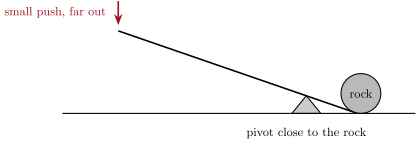
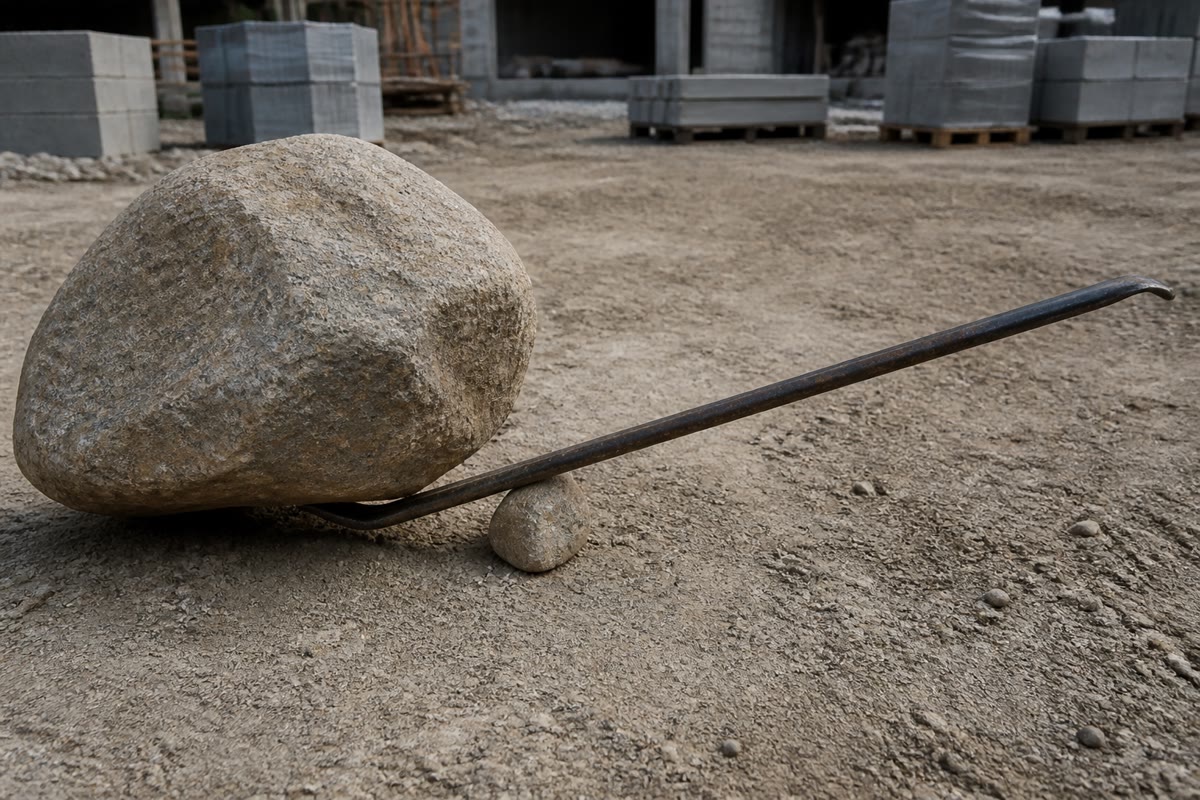
A gardener slides a long iron bar under a boulder, rests it on a log close to the boulder, and presses down on the far end — and the boulder, which ten hands could not lift, tips over gently. The lever’s secret is distance: press far from the pivot, and your small push does the work of a giant close to it. An old story says a great scientist of antiquity boasted: “Give me a place to stand, and a lever long enough, and I shall move the Earth.”
17.2 The rule of the lever
Method 17.3 (The coin seesaw)
Build a miniature seesaw to hunt for the rule:
- balance a ruler across a pencil at its middle mark;
- use identical coins as riders, placed at whole-number marks: “a coin at ” means four marks from the pencil;
- load both sides and note when the ruler balances.
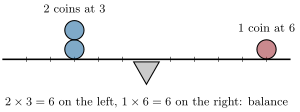
Try it: one coin at balances one coin at . Two coins stacked at balance one coin at . Three coins at — again balance with one at !
Proposition 17.4 (The lever rule)
For each side of the lever, multiply the number of coins by their distance from the pivot. The lever balances exactly when the two sides have the same product:
If one side’s product is bigger, that side goes down.
Example 17.5 (Using the rule)
Four coins sit at mark : their product is . To balance them with coins at mark , we need a product of there too: , so two coins at do it. And could a single coin balance the four? It would need to sit at mark : . The lighter the rider, the farther out it must sit — exactly what Papa’s seesaw taught us, now with numbers.
17.3 The balance scale
Definition 17.6 (Balance scale)
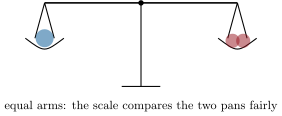
A balance scale is a lever built for fairness: two pans hanging at exactly equal distances from the pivot. With equal distances, the products match exactly when the weights match — so the scale tips toward the heavier pan, and hangs level when the two pans hold equally heavy loads.
Example 17.7 (Weighing by comparing)
For thousands of years, merchants sold flour, gold and pepper with balance scales: goods in one pan, little metal reference blocks in the other, adding blocks until the pans hung level. The scale does not know any numbers — it only answers “heavier”, “lighter” or “equal”. But comparing with well-chosen blocks is all a fair market needs — and, as the last chapter of this part will show, it is the road to measuring mass itself.
Remark 17.8 (Check the empty scale)
A fair scale must hang level when empty. If one arm is longer or one pan heavier, the products differ before the goods even arrive, and every weighing after that cheats. Honest merchants proved their empty scale level in front of the customer — an old, wordless way of saying “fair play”.
17.4 Exercises
Exercise 17.1 ★
Point out the lever and the pivot in: a seesaw; a crowbar on a log; scissors. (Scissors hide two levers — where do they pivot?)
Exercise 17.2 ★
To lift a heavy rock with a crowbar, should you press close to the pivot or far from it? Why, in one sentence?
Solution
Solution of Exercise 17.2.
Far from the pivot: the farther out the push, the bigger its product — a small push far away beats a heavy rock close in.
Exercise 17.3 ★
On the coin seesaw, compute the product for: coins at mark ; coins at mark ; coin at mark . Which pairs of these balance each other?
Solution
Solution of Exercise 17.3.
; ; . None of these products are equal, so no two of them balance each other.
Exercise 17.4 ★
One coin sits at mark on the left. Where must you put coins on the right to balance? And coins?
Solution
Solution of Exercise 17.4.
The left product is . Two coins need : mark . Four coins need : mark .
Exercise 17.5 ★
Left side: coins at mark . Right side: coins at mark . Compute both products. Which side goes down?
Solution
Solution of Exercise 17.5.
Left: . Right: . The left side’s product is bigger, so the left side goes down.
Exercise 17.6 ★
Why are the two pans of a balance scale hung at exactly equal distances from the pivot? What would a longer left arm do to every weighing?
Solution
Solution of Exercise 17.6.
With equal arms, level pans mean equal weights — the comparison is fair. A longer left arm would multiply the left load by a bigger distance, so the scale would lie in favor of that side at every weighing.
Exercise 17.7 ★
A balance scale hangs level with a bag of marbles in one pan and identical blocks in the other. What do we learn about the bag? What does the scale answer if we take one block away?
Solution
Solution of Exercise 17.7.
The bag weighs exactly as much as the blocks. With one block removed, the bag’s pan is heavier, and the scale tips toward the bag.
Exercise 17.8 ★
A seesaw: Tom weighs as much as sacks and sits at mark ; his little sister weighs as much as sack. At which mark must she sit to balance him?
Solution
Solution of Exercise 17.8.
Tom’s product: . His sister needs : she must sit at mark .
Exercise 17.9 ★
The hammer’s claw pulls a nail: your hand pushes the handle’s end, far from where the hammer head rests on the wood. Which is the pivot, and why does the nail — which your fingers could never pull — come out?
Exercise 17.10 ★★
Grandpa (heavy as sacks) wants to seesaw with little Zoe (heavy as sack). The seesaw has marks to on each side. Find two different ways to seat them so the seesaw balances.
Solution
Solution of Exercise 17.10.
Balance needs . Two ways: Grandpa at with Zoe at (), or Grandpa at with Zoe at ().
Exercise 17.11 ★★
A cheating merchant secretly makes one arm of his scale a little longer, and always puts the goods on the long-arm side. Do customers get more goods than they pay for, or less? Explain with the lever rule — and with Remark 17.8.
Solution
Solution of Exercise 17.11.
Less. On the long arm, even a light load makes a big product, so the pans level when the goods weigh less than the honest blocks on the short arm. The empty-scale check catches him: with nothing in the pans, his scale already tips toward the long arm.