Physics · Glossary

What is Canonical second-order form?

Definition 7.8 University Physics — Year 1 · Chapter 7 — Transient Regimes: First and Second Order

A quantity x(t)x(t) is a second-order linear system when

 ⁣d2x ⁣dt2+ω0Q ⁣dx ⁣dt+ω02x=ω02x,\frac{\dd^2 x}{\dd t^2} + \frac{\omega_0}{Q}\,\frac{\dd x}{\dd t} + \omega_0^2\,x = \omega_0^2\,x_\infty ,

with ω0>0\omega_0 > 0 the natural angular frequency, Q>0Q > 0 the quality factor (dimensionless), and xx_\infty the steady state. One also writes ω0/Q=2ξω0\omega_0/Q = 2\xi\omega_0 with ξ=1/2Q\xi = 1/2Q the damping ratio.

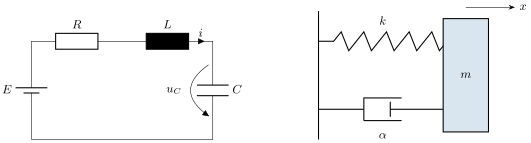
The two faces of the second-order system: the series RLC circuit (_0 = 1/√LC, Q = √L/C/R) and the mass–spring–damper (_0 = √k/m, Q = √km/). Same equation, same three regimes.
The two faces of the second-order system: the series RLC circuit (ω0=1/LC\omega_0 = 1/\sqrt{LC}, Q=L/C/RQ = \sqrt{L/C}/R) and the mass–spring–damper (ω0=k/m\omega_0 = \sqrt{k/m}, Q=km/αQ = \sqrt{km}/\alpha). Same equation, same three regimes.
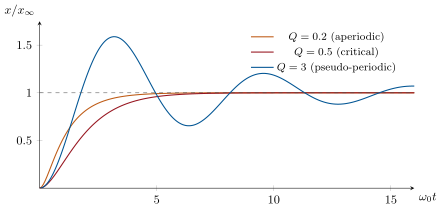
Step response of a second-order system from rest, for three quality factors. Small Q: a slow creep; Q = 1/2: the quickest return without overshoot; large Q: ringing that lasts about Q oscillations.
Step response of a second-order system from rest, for three quality factors. Small QQ: a slow creep; Q=12Q = \tfrac12: the quickest return without overshoot; large QQ: ringing that lasts about QQ oscillations.
Read in context →