Physics · Glossary

What is Center of mass?

Definition 16.1 High School Physics · Chapter 16 — Forces and Motion

The center of mass of a body or system is its balance point — the average position of its mass: the geometric center of a homogeneous symmetric body; for two point masses, the point of the joining segment at distances in the inverse ratio of the masses, d1d2=m2m1\frac{d_1}{d_2} = \frac{m_2}{m_1} — closer to the heavier.

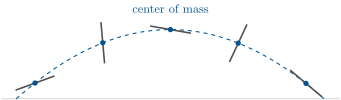
A thrown wrench at equal time intervals: the wrench spins, but its center of mass (dots) rides a plain parabola.

Examples

Example 16.2 (A lopsided dumbbell)

Balls of 2.0kg2.0\,\mathrm{kg} and 1.0kg1.0\,\mathrm{kg} sit at the ends of a light bar 0.90m0.90\,\mathrm{m} long. The center of mass divides it in the inverse ratio d1/d2=1.0/2.0d_1/d_2 = 1.0/2.0: 0.30m0.30\,\mathrm{m} from the heavy ball, 0.60m0.60\,\mathrm{m} from the light one — balance the bar there.

Read in context →