High School Physics · Grades 10–12
16Forces and Motion
Throw a wrench spinning across the room: the ends wobble wildly, yet one point inside it traces a perfect parabola. Chapter 6 settled what happens when forces compensate — nothing. This chapter asks what happens when they do not: the leftover force changes the velocity — speeding bodies up, slowing them down, turning them — and says by how much, in ratios if not yet in formulas.
16.1 The center of mass
Definition 16.1 (Center of mass)
The center of mass of a body or system is its balance point — the average position of its mass: the geometric center of a homogeneous symmetric body; for two point masses, the point of the joining segment at distances in the inverse ratio of the masses, — closer to the heavier.
Example 16.2 (A lopsided dumbbell)
Balls of and sit at the ends of a light bar long. The center of mass divides it in the inverse ratio : from the heavy ball, from the light one — balance the bar there.
Remark 16.3 (The thrown wrench)
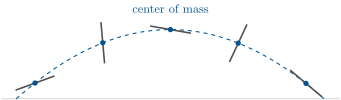
Film a tumbling wrench: every point follows a complicated looping curve — except the center of mass, which traces the clean parabola a thrown ball would. The motion of the center of mass is simple; the rest is spin around it — which is why mechanics may treat a car, a planet or a gymnast as a single point.
16.2 A net force changes the velocity
Definition 16.4 (Net force)
The net force on a body is the vector sum of all the forces acting on it, (tip to tail, as in the mathematics volume); the forces compensate exactly when .
Theorem 16.5 (Effect of a net force — semi-quantitative)
A net force acting on a body of mass for a short duration changes the velocity of its center of mass by a vector that has the direction of , and whose magnitude grows in proportion to and to and shrinks in proportion to the mass:
Proof. Admitted at this level. ∎
Remark 16.6
Double the force or its duration: twice the change; double the mass: half. Next year sharpens this into an exact equation, and the Year 1 volume asks in which frames it holds; this year ratios are enough — they already run airbags, brakes and orbits.
Proposition 16.7 (The three canonical cases)
Let a body move with velocity under a net force .
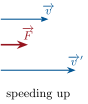
- along : it speeds up in a straight line;
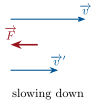
- opposite : it slows down in a straight line;
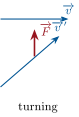
- perpendicular to : it turns without changing speed.
Proof. Add , directed along (Theorem 16.5), tip to tail onto : along the arrows pile up (longer); opposite, they partly cancel (shorter); perpendicular, each small tilts the arrow without lengthening it — only the direction turns. ∎
Example 16.8 (A sideways kick)
A puck glides east at ; a brief sideways blow adds due north. The new velocity is the vector sum: magnitude , direction , i.e. north of east — the old velocity is not erased, the change is added to it.
16.3 Comparing changes: force, time, mass
Method 16.9 (Ratio reasoning)
To compare two situations, never solve an equation — form ratios: the velocity-change ratio is the ratio, times the ratio, divided by the ratio. Then read off which factor changed, by how much.
Example 16.10 (The loaded cart)
The same push, applied for the same second, sends an empty shopping cart off at . Loaded to — triple mass, same — it leaves at a third of that, . Mass is the stubbornness of matter.
Remark 16.11 (Crashes, airbags, bent knees)
In a crash and are not negotiable — the occupant’s speed must reach zero — so is fixed. The only freedom left is time: stretch and the force shrinks in the same ratio. A head stopping on an airbag in instead of on the wheel in feels an average force eight times smaller; crumple zones, helmet foam and bent knees play the same trick.
16.4 Friction: the force that fights sliding
Definition 16.12 (Static and kinetic friction)
Friction between touching surfaces opposes their relative sliding. Static friction acts while they do not slide, adjusting itself up to a maximum to cancel whatever tries to start the slide; kinetic friction, once sliding has begun, is roughly constant, directed against the sliding, and usually weaker than the static maximum.
Example 16.13 (Pushing the wardrobe)
Push a wardrobe gently: it does not move — static friction cancels your . Push harder: at some it lurches into motion, then slides with less effort — the weaker kinetic friction has taken over.
Remark 16.14 (Why ABS brakes work)
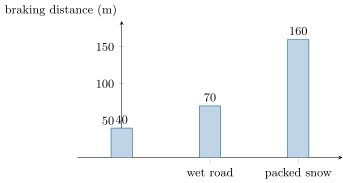
A rolling wheel’s contact point does not slide on the road: the tyre grips with static friction. A locked wheel skids and gets only the weaker kinetic friction, which points against the skid whatever the wheels do — steering dies. ABS releases the brake the instant a wheel locks: more grip, shorter stop, a driver who can steer.
16.5 Turning: circular motion needs an inward force
Definition 16.15 (Uniform circular motion)
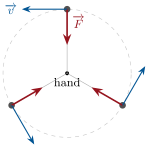
A body is in uniform circular motion when its trajectory is a circle traveled at constant speed. The velocity, tangent to the circle, changes direction at every instant — so it is never constant.
Proposition 16.16 (The inward force)
A body in uniform circular motion is subject to a net force that is never zero: at every instant it points from the body toward the center of the circle.
Proof. The speed is constant, so the net force has no part along (cases 1 and 2 of Proposition 16.7): it is perpendicular to the tangent, hence along the radius — and inward, since every bends the path toward the center. ∎
Example 16.17 (The string, the bend, the Moon)
Every steady turn hides an inward force. The whirled ball: the string’s tension. The car on a bend: the sideways static friction of road on tyres — gone on ice, and the car goes straight. The Moon: the Earth’s gravitational pull (Chapter 4), turning it around in days — not held up but pulled sideways into a perpetual turn, falling around the Earth; next year makes this the mechanics of satellites.
16.6 Exercises
Exercise 16.1 ★
Zero or nonzero net force? Justify from the velocity: (a) a car cruising straight at a steady ; (b) braking in a straight line; (c) rounding a bend at a steady ; (d) a skydiver at terminal speed.
Solution
Solution of Exercise 16.1.
(a) Constant velocity: net force zero. (b) Speed changes: nonzero, opposite the motion. (c) Direction changes (velocity is a vector): nonzero, toward the inside of the bend. (d) Constant velocity: zero — weight and drag compensate.
Exercise 16.2 ★
Balls of and sit at the ends of a light bar long. Locate the center of mass; where for equal masses?
Solution
Solution of Exercise 16.2.
with : from the ball. Equal masses: the middle, from each.
Exercise 16.3 ★
The same brief push is given to an empty luggage trolley and to the same trolley loaded to . Compare the velocity changes; what push would give the loaded trolley the empty one’s ?
Solution
Solution of Exercise 16.3.
Same , triple mass: three times smaller loaded. To match the empty trolley’s , push three times harder (or three times longer).
Exercise 16.4 ★
A tram moving at brakes; one second later it moves at , same direction. Give and the direction of the net force. Which case of Proposition 16.7 is this?
Solution
Solution of Exercise 16.4.
: , directed backward (from to ). The net force points the same way: opposite — case 2, slowing down.
Exercise 16.5 ★
Static or kinetic friction — and directed which way? (a) A crate resisting your (too gentle) push; (b) the same crate once it slides; (c) a book on a slightly tilted tray, not sliding.
Solution
Solution of Exercise 16.5.
(a) Static, opposite your push (no sliding yet). (b) Kinetic, opposite the sliding. (c) Static, pointing up the slope — against the slide that gravity is trying to start.
Exercise 16.6 ★★
A net force applied for to a mass produces . Predict for: (a) ; (b) ; (c) ; (d) .
Solution
Solution of Exercise 16.6.
: (a) ; (b) ; (c) ; (d) — the three changes cancel.
Exercise 16.7 ★★
A puck slides east at ; a blow adds due north. Compute the new speed and direction. Why is the speed not ?
Solution
Solution of Exercise 16.7.
, at , i.e. north of east. Velocities add as vectors: perpendicular contributions combine by Pythagoras, not by addition of magnitudes.
Exercise 16.8 ★★
A goalkeeper stops the same shot two ways: arms rigid (the ball stops in ) or “giving” with the ball (). Compare the average forces, and state which quantities were fixed before she chose.
Solution
Solution of Exercise 16.8.
Fixed beforehand: the ball’s mass and its (incoming speed to zero), hence the product . Stretching from to divides the average force by .
Exercise 16.9 ★★
Which external force pushes a sprinter forward at the start? Why do spiked shoes help — and why can nobody accelerate, or even walk, on perfectly frictionless ice?
Solution
Solution of Exercise 16.9.
The static friction of the track on the shoe: the foot pushes backward on the ground, and the mutual contact force pushes the sprinter forward. Spikes raise the maximum static friction (no slip at full effort). On frictionless ice no external horizontal force exists, so the velocity of the center of mass cannot change — no start, no walk.
Exercise 16.10 ★★
In an emergency stop, why does a car with ABS (wheels kept rolling) usually stop shorter than one with locked, skidding wheels — and why can the skidding car no longer be steered? Quote Definition 16.12.
Solution
Solution of Exercise 16.10.
A rolling wheel’s contact point does not slide: static friction, stronger than the kinetic friction of a skid (Definition 16.12) — shorter stop. A skidding tyre’s kinetic friction points opposite the sliding, whatever the wheels’ angle: turning the wheel changes nothing, steering is lost.
Exercise 16.11 ★★
A hammer thrower whirls the ball on its wire. What force turns the ball? Sketch its path after release. Why does the Moon need no wire, and what would its path become without gravity?
Solution
Solution of Exercise 16.11.
The tension of the wire, pointing inward to the athlete. After release the ball flies off in a straight line along the tangent, at the speed it had (inertia). The Moon’s “wire” is the Earth’s gravitational pull; switch gravity off and it leaves along its tangent, straight and uniform, forever.
Exercise 16.12 ★★★
A broom is a uniform stick (own center of mass from the top) with a head whose center of mass is from the top. Treating each part as a point mass, locate the broom’s center of mass and check the inverse-ratio rule of Definition 16.1.
Solution
Solution of Exercise 16.12.
From the top: . Distances to the two part-centers: (stick) and (head), ratio — the inverse of the mass ratio , as Definition 16.1 requires.
Exercise 16.13 ★★★
A car of mass and a loaded van of mass brake from the same speed with the same braking force.
- Compare the times needed to stop.
- Each loses speed steadily, hence travels at the same average speed: compare the stopping distances.
- The car now brakes from double the speed, same force: compare time and distance with its first stop. Moral for speed limits?
Solution
Solution of Exercise 16.13.
1. Same and , double : the van needs twice the time. 2. Same average speed for twice the time: twice the distance. 3. Double at the same and : twice the time; but the average speed also doubles, so the distance is multiplied by . Doubling your speed quadruples your braking distance.
Exercise 16.14 ★★★
The Moon orbits at in days.
- Compute its orbital speed (circumference over period).
- Which way does its velocity change point, and which force provides it?
- Improve, using Proposition 16.16: “the Moon does not fall because it moves fast enough”.
Solution
Solution of Exercise 16.14.
1. , so . 2. Toward the Earth (inward); the Earth’s gravitational pull. 3. The Moon is falling: its velocity change points earthward at every instant. Its tangential speed merely ensures that it keeps missing — it falls around the Earth instead of into it.
Exercise 16.15 ★★★
An egg of mass hits the floor at : on tile it stops in about , on thick foam in about . Compare the average forces. Explain, with the same reasoning, why you bend your knees when landing a jump, and what a gymnast’s crash mat is made of.
Solution
Solution of Exercise 16.15.
Same and , so is fixed: fifty times longer on foam means an average force fifty times smaller. Bending the knees stretches the landing’s from a jolt to a long flex; a crash mat is, mechanically speaking, made of extra milliseconds.
16.7 Problem: The crash test
Problem 16.1
Weekend problem — designing the gentle collision: since a crash fixes the velocity change, every safety device in a car is a machine for stretching time
A crash-test laboratory drives a car at into a rigid wall, with a adult dummy and a child dummy aboard; cameras time every stop. Your job: find where the violence of a crash lives, and design it away.
Part I — The measure of a crash.
- Convert to .
- In any frontal stop the occupants’ velocity change has the same magnitude. Which one? Why can no device alter it?
- Quote Theorem 16.5: with and fixed, is fixed. The designer’s only dial?
- The wall stops the car in ; a crumple zone stretches this to . Compare the average forces.
- In which direction do and the net force on the dummies point during the stop?
Part II — The crumple zone.
- Why, in one sentence, do engineers design the front of the car to be destroyed?
- In a vintage rigid car (stop in ) the dummy is strapped rigidly to the seat. Compare its force with the modern stop.
- The stopping car’s speed falls steadily (average: half the initial). How far does it travel in ? Compare with a real crumple zone.
- Why not a crumple zone? And which part of the car must not crumple?
- Summarize Part II as a slogan: “you cannot choose , so you must choose …”.
Part III — The belt, the airbag and the child.
- An unbelted dummy keeps its (Chapter 6) until the windshield stops it in ; a belted one stops with the car in . Compare the average forces.
- Why is a belt that stretches slightly better than an unstretchable steel harness?
- The head would stop on the wheel in ; the airbag stretches this to . Compare the forces.
- Adult and child undergo the same in the same . Compare the net forces the two belts must supply.
- A child on a lap: the arms must change a baby’s velocity by in , while gravity changes a velocity by each second. How many times faster must the arms act — holding what mass would feel that heavy? Conclude.
- Children feel smaller forces — so why child seats? Think of where the belt applies its force, and of .
Part IV — The safety cage, and the verdict.
- The passenger cell is rigid while both ends crumple. Why must the cell not deform, though rigidity means violent stops?
- Two identical cars collide head-on, each at . Where does each stop? Compare each crash with the wall test.
- A small car meets a loaded truck head-on. The forces they exert on each other are equal and opposite, mutual as every interaction is (Chapter 13). Whose velocity changes more?
- List the safety devices of this problem and the single quantity every one of them stretches.
- Finale: state the design law of the gentle collision in one sentence using only mass, velocity change, force and time.
Solution
Solution of Problem 16.1.
1. (call it ). 2. : the occupant moves at before and at zero after — both ends are fixed by the crash, so no device can touch . 3. (Theorem 16.5) with and fixed forces to be fixed. The designer’s only dial is . 4. : the crumple zone divides the average force by . 5. Backward, opposite the motion — the velocity shrinks from to zero. 6. The folding front is a machine for making the stop last longer: metal that crumples buys milliseconds. 7. Same and , three times shorter: the vintage dummy takes three times the force. 8. Average speed ; distance — just about the metre of deformable car a real crumple zone provides. 9. A nose is undrivable and unparkable, and its own mass would worsen every crash. The passenger cell must not crumple: it preserves the survival space. 10. “…so you must choose .” 11. : the windshield stop is thirty times more violent than the belted one. 12. A slightly stretching belt lengthens the occupant’s own a little more (and spreads the force); a steel harness would impose the car body’s shortest stop on the softest passenger. 13. : the airbag divides the head’s force by . 14. Same and : the force scales with the mass, times larger for the adult. 15. Required change: each second — about times what gravity produces ( per second). The arms must pull about times the baby’s weight: like holding a load. No arms can; the baby flies forward. 16. The belt of an adult routes force to hips and chest; on a child it would load belly and neck. The child seat applies the (smaller) force to strong body parts and its padding stretches further. 17. If the cell deforms, the occupants lose their survival space and are struck by the structure itself. Nothing should hit the rigid cell directly: the occupants’ stops are handled by belt and airbag (long ), while the cell anchors the crumpling ends. 18. By symmetry both cars stop at the contact plane: each driver undergoes over a crumple-zone stop — essentially the wall test, not “double the crash”. 19. The forces are equal and opposite, but : the small car, with the small , suffers the large velocity change. 20. Crumple zone, stretching seat belt, airbag, child-seat padding — every one of them stretches the same quantity: . 21. The crash fixes the mass and the velocity change, hence the product force time: a gentle collision is a long one — stretch the time, and the force falls in the same ratio.