
সব বই

পেশাদার

1 Markets I: The Ecosystem and Exchange-Traded Marketsবাজার অনলাইন 2 Markets II: Rates, FX and Creditবাজার অনলাইন 3 Markets III: Commodities, Energy and Cryptoবাজার অনলাইন 4 Quantitative Methodsপদ্ধতি অনলাইন 5 Derivatives and Volatilityডেরিভেটিভস অনলাইন 6 Rates, Credit, XVA and Riskসুদহার, ঋণ ও ঝুঁকি অনলাইন 7 Research Craft: Predictors, Backtests, Measurement, Portfoliosগবেষণা অনলাইন 8 Strategies I: Equities and Futuresকৌশল অনলাইন 9 Strategies II: Volatility, Relative Value, Macro and the Bank Desksকৌশল অনলাইন 10 Microstructure and Executionএক্সিকিউশন অনলাইন 11 Market Making and High-Frequency Tradingমার্কেট মেকিং অনলাইন 12 Machine Learning for Marketsমেশিন লার্নিং অনলাইন 13 Low-Latency Softwareপ্রযুক্তি অনলাইন 14 Networks, Hardware and Trading Infrastructureপ্রযুক্তি অনলাইন 15 Research, Data and Risk Platformsপ্রযুক্তি অনলাইন 16 The Desk and the Firmপ্রতিষ্ঠান অনলাইন 17 The Industry: Firms, Roles and Careersক্যারিয়ার অনলাইন 18 Interviews I: Maths, Probability and Speedক্যারিয়ার অনলাইন 19 Interviews II: Markets, Trading Games and the Final Roundক্যারিয়ার অনলাইন 20 Interviews III: Codeক্যারিয়ার অনলাইন
অ্যাপ পরিচিতি Coach সাইন ইন পড়া শুরু করো

বইগুলো এখনো বাংলা ভাষায় পাওয়া যায় না — ইংরেজি সংস্করণ দেখানো হচ্ছে।

Physics · পরিভাষা

Circuit diagram কী?

অন্য নাম: symbol

Definition 41.1 Primary & Middle School Physics · অধ্যায় 41 — Electric Circuits and Safety

A circuit diagram is the standard drawing of a circuit: each device is shown by its agreed symbol, and the wires by straight lines drawn with square corners. A diagram shows how the circuit is connected — who feeds whom, what forks where — and deliberately ignores how the real wires snake across the table.
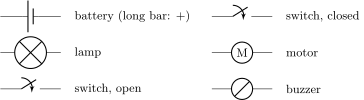
The alphabet: six symbols carry almost every circuit of this book. The same marks are read from workshop to workshop around the world.

উদাহরণ

Example 41.3 (Same circuit, two portraits)

On the table: a battery, a tangle of alligator-clip wires looping over a pencil case, a lamp leaning on a book, a switch dangling. On paper: a calm rectangle — battery on the left, switch on top, lamp on the right. The tangle and the rectangle are the same circuit: every connection identical. To decide whether two circuits are the same, ask one question only: who is connected to whom?

Example 41.4 (Motors and buzzers join the game)

Two newcomers to your kit behave just like lamps in a diagram: the motor (symbol: M in a circle) spins whenever current flows through it — fans, toy cars, drills; the buzzer (a struck circle) sounds whenever fed — doorbells, alarms. Series and parallel rules apply to them unchanged: a switch in series commands them; parallel branches make them independent.

প্রসঙ্গসহ পড়ো →