Primary & Middle School Physics · Grades 1–9
16A First Electric Circuit
Click — the flashlight throws its beam across the dark room. Inside that plastic tube live a battery, a little bulb and two strips of metal, playing a game with strict rules. Today we take the game apart: with a battery, a bulb and two wires, we will make light with our own hands.
16.1 A bulb, a battery, two wires
Definition 16.1 (The battery)
A battery is a small store of electricity. It has two different ends, called its terminals: one marked (plus), the other marked (minus). Both ends matter — electricity plays only when the two of them join the game.
Definition 16.2 (The bulb)
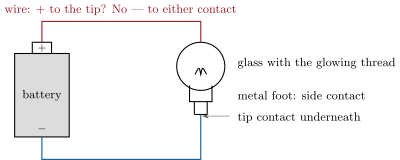
A bulb is a little lamp with a thin thread inside its glass that glows white-hot when electricity flows through it. Look closely at its metal foot: the bulb also has two contact places — the tip at the very bottom, and the metal side of its foot. Two terminals on the battery, two contacts on the bulb: that is no accident.
Method 16.3 (Lighting the bulb)
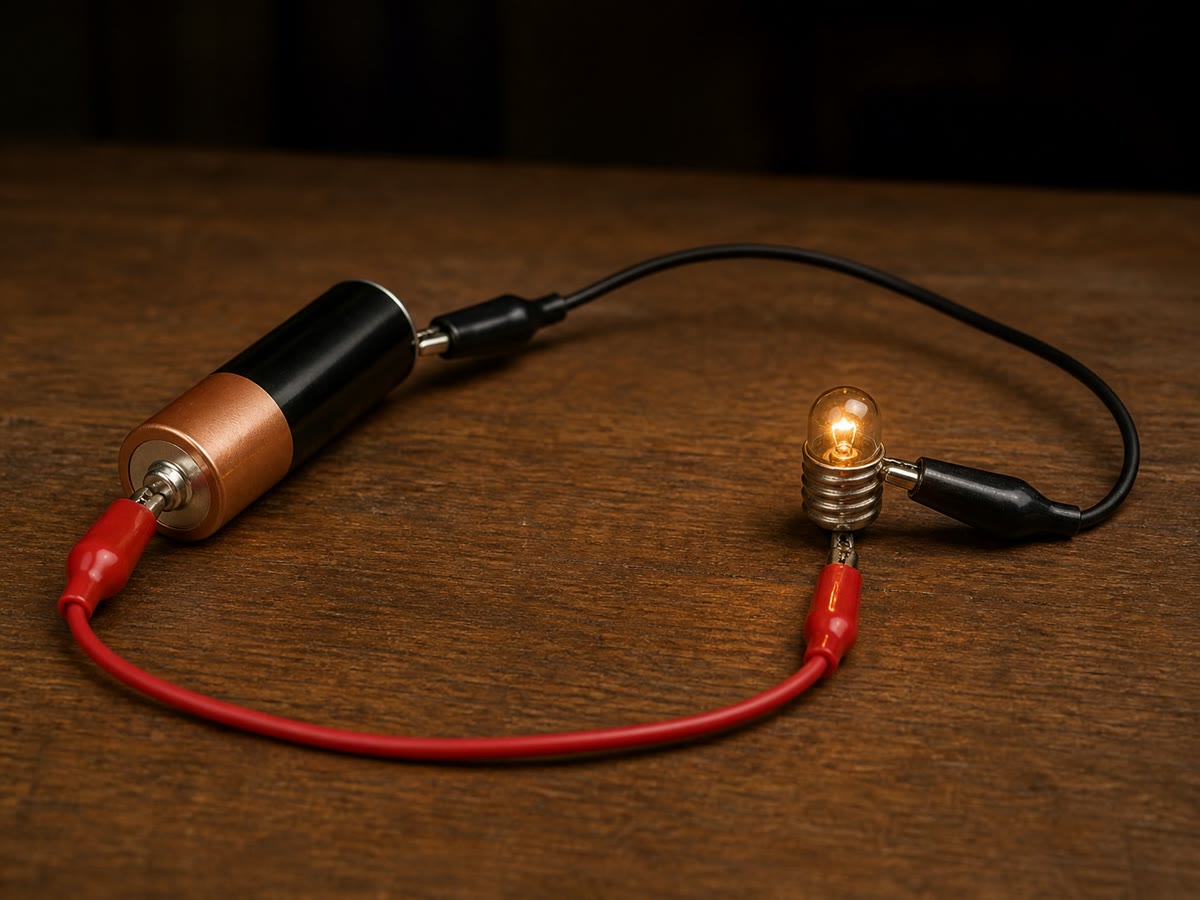
With one battery, one bulb and two wires:
- attach one wire from the battery’s terminal to the tip of the bulb’s foot;
- attach the other wire from the battery’s terminal to the metal side of the foot;
- the bulb lights — you have built a circuit!
If it stays dark, check the usual suspects: a wire touching the glass instead of the metal contact, a loose connection, or a worn-out battery.
16.2 The circuit must close
Definition 16.4 (Electric circuit)
An electric circuit is a complete loop for electricity: out of one terminal of the battery, through the wires and the bulb, and back into the other terminal. When the loop is complete we say the circuit is closed; if it has a gap anywhere, it is open.
Proposition 16.5 (The loop law)
The bulb lights only when the circuit is closed — one unbroken loop from one terminal, through the bulb, back to the other terminal. One single gap, anywhere in the loop, and the bulb goes dark: electricity does not jump gaps, and it does not flow into dead ends.
Example 16.6 (Why both ends?)
Connect two wires from the battery’s terminal to the bulb’s two contacts, leaving alone: nothing. One wire from and one from , but both to the bulb’s tip: nothing again. The bulb lights only when the loop visits the battery’s two different terminals and the bulb’s two different contacts — a full round trip.
Example 16.7 (The switch)
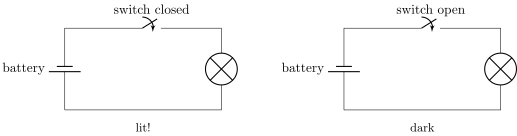
A switch is a door in the circuit: a little metal bridge that the click lays down (closed — the loop is complete, light!) or lifts open (a gap — dark). The flashlight’s button, the light switch on the wall, the button of a doorbell: all of them are doors in a loop. You can build one from a clothes-peg and a strip of kitchen foil folded over its jaws.
Remark 16.8 (Tidy drawings)
Instead of drawing every battery bump and bulb screw, electricians use symbols: two unequal bars for the battery (the long one is ), a circle with a cross for the lamp, a little drawbridge for the switch, and straight lines for the wires. A symbol drawing of a circuit is quicker to draw, and anyone in the world can read it — we will use these drawings for many years.
Remark 16.9 (Battery yes, wall socket never)
Everything in this chapter is played with small round or flat batteries: their push is tiny and safe for experiments. The wall socket is another world — its push is hundreds of times mightier, enough to hurt or kill. Never put wires, fingers or anything else into a wall socket, and never take apart anything that plugs into one. Battery games: yes. Socket: never.
16.3 Exercises
Exercise 16.1 ★
Name the two terminals of a battery and the two contact places of a bulb.
Exercise 16.2 ★
What is a closed circuit? What is an open circuit? In which one does the bulb light?
Exercise 16.3 ★
Lea connects the battery’s terminal to the bulb’s tip with one wire, and stops there. The bulb stays dark. What is missing, in the words of the loop law?
Exercise 16.4 ★
What job does a switch do in the loop? What lies inside a switch when it is closed?
Exercise 16.5 ★
Draw, with the tidy symbols of Remark 16.8, a circuit with one battery, one closed switch and one lamp. Which symbol is which?
Exercise 16.6 ★
The flashlight goes dark in the middle of a camping trip. Give three possible gaps or faults to check, from Method 16.3.
Exercise 16.7 ★
In the doorbell circuit, where is the “switch”? Why does the bell ring only while the button is pressed?
Solution
Solution of Exercise 16.7.
The button is the switch. Pressing it lays the metal bridge and closes the loop, so the bell rings; releasing it lifts the bridge, the gap opens, and the ringing stops.
Exercise 16.8 ★
Why must you never poke anything into a wall socket, when playing with a battery is fine? (See Remark 16.9.)
Solution
Solution of Exercise 16.8.
The battery’s push is tiny and safe; the wall socket’s push is hundreds of times mightier and can hurt or kill. Sockets are not for experiments — ever.
Exercise 16.9 ★
A bulb held with its tip on the battery’s terminal, and one wire from the battery’s terminal pressed against the metal side of the bulb’s foot: will it light? Follow the loop with your finger to decide.
Exercise 16.10 ★★
Sam builds a loop: battery, wire, bulb, wire, back to the battery — but he attaches both wires to the same terminal, , “because it was nearer”. The bulb stays dark although the loop looks complete. Explain what his loop is missing, using Example 16.6.
Exercise 16.11 ★★
A string of party lights has one bulb missing, and the whole string is dark, though all the other bulbs are fine. What does this tell you about how the bulbs are arranged in the loop? (Next year’s circuits chapter will give this arrangement a name.)