
সব বই

পেশাদার

1 Markets I: The Ecosystem and Exchange-Traded Marketsবাজার অনলাইন 2 Markets II: Rates, FX and Creditবাজার অনলাইন 3 Markets III: Commodities, Energy and Cryptoবাজার অনলাইন 4 Quantitative Methodsপদ্ধতি অনলাইন 5 Derivatives and Volatilityডেরিভেটিভস অনলাইন 6 Rates, Credit, XVA and Riskসুদহার, ঋণ ও ঝুঁকি অনলাইন 7 Research Craft: Predictors, Backtests, Measurement, Portfoliosগবেষণা অনলাইন 8 Strategies I: Equities and Futuresকৌশল অনলাইন 9 Strategies II: Volatility, Relative Value, Macro and the Bank Desksকৌশল অনলাইন 10 Microstructure and Executionএক্সিকিউশন অনলাইন 11 Market Making and High-Frequency Tradingমার্কেট মেকিং অনলাইন 12 Machine Learning for Marketsমেশিন লার্নিং অনলাইন 13 Low-Latency Softwareপ্রযুক্তি অনলাইন 14 Networks, Hardware and Trading Infrastructureপ্রযুক্তি অনলাইন 15 Research, Data and Risk Platformsপ্রযুক্তি অনলাইন 16 The Desk and the Firmপ্রতিষ্ঠান অনলাইন 17 The Industry: Firms, Roles and Careersক্যারিয়ার অনলাইন 18 Interviews I: Maths, Probability and Speedক্যারিয়ার অনলাইন 19 Interviews II: Markets, Trading Games and the Final Roundক্যারিয়ার অনলাইন 20 Interviews III: Codeক্যারিয়ার অনলাইন
অ্যাপ পরিচিতি Coach সাইন ইন পড়া শুরু করো

বইগুলো এখনো বাংলা ভাষায় পাওয়া যায় না — ইংরেজি সংস্করণ দেখানো হচ্ছে।

Physics · পরিভাষা

Compensating forces কী?

Definition 6.7 High School Physics · অধ্যায় 6 — Forces and the Principle of Inertia

Forces acting on a body compensate when their combined effect is nil: tip to tail, their arrows return to the start. Two forces compensate exactly when they share the same line of action with equal magnitudes and opposite ways.
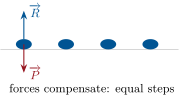
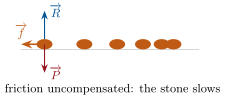
A curling stone at equal time intervals. Left: P and R compensate — equal steps. Right: an uncompensated friction f remains — the steps shrink, the velocity changes. A curling stone at equal time intervals. Left: P and R compensate — equal steps. Right: an uncompensated friction f remains — the steps shrink, the velocity changes.
A curling stone at equal time intervals. Left: P→\vect P and R→\vect R compensate — equal steps. Right: an uncompensated friction f→\vect f remains — the steps shrink, the velocity changes.

উদাহরণ

Example 6.11 (The hockey puck)

Released by the stick, a puck crosses 30 m30\,\mathrm{m} of smooth ice in 2.5 s2.5\,\mathrm{s}, straight at the constant v=30/2.5=12 m/sv = 30/2.5 = 12\,\mathrm{m}/\mathrm{s}. Inventory: weight and normal reaction (friction negligible). They compensate, and the principle predicts exactly the observed motion: nothing pushes the puck forward — and nothing needs to.

Example 6.16 (The book on the table)

A book of mass 0.50 kg0.50\,\mathrm{kg} rests on a table: weight P=0.50×9.81≈4.9 NP = 0.50 \times 9.81 \approx 4.9\,\mathrm{N} and normal reaction R→\vect R. At rest, R→\vect R compensates P→\vect P: vertical, upward, R=4.9 NR = 4.9\,\mathrm{N}. Add a second book and RR adjusts — a support pushes exactly as hard as needed.

প্রসঙ্গসহ পড়ো →