Physics · Glossary

What is Cylindrical coordinates and basis?

Definition 11.5 University Physics — Year 1 · Chapter 11 — Kinematics of a Point

Point MM is located by r0r \geq 0 (distance to the zz axis), the angle θ\theta of its projection on the xyxy plane with ex\vect e_x, and zz: OM=rer+zez\vect{OM} = r\,\vect e_r + z\,\vect e_z, where

er=cosθex+sinθey,eθ=sinθex+cosθey,\vect e_r = \cos\theta\,\vect e_x + \sin\theta\,\vect e_y, \qquad \vect e_\theta = -\sin\theta\,\vect e_x + \cos\theta\,\vect e_y,

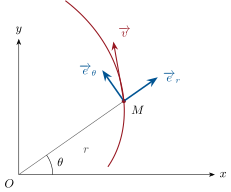
and ez\vect e_z form the local basis (er,eθ,ez)(\vect e_r, \vect e_\theta, \vect e_z), orthonormal and direct, which moves with MM. In the plane (zz fixed) these are the polar coordinates (r,θ)(r, \theta).

Polar coordinates: the local basis ( e_r, e_ ) turns with M; the velocity has a radial part r and an orthoradial part r. Here the trajectory (red) spirals outward, so r > 0 and v leans outward from the tangent to the circle.
Polar coordinates: the local basis (er,eθ)(\vect e_r, \vect e_\theta) turns with MM; the velocity has a radial part r˙\dot r and an orthoradial part rθ˙r\dot\theta. Here the trajectory (red) spirals outward, so r˙>0\dot r > 0 and v\vect v leans outward from the tangent to the circle.
Read in context →