সব বই

পেশাদার

1 Markets I: The Ecosystem and Exchange-Traded Marketsবাজার অনলাইন 2 Markets II: Rates, FX and Creditবাজার অনলাইন 3 Markets III: Commodities, Energy and Cryptoবাজার অনলাইন 4 Quantitative Methodsপদ্ধতি অনলাইন 5 Derivatives and Volatilityডেরিভেটিভস অনলাইন 6 Rates, Credit, XVA and Riskসুদহার, ঋণ ও ঝুঁকি অনলাইন 7 Research Craft: Predictors, Backtests, Measurement, Portfoliosগবেষণা অনলাইন 8 Strategies I: Equities and Futuresকৌশল অনলাইন 9 Strategies II: Volatility, Relative Value, Macro and the Bank Desksকৌশল অনলাইন 10 Microstructure and Executionএক্সিকিউশন অনলাইন 11 Market Making and High-Frequency Tradingমার্কেট মেকিং অনলাইন 12 Machine Learning for Marketsমেশিন লার্নিং অনলাইন 13 Low-Latency Softwareপ্রযুক্তি অনলাইন 14 Networks, Hardware and Trading Infrastructureপ্রযুক্তি অনলাইন 15 Research, Data and Risk Platformsপ্রযুক্তি অনলাইন 16 The Desk and the Firmপ্রতিষ্ঠান অনলাইন 17 The Industry: Firms, Roles and Careersক্যারিয়ার অনলাইন 18 Interviews I: Maths, Probability and Speedক্যারিয়ার অনলাইন 19 Interviews II: Markets, Trading Games and the Final Roundক্যারিয়ার অনলাইন 20 Interviews III: Codeক্যারিয়ার অনলাইন
অ্যাপ পরিচিতি Coach সাইন ইন পড়া শুরু করো

বইগুলো এখনো বাংলা ভাষায় পাওয়া যায় না — ইংরেজি সংস্করণ দেখানো হচ্ছে।

Physics · পরিভাষা

Flux of the field কী?

Definition 26.9 University Physics — Year 1 · অধ্যায় 26 — Electrostatics: Field and Gauss’s Law

Cut a surface SS into small elements of area  ⁣dS\dd S, each with a unit normal n→\vect n (for a closed surface, the outward normal). The flux of E→\vect E through SS is the sum

Φ=∑E→⋅n→  ⁣dS=∑En  ⁣dS(V m):\Phi = \sum \vect E\cdot\vect n\,\dd S = \sum E_n\,\dd S \qquad (\mathrm{V}\,\mathrm{m}):

the field’s normal component weighted by area — the “number of field lines” crossing SS, counted positively when they cross along n→\vect n.

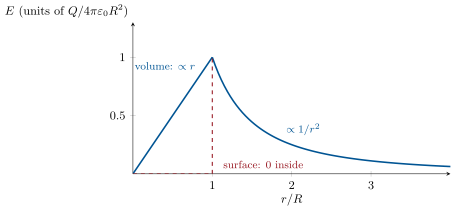
The field of a charged sphere against distance from its centre: linear inside and in 1/r2 outside when the charge fills the volume (solid); zero inside and the same outside when it sits on the surface (dashed). Outside, nothing distinguishes the sphere from a point charge at its centre.
The field of a charged sphere against distance from its centre: linear inside and in 1/r21/r^2 outside when the charge fills the volume (solid); zero inside and the same outside when it sits on the surface (dashed). Outside, nothing distinguishes the sphere from a point charge at its centre.
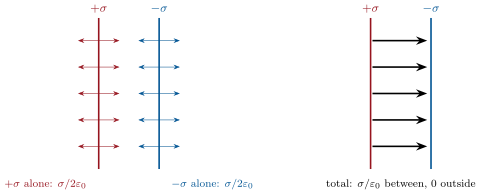
Superposition for two opposite sheets. Left: the uniform fields of each sheet alone (red from the positive one, blue toward the negative one). Right: their sum, / _0 in the gap and zero elsewhere.
Superposition for two opposite sheets. Left: the uniform fields of each sheet alone (red from the positive one, blue toward the negative one). Right: their sum, σ/ε0\sigma/\varepsilon_0 in the gap and zero elsewhere.

উদাহরণ

Example 26.13 (Two planes: the plane capacitor)

Two parallel planes carrying +σ+\sigma and −σ-\sigma: each creates σ/2ε0\sigma/2\varepsilon_0 pointing away from it (toward it for the negative one). Between the planes the two fields add to σ/ε0\sigma/\varepsilon_0, directed from ++ to −-; outside they cancel. With σ=1 µC/m2\sigma = 1\,\text{µ}\mathrm{C}/\mathrm{m}^{2}, E=10−6/8.85×10−12=1.1×105 V/mE = 10^{-6}/8.85 \times 10^{-12} = 1.1 \times 10^{5}\,\mathrm{V}/\mathrm{m} between, zero outside: the field of a charged capacitor is confined to its gap (Chapter 27).

প্রসঙ্গসহ পড়ো →